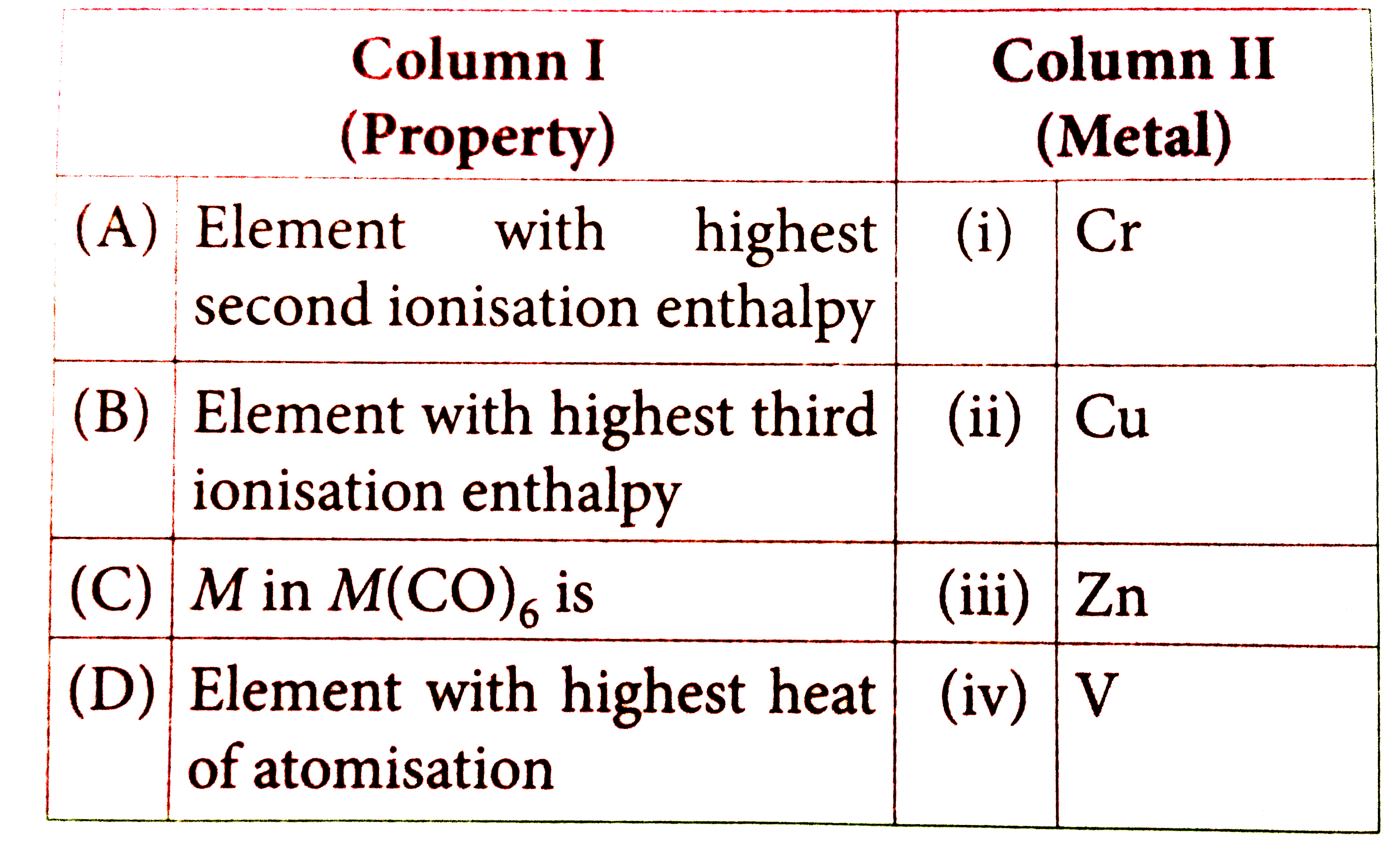
A
B
C
D
Text Solution
Verified by Experts
The correct Answer is:



Topper's Solved these Questions
THE D- AND F- BLOCK ELEMENTS
NCERT FINGERTIPS|Exercise Some Important Compounds Of Transition Elements|31 VideosTHE D- AND F- BLOCK ELEMENTS
NCERT FINGERTIPS|Exercise The Lanthanoids|18 VideosTHE D- AND F- BLOCK ELEMENTS
NCERT FINGERTIPS|Exercise Assertion And Reason|15 VideosSURFACE CHEMISTRY
NCERT FINGERTIPS|Exercise Assertion And Reason|15 VideosTHE P-BLOCK ELEMENTS
NCERT FINGERTIPS|Exercise Assertion And Reason|15 Videos
Similar Questions
Explore conceptually related problems
NCERT FINGERTIPS-THE D- AND F- BLOCK ELEMENTS -General Properties Of The Transition Elements
- Cu^(+) ion is not stable in aqueous solution because because of dispro...
Text Solution
|
- The first ionisation energies of the elements of the first transition ...
Text Solution
|
- Match the column I with column II and mark the appropriate choice.
Text Solution
|
- Identify the species in which the metal atom is in +6 oxidation state.
Text Solution
|
- In which of the following compounds manganese has oxidation number equ...
Text Solution
|
- E(Mn^(3+)//Mn^(2+))^@is highly positive than that of E(Cr^(3+)//Cr^(2+...
Text Solution
|
- The correct order of E(M^(2+)//M)^(@) Values with negative sign for th...
Text Solution
|
- Which of the following d-block element has half - filled penultimate a...
Text Solution
|
- Fe^(3+) compounds are more stable than Fe^(2+) compounds because
Text Solution
|
- The salts of Cu in +1 oxidation state are unstable because
Text Solution
|
- In which of the following pairs of ions, the higher oxidation state in...
Text Solution
|
- CuSO4 is paramagnetic while ZnSO4 is diamagnetic because
Text Solution
|
- Which of the following transition metal ions has highest magnetic mome...
Text Solution
|
- Select the correct option, among Sc(III) , Ti(IV), Pd(II) and Cu(II) i...
Text Solution
|
- The correct order of the number of unpaired electrons in the ions Cu^(...
Text Solution
|
- Calculate the magnetic moment of a divalent ion in aqueous solution if...
Text Solution
|
- Arrange the following in increasing value of magnetic moments. (i) ...
Text Solution
|
- Which of the following statements is not correct about magnetic behav...
Text Solution
|
- The number of unpaired electrons in gaseous species of Mn^(3+), Cr^(3+...
Text Solution
|
- Which of the following arrangements represent the correct order of the...
Text Solution
|