Home
Class 12
CHEMISTRY
Match the column I with column II and ma...

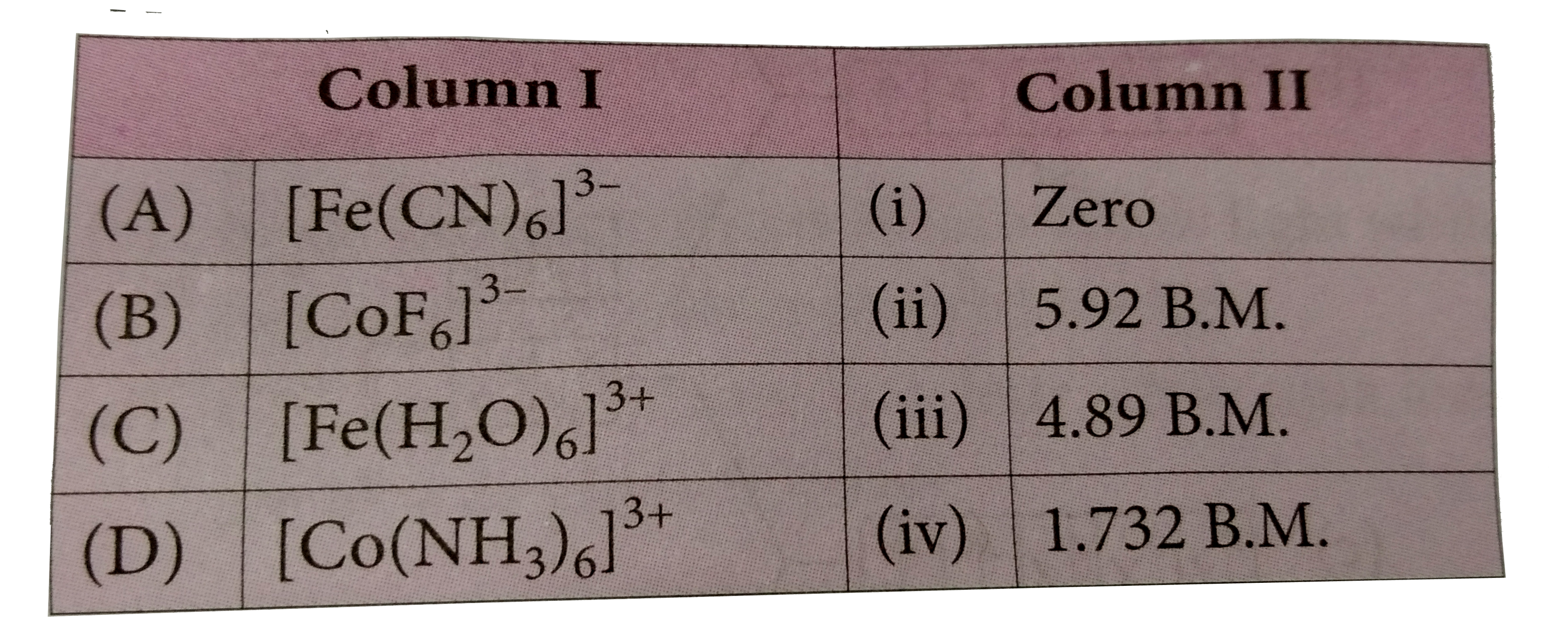
Match the column I with column II and mark the appropriate choice .

A

`(A) to (ii) , (B) to (iii) , (C) to (iv) , (D) to (i) `

B

`(A) to (iii) , (B) to (ii) , (C) to (i), (D) to (iv) `

C

`(A) to (i) , (B) to (iii) , (C) to (iv) , (D) to (ii)`

D

`(A) to (iv) , (B) to (iii) , (C) to (ii) , (D) to (i)`

Text Solution

Verified by Experts

The correct Answer is:

D

`Fe^(3+) : 3d^(5)` , since `CN^(-)` is a strong field ligand , pairing will take place .
`[Fe(CN)_(6)]^(3+) : (##NCERT_OBJ_FING_CHE_XII_C09_E01_073_S01##) " " [ because n = 1]`
`mu = sqrt(n(n+2)) = sqrt(1(1 + 2)) = sqrt3 = 1.732` B.M.
In `[CoF_(6)]^(3-)` , oxidation state of Co = + 3
`Co^(3+) : 3d^(6)` , since `F^(-)` is a weak field ligand , pairing will not occur .
`[CoF_(6)]^(3-) : (##NCERT_OBJ_FING_CHE_XII_C09_E01_073_S02##) " " [because n = 4]`
`mu = sqrt(4(4 + 2)) = sqrt(24) = 4.89` B.M.
In `[Fe(H_(2)O)_(6)]^(3+)` , oxidation state of Fe = +3
`Fe^(3+) : 3d^(5)` , since , `H_(2)O` is a weak field ligand , pairing will not take place .
`[Fe(H_(2)O)_(6)]^(3+) : (##NCERT_OBJ_FING_CHE_XII_C09_E01_073_S03##) " " [ because n = 5]`
`mu = sqrt(5(5 + 2)) = sqrt(35) = 5.92 B.M.`
In `[Co(NH_(3))_(6)]^(3+) ` , oxidation state of Co = + 3
`Co^(3+) : 3d^(6)` , since `NH_(3)` is a strong field ligand , pairing will take place .
`[Co(NH_(3))_(6)]^(3+) : (##NCERT_OBJ_FING_CHE_XII_C09_E01_073_S04##) " " [ because n = 0]`
`mu = sqrt(0(0 + 2)) = 0`
Promotional Banner

Topper's Solved these Questions

  • COORDINATION COMPOUNDS

    NCERT FINGERTIPS|Exercise Bonding In Metal Carbonyls|5 Videos
  • COORDINATION COMPOUNDS

    NCERT FINGERTIPS|Exercise Application Of Coordination Compounds|2 Videos
  • COORDINATION COMPOUNDS

    NCERT FINGERTIPS|Exercise Isomerism In Coordination Compounds|16 Videos
  • CHEMISTRY IN EVERYDAY LIFE

    NCERT FINGERTIPS|Exercise Assertion And Reason|15 Videos
  • ELECTROCHEMISTRY

    NCERT FINGERTIPS|Exercise Assertion And Reason|15 Videos

Similar Questions

Explore conceptually related problems

Match the columm I with column II and mark the appropriate choice .

Match the column I with Column II and makt the appropriate choice .

Match the column I and column II and mark the appropriate choice.

Match of the Column I with column II and mark the appropriate choice.

Match the column I and with column II and mark the appropriate choice .

Match column I wht colun II and mark the appropriate choice.

Match the compounds given in column I with column II and mark the appropriate choice.

Match the values of column II with column I and mark the appropriate choice.

Match the columns I, II and III and mark the appropriate choice.

NCERT FINGERTIPS-COORDINATION COMPOUNDS -Bonding In Coordination Compounds
  1. The spin only magnetic moment value of Cr(CO)(6) is

    Text Solution

    |

  2. Which of the following complexes will show maximum paramagnetism ?

    Text Solution

    |

  3. Match the column I with column II and mark the appropriate choice .

    Text Solution

    |

  4. Electronic configuration of [Cu(NH(3))(6)]^(2+) on the basis of crysta...

    Text Solution

    |

  5. Which of the following energy level diagram for [FeF(6)]^(3-) is corre...

    Text Solution

    |

  6. In [NiCl(4)]^(2-) ,the number of unparied electron is

    Text Solution

    |

  7. Which of the following shell from an octahedral complex

    Text Solution

    |

  8. The value of 'spin only' magnetic moment for one of the following conf...

    Text Solution

    |

  9. Which of the following statements is/are correct ? (i) In octahedra...

    Text Solution

    |

  10. [FeF(6)]^(3-) is paramagnetic due to presence of unpaired electrons in...

    Text Solution

    |

  11. [Co(Cr(2)O(4))(3)]^(3-) is a

    Text Solution

    |

  12. What are the correct oxidation state , coordination number , configura...

    Text Solution

    |

  13. Which of the following statements is correct about [Co(H(2)O)(6)]^(2+)...

    Text Solution

    |

  14. The increasing order of the crystal field splitting power of some comm...

    Text Solution

    |

  15. What is crystal field splitting energy? How does the magnitude of tria...

    Text Solution

    |

  16. Why are low spin tetrahedral complexes not formed ?

    Text Solution

    |

  17. A substance appears coloured because

    Text Solution

    |

  18. Match the complex ions given in column I with their colour given in co...

    Text Solution

    |

  19. CuSO(4).5H(2)O is blue in colour while CuSO(4) is colourless. Why ?

    Text Solution

    |

  20. [Fe(CN)(6)]^(4-) and [Fe(H(2)O)(6)]^(2+) are of different colours in d...

    Text Solution

    |
