Home
Class 11
CHEMISTRY
A reaction proceeds through two paths I ...

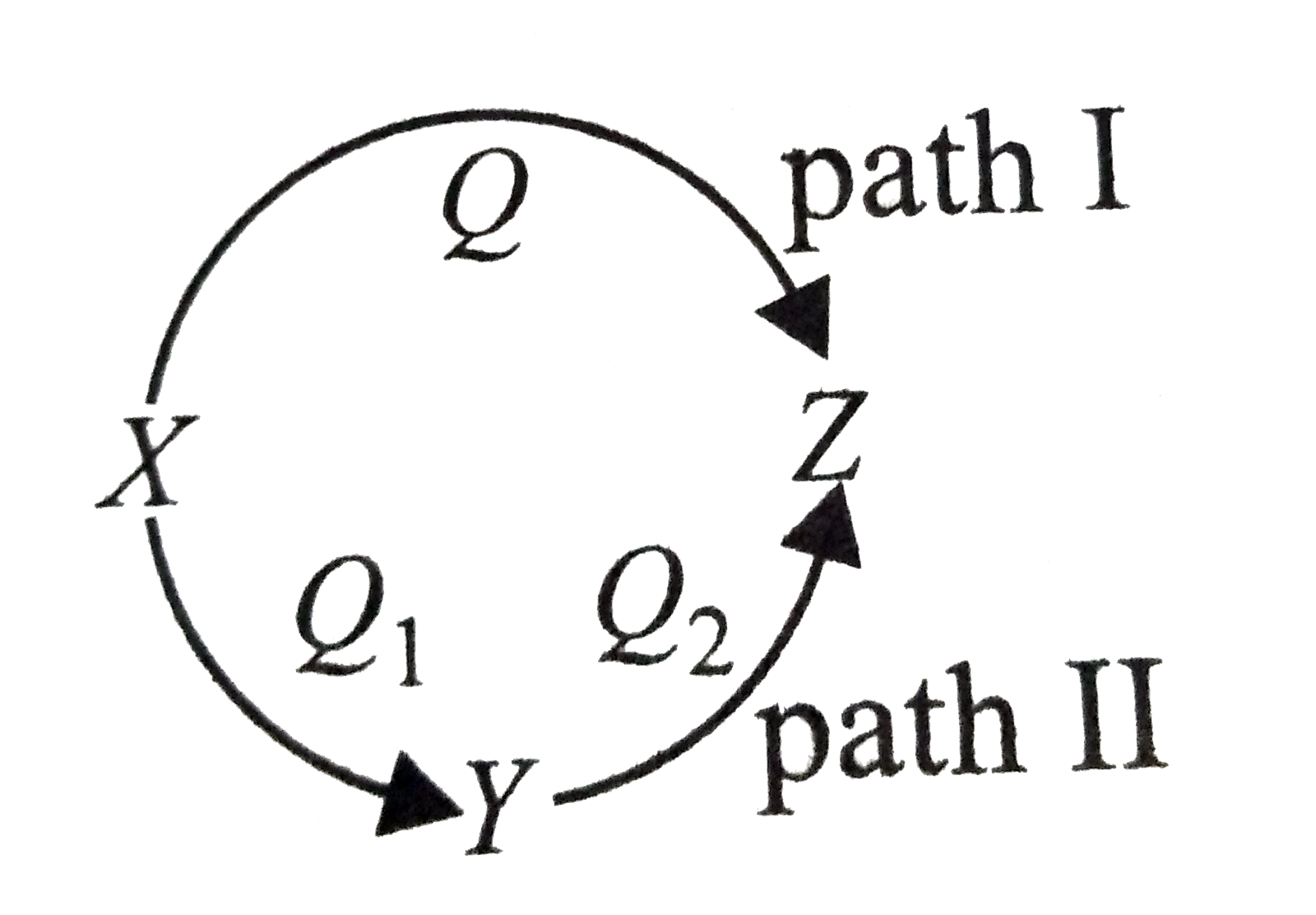
A reaction proceeds through two paths I and II to convert `X rarr Z`.

What is the correct relationship between `Q. Q_(1) and Q_(2)` ?

A

`Q=Q_(1)xxQ_(2)`

B

`Q=Q_(1)+Q_(2)`

C

`Q=Q_(2)-Q_(1)`

D

`Q=Q_(1)//Q_(2)`

Text Solution

Verified by Experts

The correct Answer is:

B
Promotional Banner

Topper's Solved these Questions

  • THERMODYNAMICS

    NCERT FINGERTIPS|Exercise MCQs|2 Videos
  • THERMODYNAMICS

    NCERT FINGERTIPS|Exercise Enthalpy Change Of A Reaction|13 Videos
  • THERMODYNAMICS

    NCERT FINGERTIPS|Exercise Assertion And Reason|15 Videos
  • THE S-BLOCK ELEMENTS

    NCERT FINGERTIPS|Exercise Assertion And Reason|15 Videos

Similar Questions

Explore conceptually related problems

A reaction proceeds through two paths I and II and convert XrarrZ What is the correct relationship between Q, Q_1 and Q_2 ?

Identify the correct statement about the charges q_(1) and q_(2) .

Three charged paricles are placed on a straight line as shown in fig. q_(1) and q_(2) are fixed but q_(3) can be moved. Under the action of the forces from q_(1),q_(2) and q_(3) is in equilbrium. What is the relation between q_(1) and q_(2) .

A charge Q is divided into two parts. Charge on each part is q. Also, Q//q=2 . What is the Columbic force between two charges q and q when both parts are placed certain distance apart?

When two charges q_(1) and q_(2) are kept at some distance apart, force acting between these charges is F. If a third change q_(3) is placed quite close to q_(3) is placed quite close to q_(2) what will happen to the force between q_(1) and q_(2) ?

Is the force acting between two point charges q_(1) and q_(2) kept at some distance in air, attractive or repulsive when: (i) q_(1) q_(2) gt 0 (ii) q_(1) q_(2) lt 0

The electric lines of force of two point charges are shown in fig. What is the value of the ratio q_(1)//q_(2) ?

NCERT FINGERTIPS-THERMODYNAMICS-Applications
  1. Two litres of an ideal gas at a pressure of 10 atm expands isothermall...

    Text Solution

    |

  2. If the heat change at constant volume for decomposition of silver oxid...

    Text Solution

    |

  3. The enthalpy change of a reaction does not depend upon

    Text Solution

    |

  4. Consider the given diagram for 1 mole of a gas X and answer the follow...

    Text Solution

    |

  5. Which of the following relationships is not correct for the relation b...

    Text Solution

    |

  6. Two reactions are given below : (i) CO((g))+(1)/(2)O(2(g))rarrCO(2(...

    Text Solution

    |

  7. Consider the following reaction : CO((g))+(1)/(2)O(2(g)) rarr CO(2(g...

    Text Solution

    |

  8. Match the column I with column II and mark the appropriate choice.

    Text Solution

    |

  9. For combustion of 1 mole of benzene at 25^(@)C, the heat of reaction a...

    Text Solution

    |

  10. Reaction of methanol with dioxygen was carried out and DeltaU was foun...

    Text Solution

    |

  11. According to the first law of thermodynamics, DeltaU=q+w. In special c...

    Text Solution

    |

  12. A reaction proceeds through two paths I and II to convert X rarr Z. ...

    Text Solution

    |

  13. What will be the standard internal energy change for the reaction at 2...

    Text Solution

    |

  14. The value for DeltaU for the reversible isothermal evaporation of 90 ...

    Text Solution

    |

  15. A system changes from state X to Y with a change in internal energy me...

    Text Solution

    |

  16. What will be the change in internal energy when 12 kJ of work is done ...

    Text Solution

    |

  17. A system absorbs 50 kJ heat and does 20 kJ of work. What is the net ch...

    Text Solution

    |

  18. 200 joules of heat was supplied to a system at constant volume. It re...

    Text Solution

    |

  19. In thermodynamics, which one of the following properties is not an int...

    Text Solution

    |

  20. The molar heat capacity of water at constant pressure, C(p) is "75 J K...

    Text Solution

    |
