Home
Class 11
PHYSICS
A particle starts with some initial velo...

A particle starts with some initial velocity with an acceleration along the direction of motion. Draw a graph depicting the variation of velocity (v) along y-axis with the variation of displacement(s) along x-axis.

Text Solution

Verified by Experts
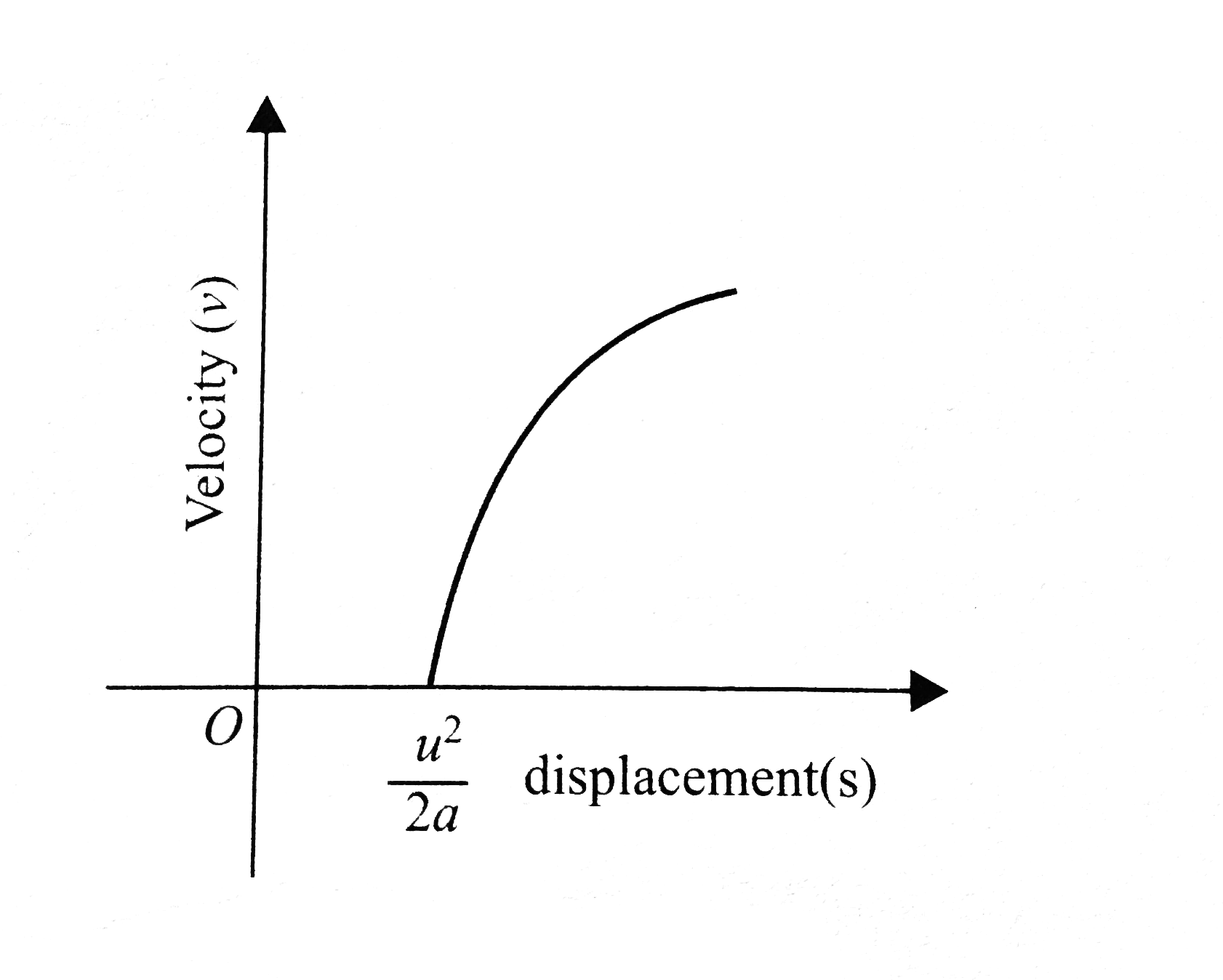
For uniformly accelerated motion, the relation between velocity (v) and displacement (s) is given by `v^(2)=u^(2)+2as`

Now, the above equation shoulb be transformed to a suitable form, before the exact shape can be known.
`:. (v-0)^(2)=2a(s-(u^(2))/(2a))`
which is of the form
`(y-k)^(2)=4a(x-h)`
The vertex is at `(h,k)`, i.e., `((u^(2))/(2a),0)` and axis coincides with x (i.e., s)-axis.
Promotional Banner

Topper's Solved these Questions

  • BASIC MATHEMATICS

    CENGAGE PHYSICS|Exercise Solved Examples|9 Videos
  • BASIC MATHEMATICS

    CENGAGE PHYSICS|Exercise Exercise 2.1|2 Videos
  • ARCHIVES 2 VOLUME 6

    CENGAGE PHYSICS|Exercise Integer|4 Videos
  • CALORIMETRY

    CENGAGE PHYSICS|Exercise Solved Example|13 Videos

Similar Questions

Explore conceptually related problems

If v is the velocity of a body moving along x-axis, then acceleration of body is

For a body moving with uniform acceleration along straight line, the variation of its velocity (v) with position (x) is best represented by

A particle starts with uniform acceleration. Draw a graph taking the displacement(s) of the particle along y-axis and time(t) along x-axis. What is the curve known as?

Two point charge +-q are placed on the axis at x= -a and x= +-a , as shown in fig. (i) Plot the variation of E along the x-axis. (ii) Plot the variation of E along the y-axis.

At the start of a motion along a line the initial velocity is u and acceleration is at. The final velocity vafter time t, is

A particle starts its motion from the origin in positive x-direction. The given graph shows the variation of acceleration (a) with velocity (v). Plot the corresponding graph between velocity and time.

A particle starting from rest moves along a straight line with constant acceleration for this velocity displacement graph will have the form-

CENGAGE PHYSICS-BASIC MATHEMATICS-Exercise 2.6
  1. A particle starts with some initial velocity with an acceleration alon...

    Text Solution

    |

  2. The displacement of a particle is given by y=(6t^2+3t+4)m, where t is ...

    Text Solution

    |

  3. The velocity of a particle is given by v=12+3(t+7t^2). What is the acc...

    Text Solution

    |

  4. A particle starts from origin with uniform acceleration. Its displacem...

    Text Solution

    |

  5. The acceleration of a particle is given by a=t^3-3t^2+5, where a is in...

    Text Solution

    |

  6. A particle starts moving along the x-axis from t=0, its position varyi...

    Text Solution

    |

  7. A particle moves along the x-axis obeying the equation x=t(t-1)(t-2), ...

    Text Solution

    |

  8. The speed of a car increases uniformly from zero to 10ms^-1 in 2s and ...

    Text Solution

    |

  9. A car accelerates from rest with 2ms^-2 for 2s and then decelerates co...

    Text Solution

    |

  10. A stationary particle of mass m=1.5kg is acted upon by a variable forc...

    Text Solution

    |

  11. The displacement of a body at any time t after starting is given by s=...

    Text Solution

    |

  12. A particle moves along a staight line such that its displacement at an...

    Text Solution

    |

  13. The displacement x of a particle moving in one dimension under the act...

    Text Solution

    |

  14. The position x of a particle varies with time t according to the relat...

    Text Solution

    |

  15. The displacement of a particle along the x-axis is given by x=3+8t+7t^...

    Text Solution

    |

  16. The acceleration a in ms^-2 of a particle is given by a=3t^2+2t+2, whe...

    Text Solution

    |

  17. The displacement x of a particle along the x-axis at time t is given b...

    Text Solution

    |

  18. A particle moves along a straight line such that its displacement s at...

    Text Solution

    |

  19. The acceleration of a bus is given by ax(t)=at, where a=1.2ms^-2. a....

    Text Solution

    |

  20. The acceleration of a motorcycle is given by ax(t)=At-Bt^2, where A=1....

    Text Solution

    |

  21. The acceleration of a particle varies with time t seconds according to...

    Text Solution

    |

