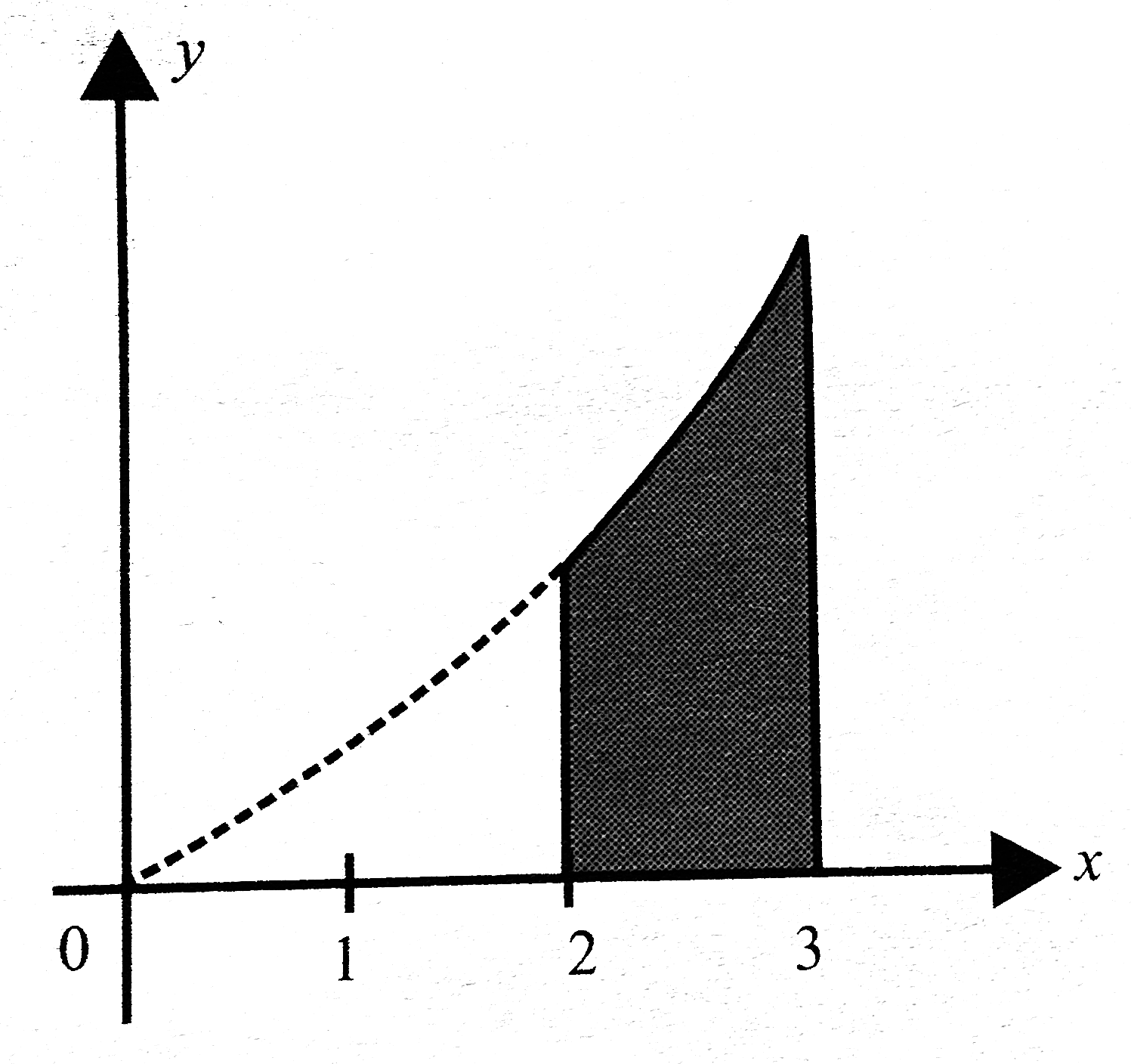
A
B
C
D
Text Solution
Verified by Experts
The correct Answer is:



Topper's Solved these Questions
Similar Questions
Explore conceptually related problems
CENGAGE PHYSICS-BASIC MATHEMATICS-Exercise 2.6
- Calculate the area enclosed under the curve f(x)=x^2 between the limit...
Text Solution
|
- The displacement of a particle is given by y=(6t^2+3t+4)m, where t is ...
Text Solution
|
- The velocity of a particle is given by v=12+3(t+7t^2). What is the acc...
Text Solution
|
- A particle starts from origin with uniform acceleration. Its displacem...
Text Solution
|
- The acceleration of a particle is given by a=t^3-3t^2+5, where a is in...
Text Solution
|
- A particle starts moving along the x-axis from t=0, its position varyi...
Text Solution
|
- A particle moves along the x-axis obeying the equation x=t(t-1)(t-2), ...
Text Solution
|
- The speed of a car increases uniformly from zero to 10ms^-1 in 2s and ...
Text Solution
|
- A car accelerates from rest with 2ms^-2 for 2s and then decelerates co...
Text Solution
|
- A stationary particle of mass m=1.5kg is acted upon by a variable forc...
Text Solution
|
- The displacement of a body at any time t after starting is given by s=...
Text Solution
|
- A particle moves along a staight line such that its displacement at an...
Text Solution
|
- The displacement x of a particle moving in one dimension under the act...
Text Solution
|
- The position x of a particle varies with time t according to the relat...
Text Solution
|
- The displacement of a particle along the x-axis is given by x=3+8t+7t^...
Text Solution
|
- The acceleration a in ms^-2 of a particle is given by a=3t^2+2t+2, whe...
Text Solution
|
- The displacement x of a particle along the x-axis at time t is given b...
Text Solution
|
- A particle moves along a straight line such that its displacement s at...
Text Solution
|
- The acceleration of a bus is given by ax(t)=at, where a=1.2ms^-2. a....
Text Solution
|
- The acceleration of a motorcycle is given by ax(t)=At-Bt^2, where A=1....
Text Solution
|
- The acceleration of a particle varies with time t seconds according to...
Text Solution
|