Home
Class 11
PHYSICS
Two forces of unequal magnitude simultan...

Two forces of unequal magnitude simultaneously act on a particle making an angle `theta (=120^(@))` with each other.If one of them is reversed ,the accelaration of the particle is become `sqrt(3)` times. Calculate the ratio of the magnitude of the forces.

Text Solution

Verified by Experts
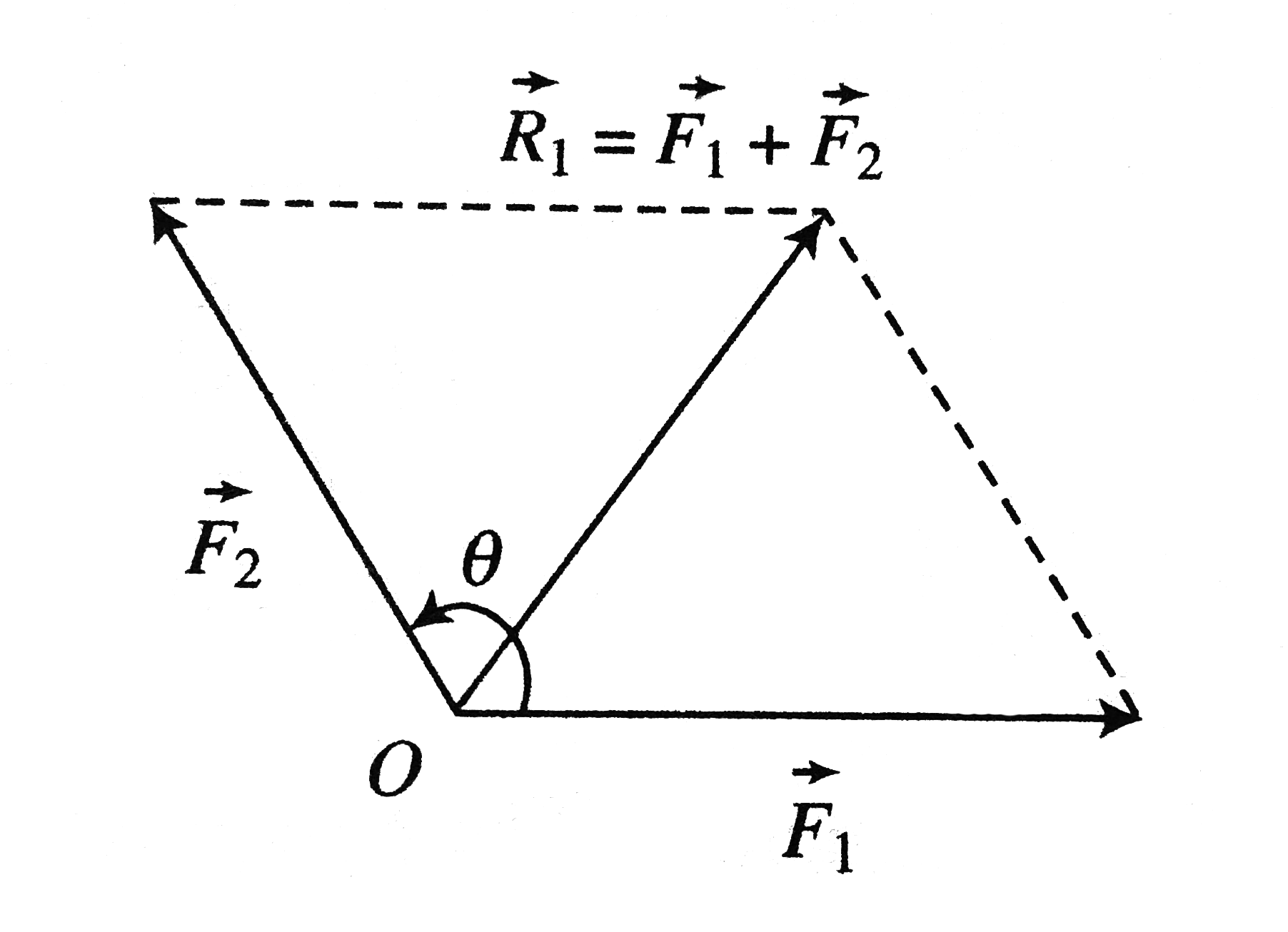
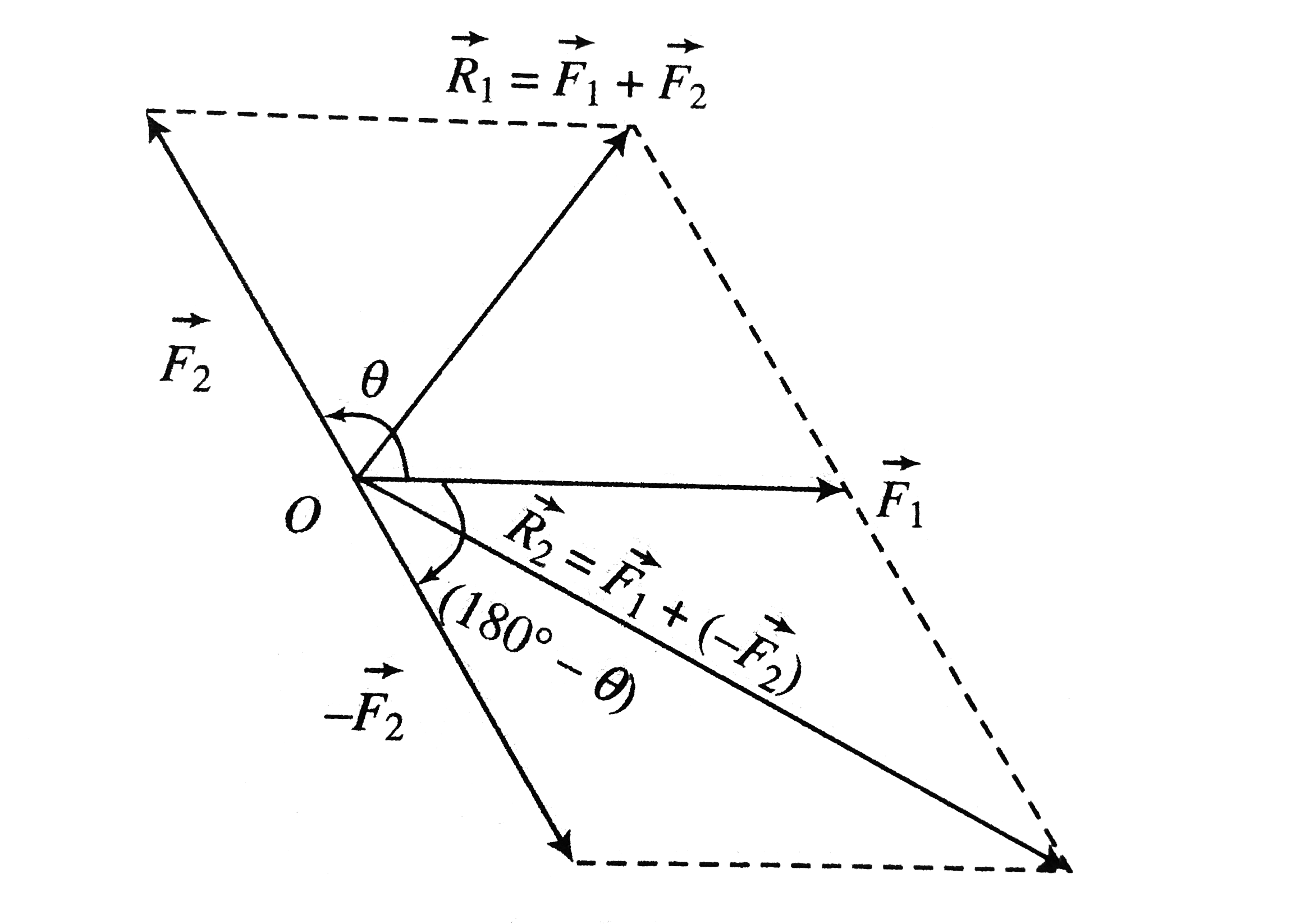
Let the two forces be `vec(F)_(1)` and `vec(F)_(2)` that are inclined at angle `theta`.
.
The resultant of these forces is `vec(R)_(1)=vec(F)_(1)+ vec (F)_(2)`. Then `|vec(R)_(1)|=|vec(F)_(1)+vec(F)_(2)|`.
Using parallelogram law of vector addition,we have
`|vec(R)_(1)|=sqrt(F_(1)^(2)+F_(2)^(2)+2F_(1)F_(2)costheta)`....(i)
If the direction of `vec(F)_(2)`is reversed,new
resultant force `vec(R)_(2)=vec(F)_(1)+(-vec(F)_(2))`.
Using parallelogram law of vectors, the magnitude of new resultant is `|vec(R)_(2)|=sqrt(F_(1)^(2)+F_(2)^(2)+2F_(1)F_(2)cos theta)`..(ii)

since force is directly propotional to acceleration `vec(F)prop vec(a)`.
Hence, `|vec(R)_(2)|/(|vec(R)_(1)|)=a_(2)/(a_(1))=sqrt(3/1)`
From Eqs.(i) (ii) ,
`sqrt(F_(1)^(2)+F_(2)^(2)-2F_(1)F_(2)costheta)/sqrt(F_(1)^(2)+F_(2)^(2)+2F_(1)F_(2)costheta)=sqrt(3)`
`rArrF_(1)^(2)+F_(2)^(2)+4F_(1)F_(2)cos theta=0`..(iii)
Here `theta=120^(@)` and dividing Eq.(iii) by `F_(2)^(2)`,
`((F_(1))/(F_2))^(2)+1-2((F_2)/(F_1))=0`..(iv)
Let `F_(1)/F_(2)=x`.Equation (iv)becomes `(x)^(2)+1-2(x)=0`
after solving ,`x=1 "or" F_(1)/F_(2)=1`.
Promotional Banner

Topper's Solved these Questions

  • VECTORS

    CENGAGE PHYSICS|Exercise Exercise 3.1|19 Videos
  • VECTORS

    CENGAGE PHYSICS|Exercise Exercise 3.2|13 Videos
  • TRAVELLING WAVES

    CENGAGE PHYSICS|Exercise Integer|9 Videos
  • WORK, POWER & ENERGY

    CENGAGE PHYSICS|Exercise Archives (integer)|4 Videos

Similar Questions

Explore conceptually related problems

Two forces of equal magnitude act at a point making an angle theta with each other. If the direction of one of the forces is reversed, the direction of the resultant will turn through

Two forces of magnitudes 3N and 4 N act together on an object making an angle 60^(@) with each other. Find the resultant force acting on the object.

Two forces of 12 N and 5 N are acting on a particle , with an angle of 60^(@) between them , Calculate the resultant force .

Eleven forces each equal to 5N act on a particle simultaneously.If each force makes an angle 30^(@) with the next one, the resultant of all forces is

Two forces of magentude 7 newton and 5 newton act on a particle at an angle theta can have any value . The minimum magnitude of the resultant forces is :

If two forces of equal magnitude 4 units acting at a point and the angle between them is 120^(@) , then find the magnitude of direction of the sum of the two vectors

Three forces of magnitude 10N are acting on a block of mass 2 kg at 120^(@) angle with each other. If suddenly one 10N force stops to act then acceleration of body will be (No gravity)

Two vectors having equal magnitudes A make an angle theta with each each other.Find the magnitude and direction of the resultant.

Kinetic energy of a particle moving in a straight line is proportional to the time t. The magnitude of the force acting on the particle is :

Two forces of equal magnitude F are at a point. If theta is the angle between two forces then magnitude of the resultant forces will be