Home
Class 11
PHYSICS
A particle is moving with velocity v=100...

A particle is moving with velocity `v=100m s^(-1)`. If one of the rectangular components of a velocity is `50m s^(-1)`. Find the other component of velocity and its angle with the given component of velocity.

Text Solution

Verified by Experts
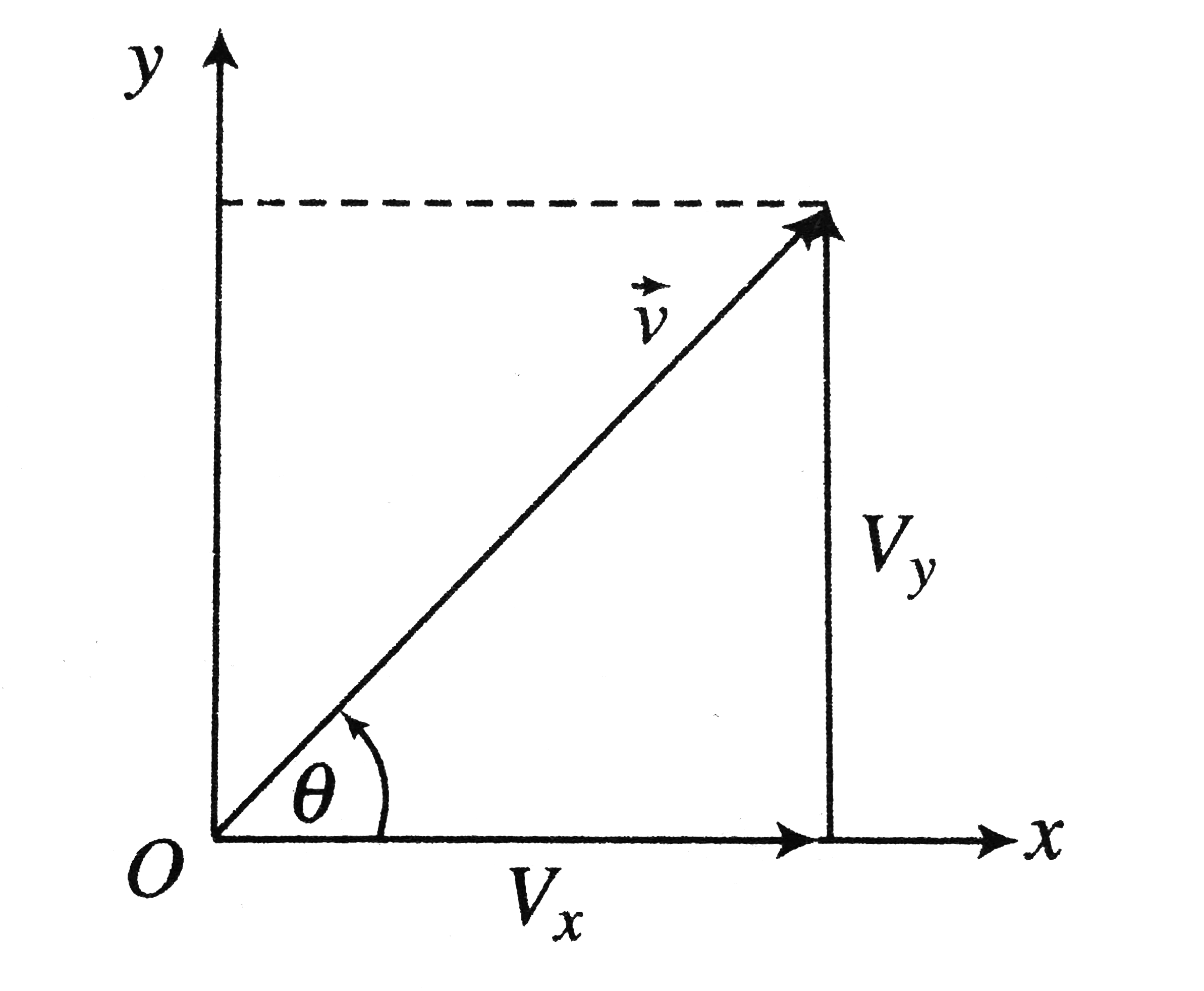
Here we are given net velocity `v=100m s^(-1)`.

Let `v_(x)=50m s^(-1)rArrv_(x)=vcos theta`
`rArr50=100cos theta`
`rArrcos theta=1/2ortheta=60^(@)`
`:.v_(y)=vsin theta=100 sin60^(@)`
`=100xxsqrt(3)/2=50sqrt(3)m s^(-1)`.
Promotional Banner

Topper's Solved these Questions

  • VECTORS

    CENGAGE PHYSICS|Exercise Exercise 3.1|19 Videos
  • VECTORS

    CENGAGE PHYSICS|Exercise Exercise 3.2|13 Videos
  • TRAVELLING WAVES

    CENGAGE PHYSICS|Exercise Integer|9 Videos
  • WORK, POWER & ENERGY

    CENGAGE PHYSICS|Exercise Archives (integer)|4 Videos

Similar Questions

Explore conceptually related problems

One of the rectangular components of a velocity of 80 kmh^(-1) is 40 kmh^(-1) . Find the other component.

One of the rectangular of a velocity 20m/s is 10sqrt(3)m/s .Find the other component

One of the rectangular components of velocity of 80Kmh^(-1) is 40Kmh^(-1) . What is the other components?

One of the rectangular components of a velocity of 60" km" h ^(-1) " is "30 " km " h ^(-1) . Find other rectangular component ?

A velocity is inclined at 30^(@) to the horizontal . If its rectangular component in horizontal direction is 40 km//hr , find the magnitude of velocity and its vertical component.

An uniform electric field of strength E exists in a region. An electron of mass m enters a point A perpendicular to x - axis with velocity V . It moves through the electric field and exists at point B . The components of velocity at B are shown in (Fig. 3.156). At B the y - component of velocity remain uncharged. . Find velocity at B .

The projectile has only vertical component of velocity at the highest point of its trajectory. At the highest point, only one component of velocity is present.

An aeroplane takes off at angle of 30^(@) to the horizontal. If the component of its velocity along the horizontal is 250 kmh^(-1) , what is the actual velocity ? Find also the vertical component of the velocity.

