Home
Class 11
PHYSICS
An aeroplane takes off at an angle of 60...

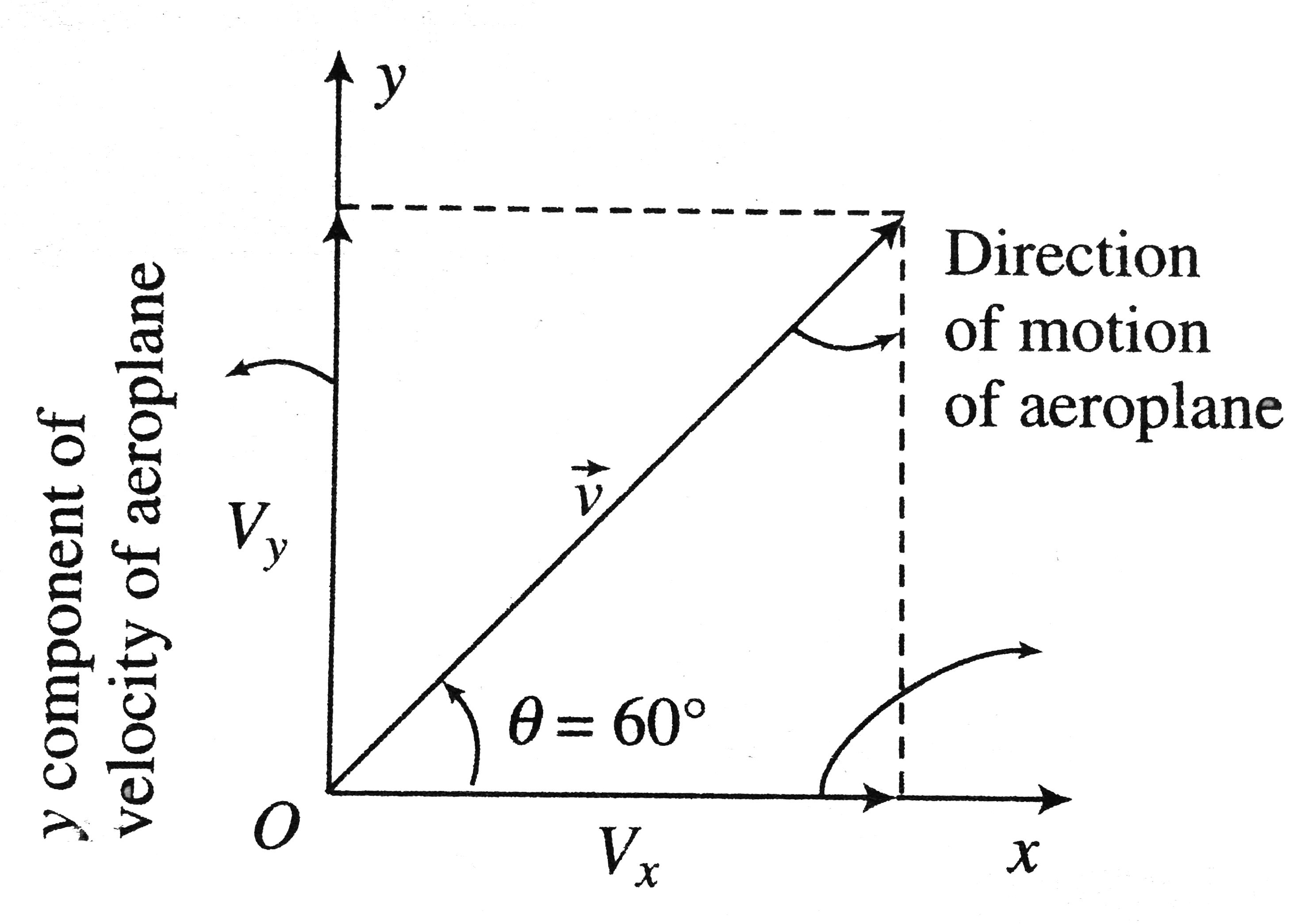
An aeroplane takes off at an angle of `60^(@)` to the horizontal. If the velocity of the plane is `200kmh^(-1)`,calculate its horizontal and vertical component of its velocity (in `kmh^(-1)`) .

A

`v_(x) =50` , `v_(y) = 10sqrt3`

B

`v_(x) =50sqrt3` , `v_(y) = 100sqrt3`

C

`v_(x) =100sqrt3` , `v_(y) = 100sqrt3`

D

`v_(x) =100` , `v_(y) = 100sqrt3`

Text Solution

Verified by Experts

The correct Answer is:
D

Here `v=200 km h^(-1),theta=60^(@)`

`:.`Horizontal component
`v_(x)=vcos theta=200cos60^(@)`
`=200xx1/2=100Km h^(-1)`
Vertical component
`v_(y)=vsin theta=200sin60^(@)=200xxsqrt(3)/2=100 sqrt3Km h^(-1)`
Promotional Banner

Topper's Solved these Questions

  • VECTORS

    CENGAGE PHYSICS|Exercise Exercise 3.1|19 Videos
  • VECTORS

    CENGAGE PHYSICS|Exercise Exercise 3.2|13 Videos
  • TRAVELLING WAVES

    CENGAGE PHYSICS|Exercise Integer|9 Videos
  • WORK, POWER & ENERGY

    CENGAGE PHYSICS|Exercise Archives (integer)|4 Videos

Similar Questions

Explore conceptually related problems

A force is inclined at an angle of 60^(@) from the horizontal. If the horizontal component of the force is 40N,calculate the vertical component.

An aeroplane takes off at an angle of 60^(@) to the vertical .If the component of velocity along the vertical is 250km//hr , calculate its (i) actual velocity and (ii) horizontal component of velocity.

A force is inclined at an angle of 60^(@) from the horizontal. If the horizontal component of the force is 40N. Calculate the vertical component.

An aeroplane taked off at an angle of 30^(@) to the horizontal. If the component of its velocity along the horizontal is 200 kmh^(-1) , what is its actual velocity ? Also find the vertical component of its velocity.

An aeroplane takes off at angle of 30^(@) to the horizontal. If the component of its velocity along the horizontal is 250 kmh^(-1) , what is the actual velocity ? Find also the vertical component of the velocity.

An aeroplane takes off at an angle or 30^(@) to the horizontal. If the component of its velocity along the horizontal is 240 km h^(-1) . What is the actual velocity. ? Also find the vertical component of its velocity ?

A ball is thrown at an angle theta with the horizontal. Its time of flight is 2 s. Its horizontal range is 100 m. What is the horizontal component of velocity of projection ? Take g =10 ms^(-2) .

A force of 4N is inclined at an angle of 60^(@) from the vertical. Find out its components along horizontal and vertical directions.

