Home
Class 11
PHYSICS
A student is running at her top speed of...

A student is running at her top speed of `5.0 m s^(-1)`, to catch a bus, which is stopped at the bus stop. When the student is still `40.0m` from the bus, it starts to pull away, moving with a constant acceleration of `0.2 m s^(-2)`.
a For how much time and what distance does the student have to run at `5.0 m s^(-1)` before she overtakes the bus?
b. When she reached the bus, how fast was the bus travelling?
c. Sketch an `x-t` graph for bothe the student and the bus.
d. Teh equations uou used in part (a)to find the time have a second solution, corresponding to a later time for which the student and the bus are again at thesame place if they continue their specified motions. Explain the significance of this second solution. How fast is the bus travelling at this point?
e. If the student`s top speed is `3.5 m s^(-1), will she catch the bus?
f. What is the minimum speed the student must have to just catch up with the bus?For what time and what distance dies she have to run in that case?

Text Solution

Verified by Experts
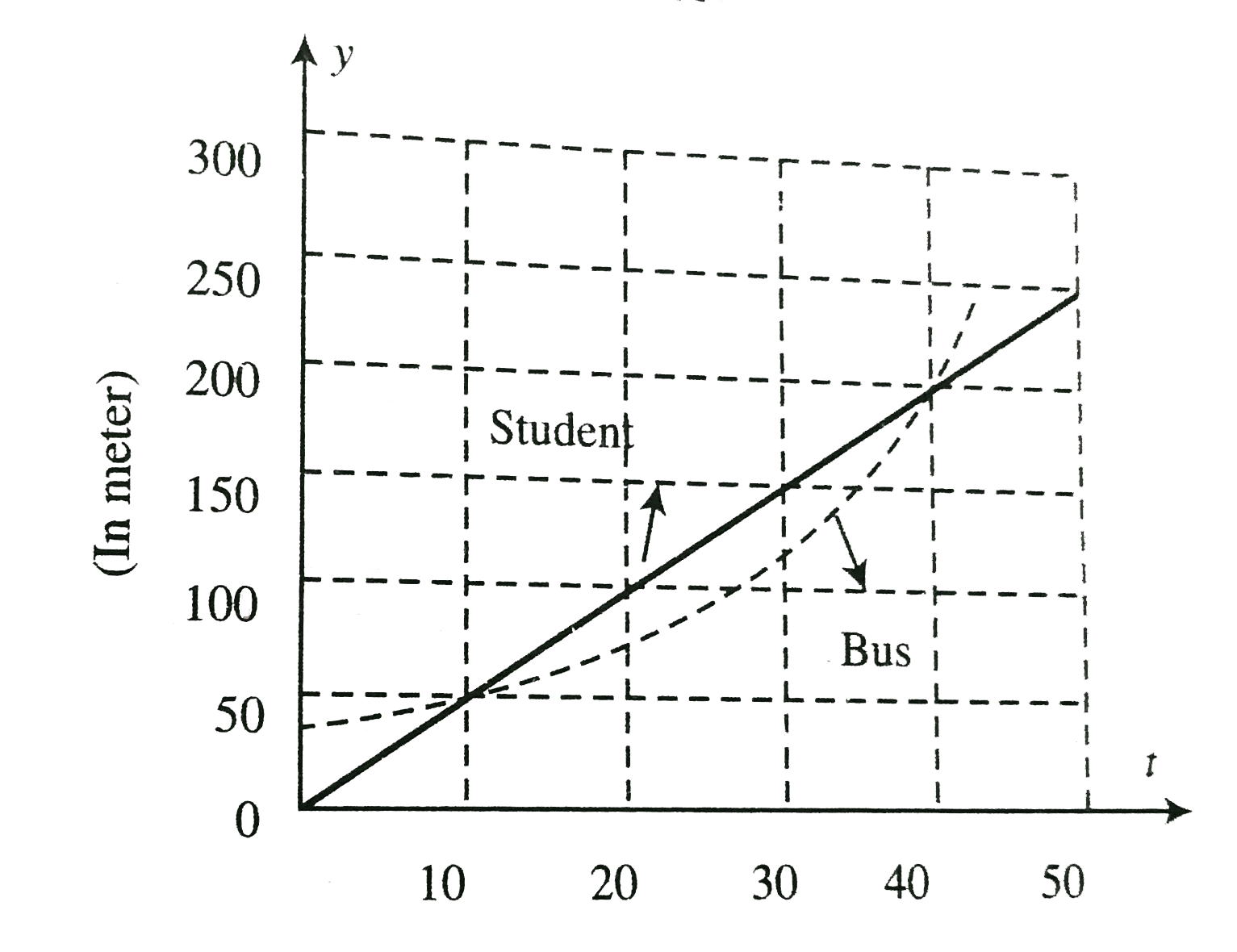
For conventence, let the student`s (constant) sped be `v_(0)` and the bus`s initial position be `x_(0)` Not that these quantities are for separate objects, the sturdent and the bus, The initial position of the student is taken to be zero and the initial velocity of the bus is taken to be zero, The positions of student `x_(1)` and `x_(2)` as functions of time are then `x_(1)=v_(0)t, x_(2)=x_(0)+ (1//2)at^(2)`
a. Setting `x_(1)=x_(2)` and solvint for the time `t` give ` t=(1)/(2)(v_(0)+-sqrtv_(0)^(2)-2ax_(0))`
`=(1)/(0.2)((5.0)=-sqrt((5.0)^(2)-2(0.2)(40.0))) =10, 40 s`
The student will be likely to hop on the bus the first time she passes it [see part `d` for a discussion of the later time]. During this time, thes student has run a distance
`v_(0)t=(5 m s^(-1)(10 sd) =50 m`
b. The speed of the is `v=at=0.2 xx10=20 m s^(-1)` ltbergt c. The results can be verified by notin that the `x` lines for the student and the bus intersect at two points:
.
d. At the later time the studnt has passed the bus, maintaining her constant speed, but the accelerating bus then catches up with her. At this later time the bus's velocity si `(0.2 m s^(-2)) (40 s)=8. 0 m s^(-1)`
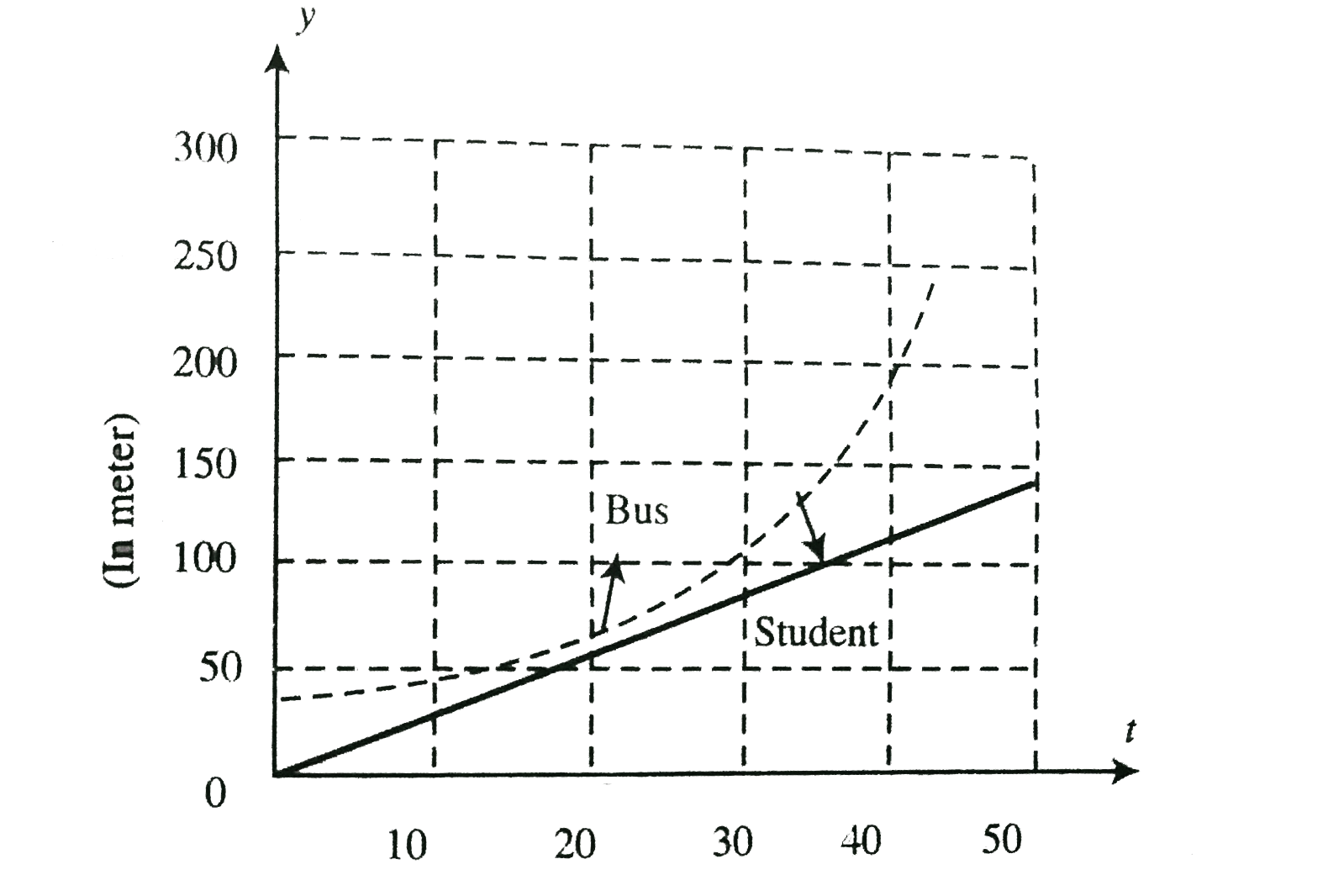
e. No, `v_(0)^(2) le 2a_(0)`, and thr roots of the quadratic are imaginary When the student runs at `3.5 ms^(-1)`, two lines do not interct:
.
f. for the student to catch the bus, `v_(0)^(2) le 2ax_(0)`, and so the minimum speed is `sqrt(2(0.2 m s^(-2)(40 m))=4.0 m s^(-1))` She would be running for a time `(4.0 ms^(-1))/(0.2 m s^(-2)) =20 s`, and cover a
distance of `(4.0 b s^(-1)920 s) =80.0 m`.
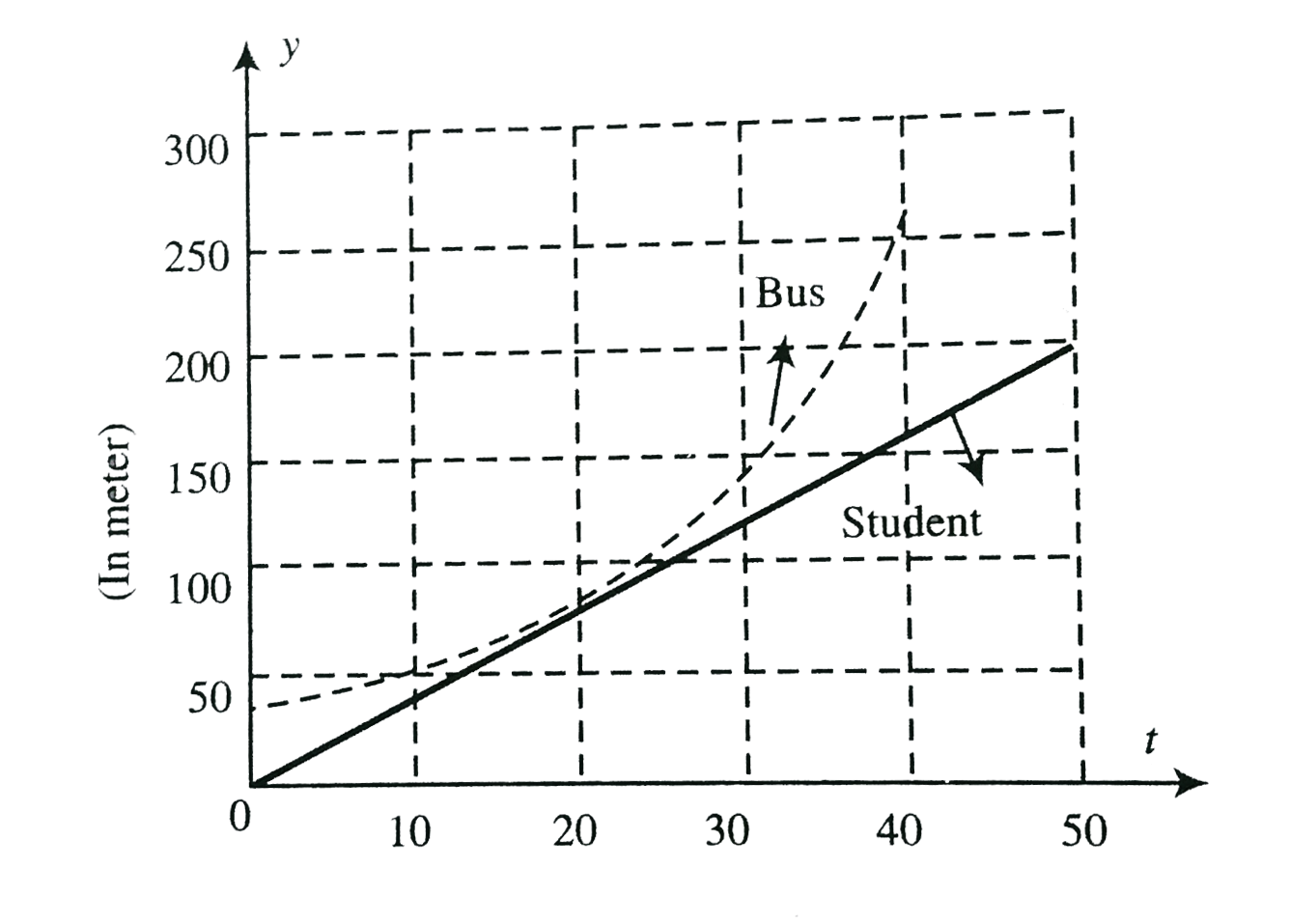
How ever, when the student runs at `4.0 m s^(-1)`, the lines
intrrsect at one point (x=80 m).
.
Promotional Banner

Topper's Solved these Questions

  • KINEMATICS-1

    CENGAGE PHYSICS|Exercise Exercise 4.1|17 Videos
  • KINEMATICS-1

    CENGAGE PHYSICS|Exercise Exercise 4.2|12 Videos
  • KINEMATICS-1

    CENGAGE PHYSICS|Exercise Integer|9 Videos
  • GRAVITATION

    CENGAGE PHYSICS|Exercise INTEGER_TYPE|1 Videos
  • KINEMATICS-2

    CENGAGE PHYSICS|Exercise Exercise Integer|9 Videos

Similar Questions

Explore conceptually related problems

A bus starts from rest with constant acceleration of 5 ms^–2 . At the same time a car travelling with a constant velocity of 50 ms^–1 overtakes and passes the bus. (i) Find at what distance will the bus overtake the car ? (ii) How fast will the bus be travelling then ?

A bus starts from rest and moves with constant acceleration 8 m//s^(2) . At the same time, a car traveling with a constant velocity 16 m//s overtakes and passes the bus. After how much time and at what distance the bus overtakes the car?

A man is at a distance of 6 m from a bus. The bus begins to move with a constant acceleration of 3 ms^(−2) . In order to catch the bus, the minimum speed with which the man should run towards the bus is

A bus starts from rest with a constant acceleration of 5 m//s^(2) at the same time a car travelling with a constant velocity 50 m//s over takes and passes the bus. How fast is the bus travelling when they are side by side?

A bus starting from rest moves with a uniform acceleration of 0.1 m//s^(2) for 2 minutes. Find (a) the speed acquired, (b) th distance travelled.

A bus begins to move with an acceleration of 1 ms^(-1) . A man who is 1 48m behind the bus starts running at 10 ms^(-1) to catch the bus, the man will be able to catch the bus after .

A bus starts from rest and moves whith acceleration a = 2 m/s^2 . The ratio of the distance covered in 6^(th) second to that covered in 6 seconds is