Home
Class 11
PHYSICS
A motorcyclist situated at origin is loc...

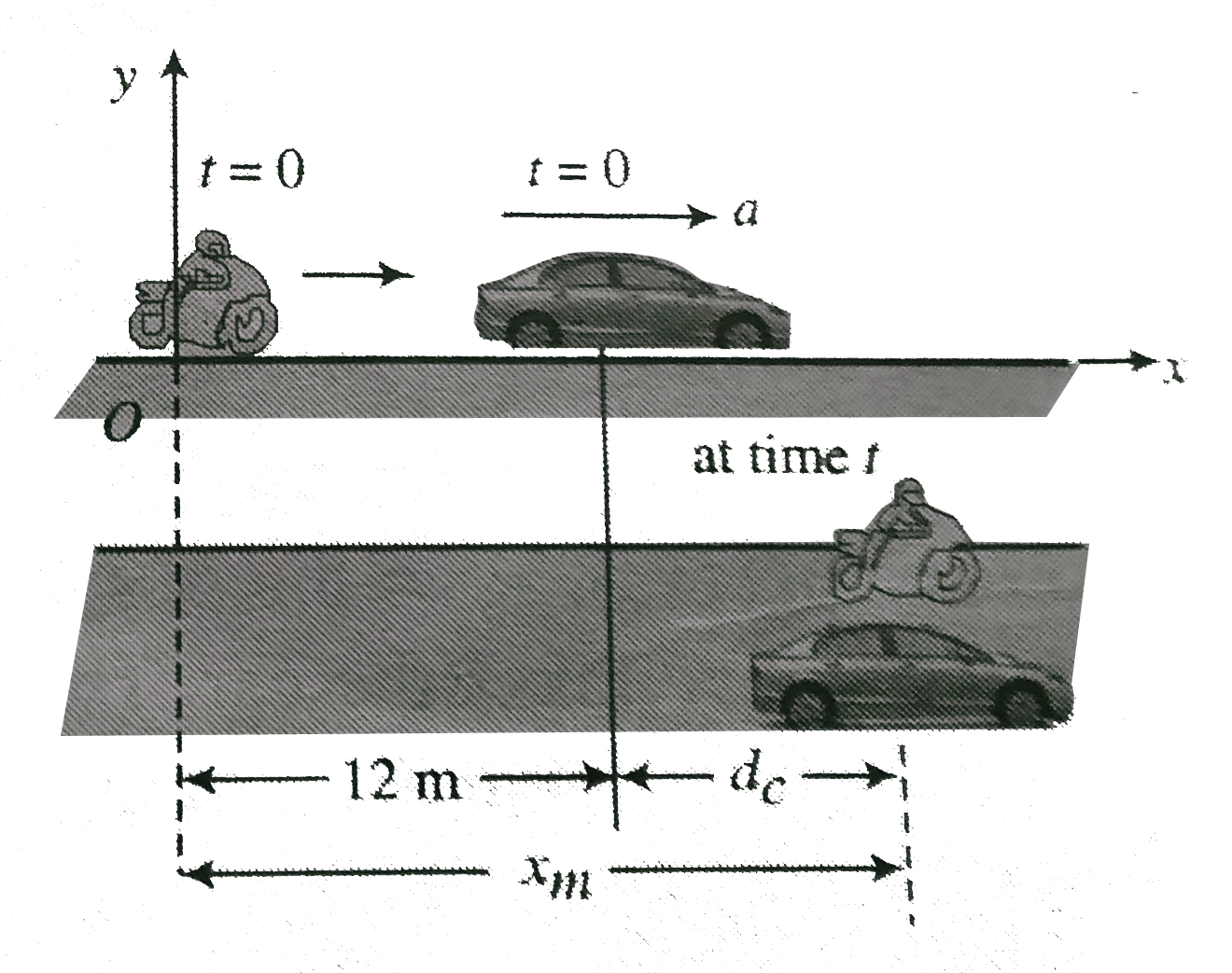
A motorcyclist situated at origin is located at a distance `12 m`. Behind a car (Fig. 4.150).
.
At` t=0` the motorcyclist stars moving with a constant velocity `v= 8 m s^(-1)` and same time the car starts acceleration from rest with `a=2 m s&(-2)`, (a) When and wher do they meet?

Text Solution

Verified by Experts

Let the car and motorcycle meet, after a time `t`. During the time, the motorcycle comers a distance `d_(m)` say. Position of motorcycle, `x_(m)=d_(m)=vt` ..(i)
During the time `t` the car moves through a distance
`d_(c)=(1)/(2)at^(2)`
Position of car, `x_(c)=12 +d_(c) =12 +(1)/(2)at^(2)` ...(ii)
When both motorcycle and car meet their positions will be same.
From (i) and (ii) `x_(m)=x_(c)`.
We have `vt=12+(1)/(2) at^(2)`
Then substituting `v=8 m s^(-1)` and `a=2 m s^(-2)`, We have
`r^(2)-8t+ 12 =0`
.
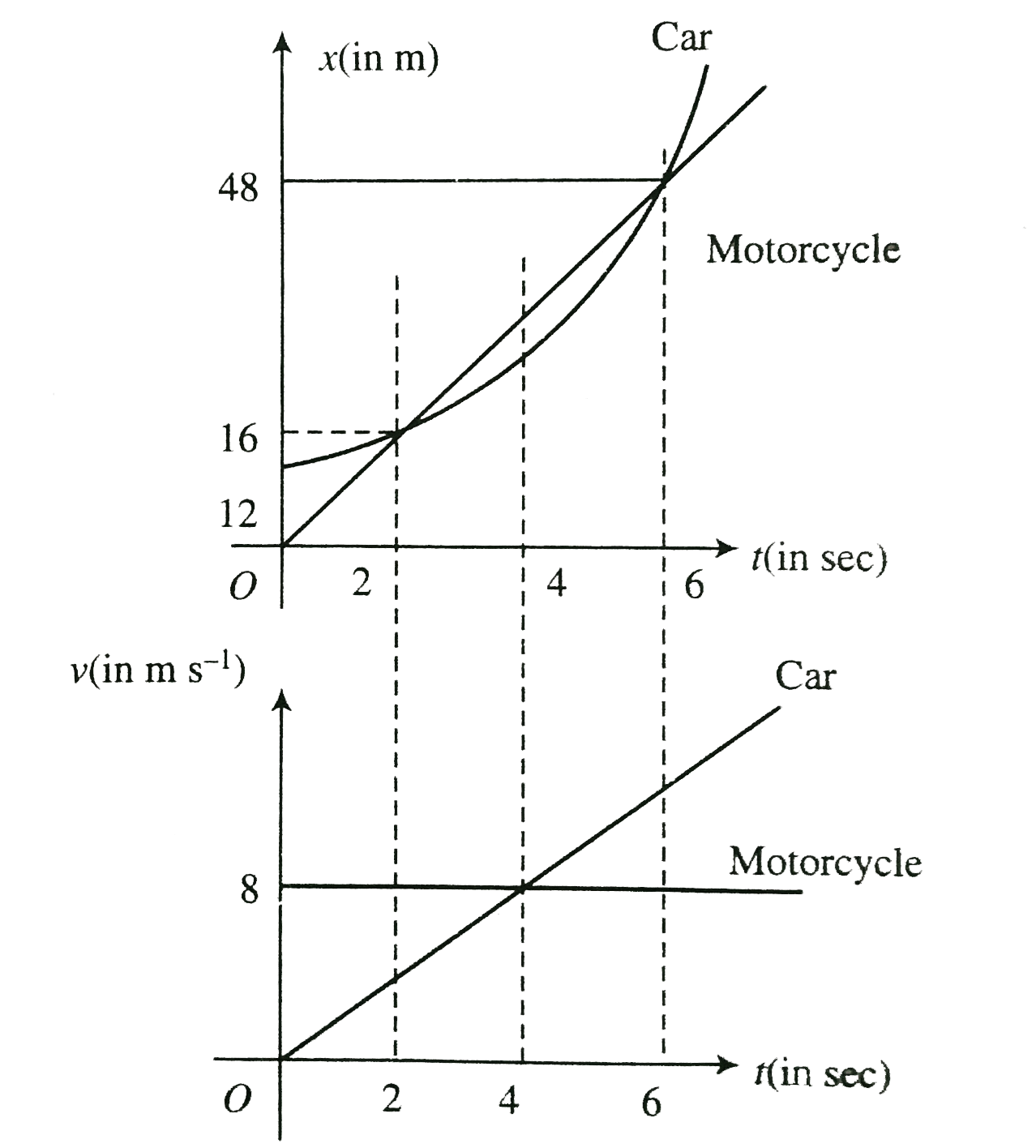
This yields two real values of time, i.e., `t-2 s` and `6 s`.
The following conclusion can be made from the above mathematical proceedings.
At ``t=2 s` the motorcycle approaches the car.
The position of motorcyclist
`(x_(m))_(t=2s)=8 xx2 =16 m`
At `t=6 s`, the car overtakes the motorcycle.
At `t=2 s`, the motorcycle overtakes the car. The it diverges (moves away from the car )till the acquires a velocity equal to that of motorcycle at `t=4 s`. Then the distance jof separation will gradually decreases as the car moves faster than the motorcycle. After that, the car will take a lead leaving the motorcyle behind it.
Promotional Banner

Topper's Solved these Questions

  • KINEMATICS-1

    CENGAGE PHYSICS|Exercise Exercise 4.1|17 Videos
  • KINEMATICS-1

    CENGAGE PHYSICS|Exercise Exercise 4.2|12 Videos
  • KINEMATICS-1

    CENGAGE PHYSICS|Exercise Integer|9 Videos
  • GRAVITATION

    CENGAGE PHYSICS|Exercise INTEGER_TYPE|1 Videos
  • KINEMATICS-2

    CENGAGE PHYSICS|Exercise Exercise Integer|9 Videos

Similar Questions

Explore conceptually related problems

A cyclist starts from rest and moves with a constant acceleration of 1 m//s^(2) . A boy who is 48 m behind the cyclist starts moving with a constant velocity of 10 m//s . After how much time the boy meets the cyclist?

Two cars A and B are at rest at the origin O. If A starts with a uniform velocity of 20 m// s and B starts in the same direction with a constant acceleration of 2 m//s^(2) , then the cars will meet after time

A motorcyclist starts from rest and reaches a speed of 6 m/s after travelling with uniform acceleration for 3 s. What is his acceleration ?

In the previous problem if the car is moving with a constant acceleration of 2 m//s^(2) , the ball will fall behind the person at a distance

Two cars A and B are at rest at same point initially. If A starts with uniform velocity of 40 m/sec and B starts in the same direction with constant acceleration of 4m//s^(2) , then B will catch A after :

A partical is moving in a straight line under constant acceleration 4 m//s^(2) . The motion starts from rest. Sketch v-t and s-t graph for the duration t=0 to t=5 s .

A bus starts from rest and moves with constant acceleration 8 m//s^(2) . At the same time, a car traveling with a constant velocity 16 m//s overtakes and passes the bus. After how much time and at what distance the bus overtakes the car?

A car accelerates from rest at a constant rate of 2 m s^(-2) for some time. The it retatds at a constant rate of 4 m s^(-2) and comes to rest. It remains in motion for 6 s .

A racing car has a uniform acceleration of 4 m//s^(2) . What distance will it cover in 10 s after start ?

A bus starts from rest with a constant acceleration of 5 m//s^(2) at the same time a car travelling with a constant velocity 50 m//s over takes and passes the bus. How fast is the bus travelling when they are side by side?