Home
Class 11
PHYSICS
A diwali rocket moves vertically up with...

A diwali rocket moves vertically up with a constant acceleration `a_(1) =20`//` 3 m s^(-2)`. After sometives, its fuel gers exhausted ad then if falls freely with an acceleration `a_(2) =10 m s^(-2)`, If themaximum height attained by the diwalin rocket is (h), using graphicalmerhod, find its speed when the fuel is just exausted. Assume `h=50 m`.

Text Solution

Verified by Experts
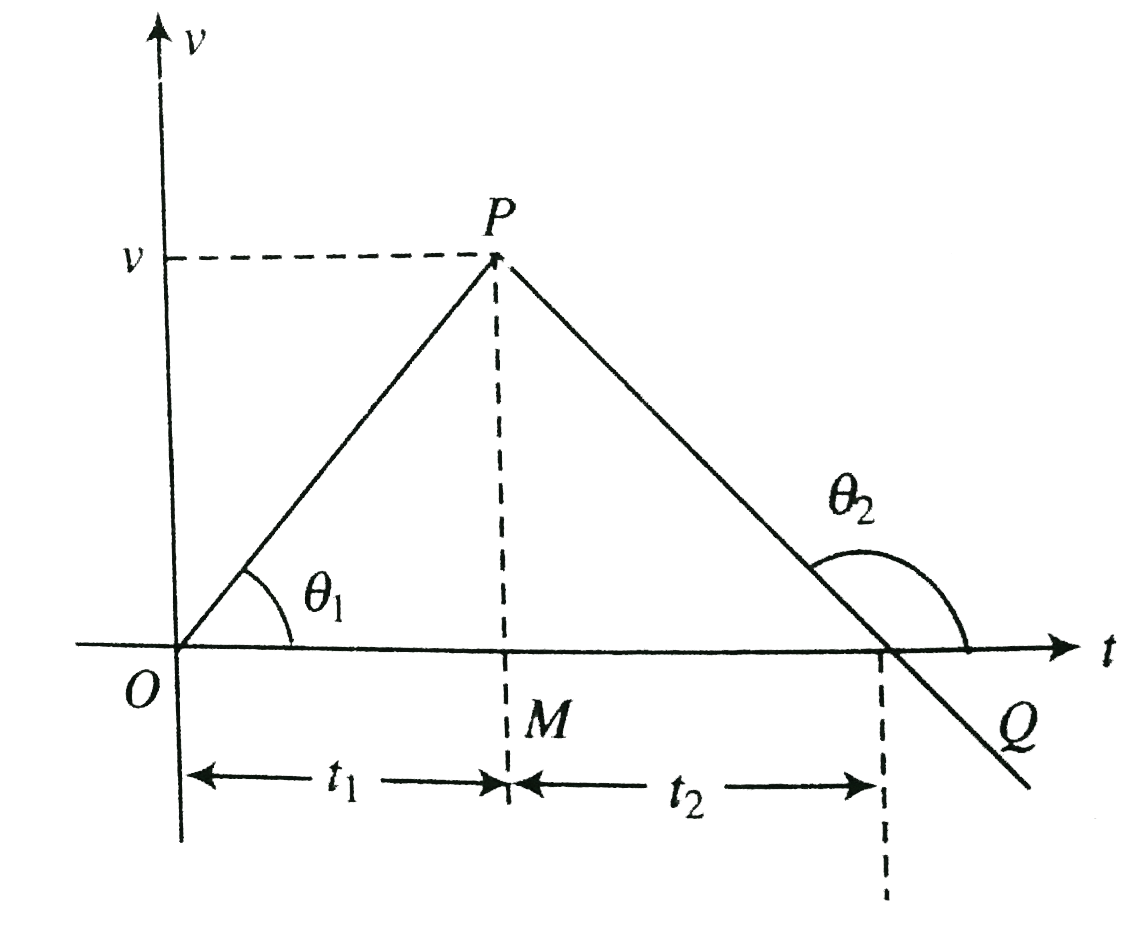
Let the rocket acquire a speed `v` at the time when all its fuel gets exhausted. Referring to the `v-t` graph in Fig. the slope of `OP` gives the acceleration `a_(1)`.
.
The slope of `OP` gives the acceleration `a_(1) =tan theta_(1) =(v)/(t_(1))`
The slope of `PQ` gives the acceleraion
`(-a_(2))=tan theta_(2) =(-v)/t(2)`
From (i) and (ii), we have
`v=a_(1)t_(1) =a_(2)t_(2)`.
The area under `v-t` graph=Area `Delta OPQ =(1)/(2) OQ.PM =s`
Susbstituting `OQ=t _(1) +t_(2)` and `(t_(1)+t_(2)`
Substituting `t_(12)=(v)/(a_(1))` and `t_(2) (v)/(a_(2))` from (iii) in (iv), we have
`s=(v)/(2)((v)/(a_(1)+(v)/(a_(2))))` Finally substituting `s=+h` (as the area is positive), `a_(1)=(20)/(3) m s^(-2)`
and `a_(2) =10 m s^(-2)`, we have `
`v=sqrt((2a_(1)a_(2)h)/(a_(1)+a_(2)))=sqrt((2xx(20)/(3)xx10xx50)/((20)/(3)+10))`
This sields `v=20 m s^(-1)`.
Promotional Banner

Topper's Solved these Questions

  • KINEMATICS-1

    CENGAGE PHYSICS|Exercise Exercise 4.1|17 Videos
  • KINEMATICS-1

    CENGAGE PHYSICS|Exercise Exercise 4.2|12 Videos
  • KINEMATICS-1

    CENGAGE PHYSICS|Exercise Integer|9 Videos
  • GRAVITATION

    CENGAGE PHYSICS|Exercise INTEGER_TYPE|1 Videos
  • KINEMATICS-2

    CENGAGE PHYSICS|Exercise Exercise Integer|9 Videos

Similar Questions

Explore conceptually related problems

A rocket is fired and ascends with constant vertical acceleration of 10 m//s^(2) for 1 minute. Its fuel is exhausted and it continues as a free particle. The maximum altitude reached is (g=10 m//s^(2))

A particle moves rectilinearly with a constant acceleration 1 m//s^2 . Its speed after 10 seconds is 5 m//s . The distance covered by the particle in this duration is.

A rocket is fired vertically upwards and moves with net acceleration of 10 m//s^(2) . After 1 min the fuel is exhausted. The time taken by it to reach the highest point after the fuel is exhausted will be:

A rocket is fired vertically from the ground. It moves upwards with a constant acceleration 10m//s^(2) after 30 sec the fuel is finished. After what time from the instant of firing the rocket will attain the maximum height? g=10m//s^(2) :-

A body moves from rest with a constant acceleration of 5m//s^(2) . Its instantaneous speed (in m/s) at the end of 10 sec is

A rocket is fired upwards such that its engine takes 10 s to explods fully. Its velocity- time graph is as shown in the figure. Acceleration due to gravity is 10m//s^(2) . The maximum height attained by the rocket is

A bus moving along a straight line at 20 m/s undergoes an acceleration of 4 m/ s^(2) . After 2 seconds, its speed will be :

A rocket is fired vertically up from the ground with an acceleration 10 m//s^(2) . If its fuel is finished after 1 minute then calculate - (a) Maximum velocity attained by rocket in ascending motion. (b) Height attained by rocket fuel is finished. (c ) Time taken by the rocket in the whole motion. (d) Maximum height attained by rocket.

