Home
Class 11
PHYSICS
Two cars C(1) and C(2) moving in the sam...

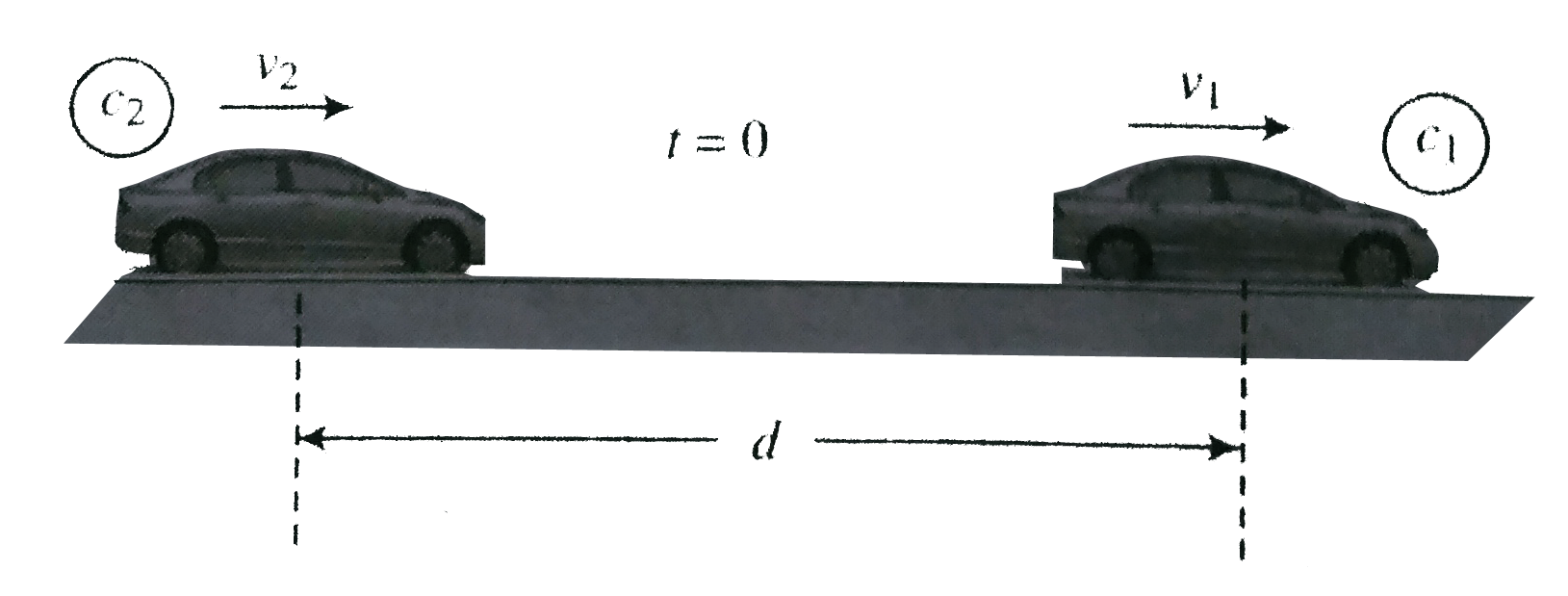
Two cars `C_(1)` and `C_(2)` moving in the same direction on a straight single lane road with velocities `v_(1)=12 m s^(-1)` and `v_(2) =10 m s^(-1)`, respectively . When the separation between the two was `d=200 m`, `C_(2)` started accelerating to avoid collision. What is the minimum acceleration of car `C_(2)` so that they do not collide?
.

Text Solution

Verified by Experts

Acceleration is just avoided if the relative velocity becomes zero just at the moment the two cars meet each other, i.e.
`veca_(2) =vec a_(1)-vec a_(c_(1)- vec a_(c)_(2) =0-a(-a)`
`vec u_(12) =vec u_(1)-vec u_(2) =12-10 =2 ms^(-2)`
The collsion is just avoided if the relative velocity becomes zero just at the moment the two cars meer each other, i.e.,
`v_(12)=0` when `s_(12)=200`.
Now `v_(12)=0, vec u_(12)=2, =vec a_(12)=-a`, and `s_(12) =200`.
`v_(12)^(2)-u_(12)^(2)=2a_(12)s_(12) becuase 0-2^(2)=-2xxaxx200`
`rarr a-(1)/(100)ms^(-2) =0. 1 ms^(-2) =1 cms^(-2)`
Therefore, minimum acceleration needed by car `c_(2)=1 cm s^(-2)`.
Promotional Banner

Topper's Solved these Questions

  • KINEMATICS-1

    CENGAGE PHYSICS|Exercise Exercise 4.4|16 Videos
  • KINEMATICS-1

    CENGAGE PHYSICS|Exercise Subjective|29 Videos
  • KINEMATICS-1

    CENGAGE PHYSICS|Exercise Exercise 4.2|12 Videos
  • GRAVITATION

    CENGAGE PHYSICS|Exercise INTEGER_TYPE|1 Videos
  • KINEMATICS-2

    CENGAGE PHYSICS|Exercise Exercise Integer|9 Videos

Similar Questions

Explore conceptually related problems

Two cars C_(1) and C_(2) are moving on parallel roads in the same direction with velocity v. The relative of C_(1) w.r.t. C_(2) is :

Two bodies starts moving from same point along straight line with velocities v_(1) = 6 m//s " and " v_(2) = 10 m//s simultaneously. After what time the separation becomes 40 m ?

Two particles A and B are projected simultaneously in the direction shown in the figure with velocities V_(A)=20m//s and V_(B)=10m//s respectively. If they collide in air after 1/2 sec. then

Two equal masses m_1 and m_2 moving along the same straight line with velocites +3 m//s and - 5 m//s respectively collide elastically. Their velocities after the collision will be respectively.

If acceleration of A is 2m//s^(2) to left and acceleration of B is 1m//s^(2) to left, then acceleration of C is-

A particle moving with uniform acceleration from A to B along a straight line has velcities v_(1) and v_(2) at A and B respectively. If C is the mid-point between A and B then determine the velocity of the particle at C . .

Two cars of same mass are moving with velocities v_(1) and v_(2) respectively. If they are stopped by supplying same breaking power in time t_(1) and t_(2) respectively then (v_(1))/(v_(2)) is

Two particles of mass m and 2 m moving in opposite directions collide elastically with velocities v and 2v. Find their velocities after collision.

Two particles of masses m and 2m moving in opposite directions collide elastically with velocity 2v and v , respectiely. Find their velocities after collision.

Car A has an acceleration of 2m//s^2 due east and car B, 4 m//s^2. due north. What is the acceleration of car B with respect to car A?

