Home
Class 11
PHYSICS
A car accelerates from rest at a constan...

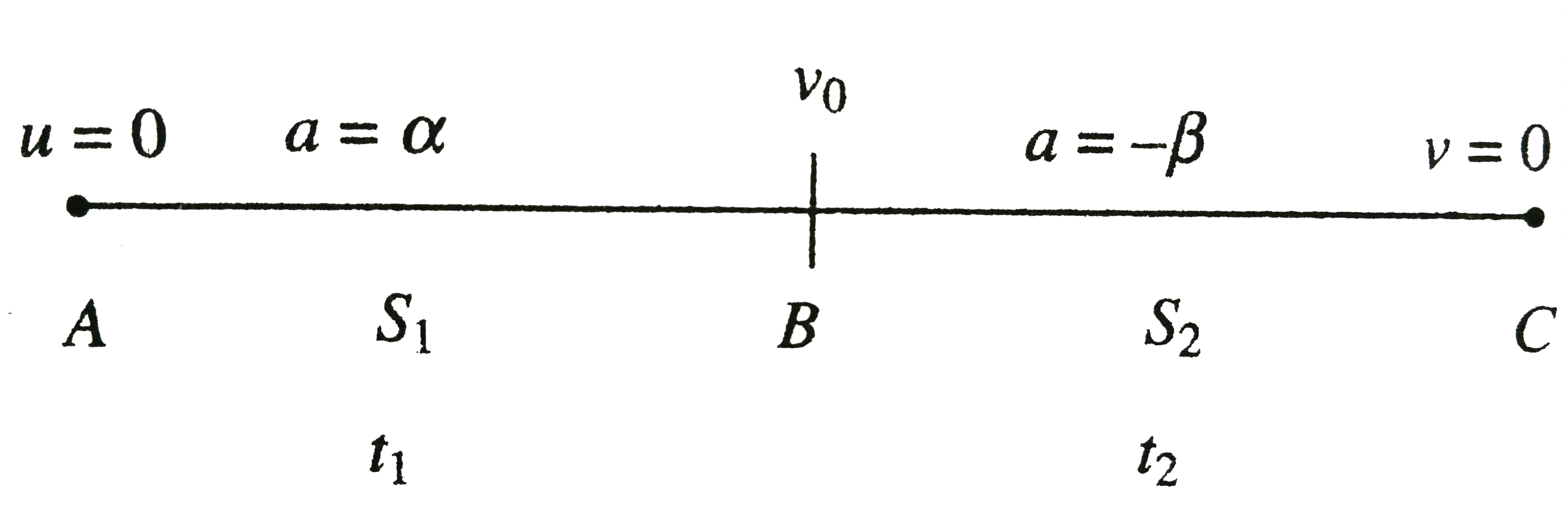
A car accelerates from rest at a constant rate `alpha` for some time, after which it decelerates at a constant rate `beta,` to come to rest. If the total time elapsed is t seconds. Then evalute (a) the maximum velocity reached and (b) the total distance travelled.

A

`(alph beta)/(2(alpha+beta))t`

B

(alpha beta)/(alpha+beta) t`

C

`(2alph beta)/(alph +beta)t`

D

`(4 alpha beta)/(alpha+beta) t`

Text Solution

Verified by Experts

The correct Answer is:
B

.
From `A` to `B` applying `v =u +at`, we get
`v_(0)=0 +at_(1) rArr t_(1) t_(1) -v_(0)//a`
From `B` to `C`, again applying `v=u +at`, we get `0=v_(0) bt_(2) rArr t_(2) =v_(0)//b`
Given `t_(1) +t_(2) =t rArr (v_(0))/(alpha) + (v_(0))/(beta) =t rArr v_(0) =(alpha beta t)/(alpha +beta)`
`v_(0)` is the maximum velocity attained.
Promotional Banner

Topper's Solved these Questions

  • KINEMATICS-1

    CENGAGE PHYSICS|Exercise Integer|9 Videos
  • KINEMATICS-1

    CENGAGE PHYSICS|Exercise Assertion-reasoning|5 Videos
  • GRAVITATION

    CENGAGE PHYSICS|Exercise INTEGER_TYPE|1 Videos
  • KINEMATICS-2

    CENGAGE PHYSICS|Exercise Exercise Integer|9 Videos

Similar Questions

Explore conceptually related problems

A car acceleration form rest at a constant rate alpha for some time, after which it decelerates at a constant rate beta , to come to rest. If the total time elapsed is t evaluate (a) the maximum velocity attained and (b) the total distance travelled.

A car accelerates from rest at a constant rate for some time after which it decelerates at a constant rate beta to come to rest. If the total time elapsed is t, the maximum velocity acquired by the car is given by :

A car accelerates from rest at a constant rate alpha for sometime , after which it decelerates at a constant rate beta and comes to rest. If T is the total time elapsed, the maximum velocity acquired by the car is

A bus accelerated from rest at a constant rate alpha for some time, after which it decelerates at a constant rate beta to come to rest. If the total time elapsed is t seconds. Then evaluate following parameters from the given graph (a) the maximum velocity achieved. (b) the total distance travelled graphically and (c) Average velocity.

A car accelerates from rest at a constant rate alpha for some time, after which it decelerates at a constant rate beta and ultimately comes to rest.If the total time-lapse is t, what is the total distance described and maximum velocity reached ?

A car accelerates from rest at acionstant rate 36 km h^@ to comet to rest. If the total time elapsed id 1 hour, calculate (i) the maximum velocity attained by the car and (ii) the total distance travelled by car.

A particle accelerates from rest at a constant rate for some time and attains a velocity of 8 m/sec. Afterwards it decelerates with the constant rate and comes to rest. If the total time taken is 4 sec, the distance travelled is

A car accelerates from rest at a constant rate of 2 m s^(-2) for some time. The it retatds at a constant rate of 4 m s^(-2) and comes to rest. It remains in motion for 6 s .

CENGAGE PHYSICS-KINEMATICS-1-Linked Comprehension
  1. A body is dropped from the top of the tower and falls freely. The di...

    Text Solution

    |

  2. A body is dropped from the top of the tower and falls freely. The ve...

    Text Solution

    |

  3. A car accelerates from rest at a constant rate alpha for some time, af...

    Text Solution

    |

  4. A car accelerates from rest at a constant rate alpha for some time, af...

    Text Solution

    |

  5. A body is moving with uniform velocity of 8 ms^-1. When the body just ...

    Text Solution

    |

  6. A body is moving with uniform velocity of 8 m s^(-1). When the body ju...

    Text Solution

    |

  7. A body is allowed to fall from a height of 10 m. If the time taken for...

    Text Solution

    |

  8. A body is allowed to fall from a height of 10 m. If the time taken for...

    Text Solution

    |

  9. A body is allowed to fall from a height of 10 m. If the time taken for...

    Text Solution

    |

  10. A body is dropped from a balloon moving up with a velocity of 4 m s^(-...

    Text Solution

    |

  11. A body is dropped from a balloon meving up wigh a velocity of 4 m s^(-...

    Text Solution

    |

  12. A bus starts moving with acceleration 2 ms^-2. A cyclist 96 m behind t...

    Text Solution

    |

  13. A bus starts moving with acceleration 2 ms^(-2). A cyclist 96 m behind...

    Text Solution

    |

  14. A car is moving towards south with a speed of 20 m s^(-1). A motorcycs...

    Text Solution

    |

  15. A car is moving towards south with a speed of 20 m s^(-1). A motorcycs...

    Text Solution

    |

  16. Two particles A and B are initially 40 m apart, A is behind B. Particl...

    Text Solution

    |

  17. Two particles A and B are initially 40 mapart, A is behind B. Particl...

    Text Solution

    |

  18. The velocity-time graph of a particle in straight line motion is veloc...

    Text Solution

    |

  19. The velocity-time graph of a particle in straight line motion is veloi...

    Text Solution

    |

  20. The velocity-time graph of a particle in straight line motion is veloi...

    Text Solution

    |

