Home
Class 11
PHYSICS
Suppose two particles 1 and 2 are projec...

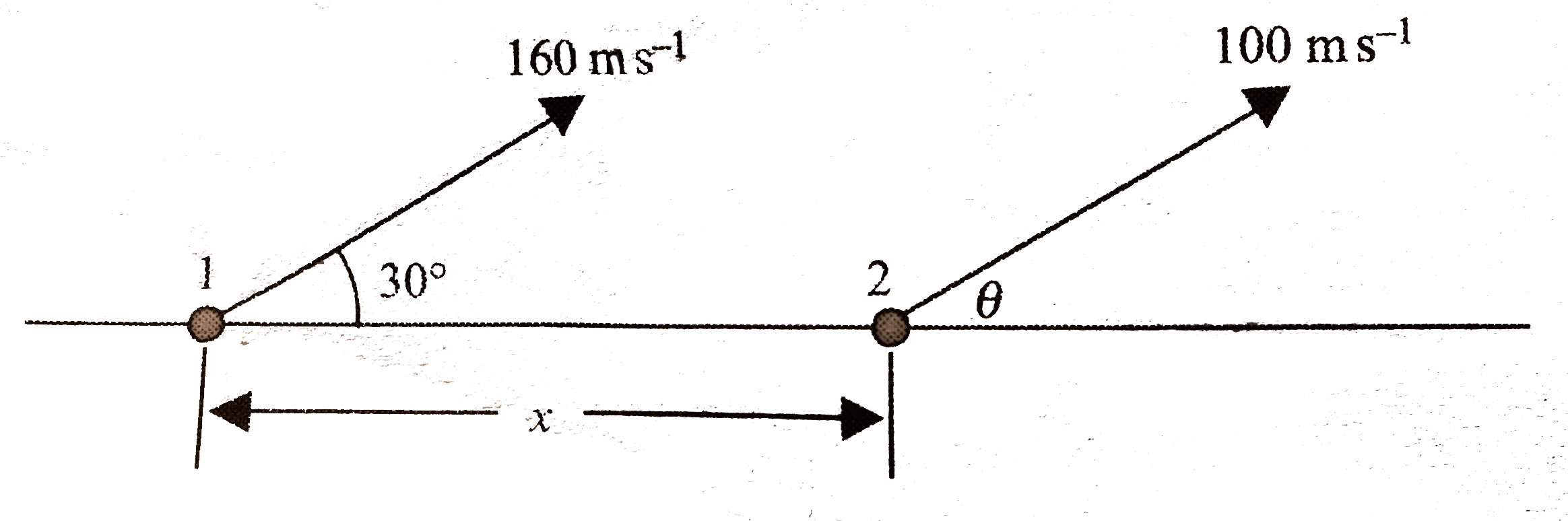
Suppose two particles `1 and 2` are projected in vertical plane simultaneously.
Their angles of projection are `30^@ and theta`, respectively, with the horizontal. Let they collide after a time`t` in air. Then
.

A

`theta = sin^-1(4//5)` and they will have same speed just before the collision.

B

`theta = sin^-1(4//5)` and they will have different speed just before the collision.

C

`x lt 1280 sqrt(3) - 960 m`.

D

It is possible that the particles collide when both of them are at their highest point.

Text Solution

Verified by Experts

The correct Answer is:
C, D

(b.,c.,d.) If they collide, their vertical component of velocities should be same, i.e.,
`100 sin theta = 160 sin 30^@`
`rArr sin theta = 4//5`
Their vertical components will always be same. Horizontal components :
`160 cos 30 = 80 sqrt(3) ms^-1`
and `100 cos theta = 100 xx 3//5 = 60 ms^-1`
They are not same, hence their velocities will not be same at any time. So (b) is correct.
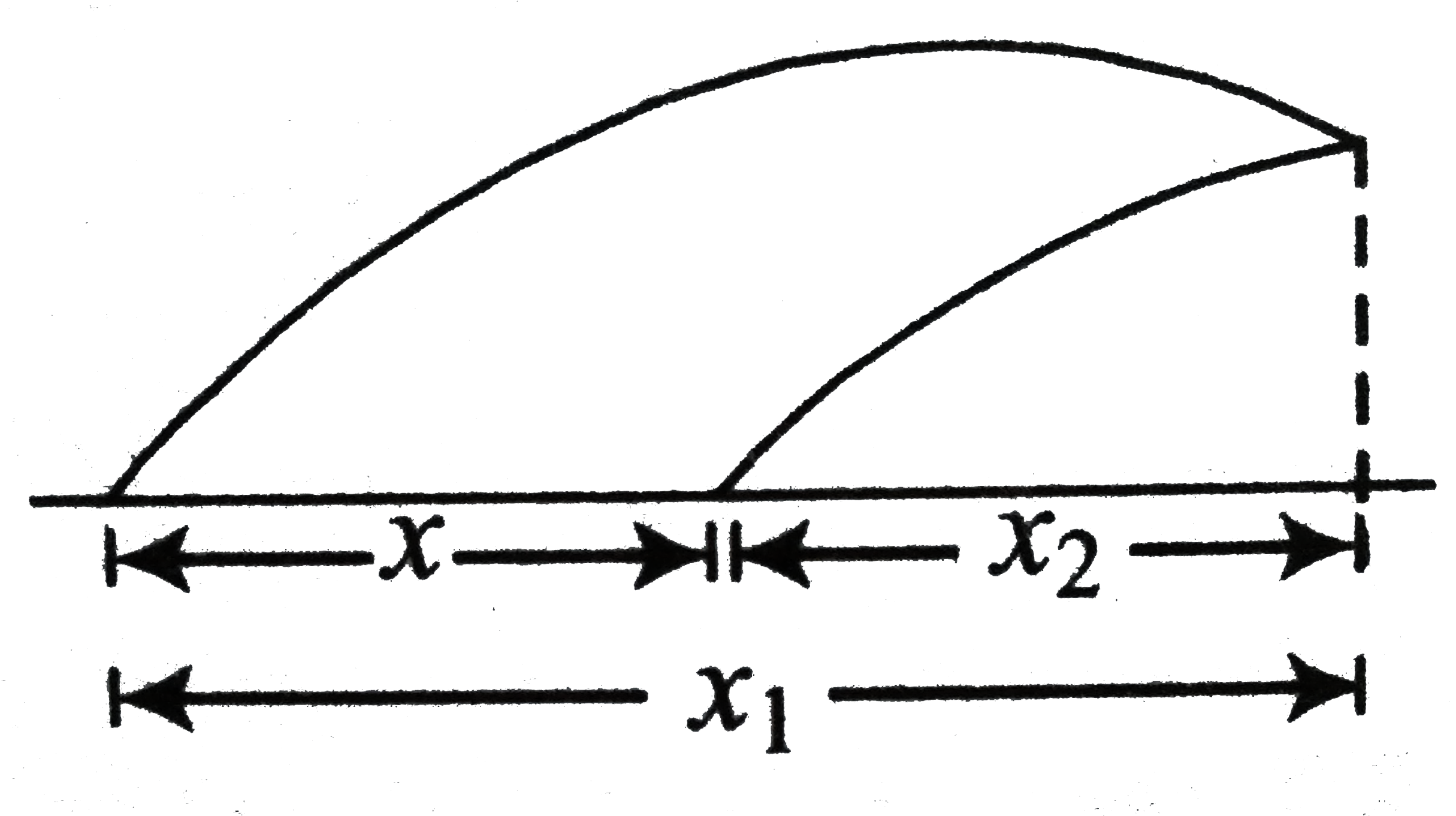
`x = x_1 - x_2 = 160 cos 30^@ t - 100 cos theta t`
`rArr x = (80 sqrt(3) - 60) t`
Time of flight : `T = (2 xx 160 xx sin 30)/(g) = 16 s` (same for both)
Now `t lt T_x rarr` to collide in air
`rArr (x)/(80 sqrt(3) - 60) lt16 rArr x lt 1280 sqrt(3) - 960`
Since their times of flight are same, they will simultaneously reach their maximum height. So it is possible to collide at the highest point for certain values of `x`.
.
Promotional Banner

Topper's Solved these Questions

  • KINEMATICS-2

    CENGAGE PHYSICS|Exercise Exercise Assertion - Reasoning|5 Videos
  • KINEMATICS-2

    CENGAGE PHYSICS|Exercise Exercise Comprehension|21 Videos
  • KINEMATICS-2

    CENGAGE PHYSICS|Exercise Exercise Single Correct|76 Videos
  • KINEMATICS-1

    CENGAGE PHYSICS|Exercise Integer|9 Videos
  • KINETIC THEORY OF GASES

    CENGAGE PHYSICS|Exercise Compression|2 Videos

Similar Questions

Explore conceptually related problems

Two particles are projected simultaneously in the same vertical plane, from the with speed u_(1) and u_(2) at angle of projection theta_(1) and theta_(2) respectively with the horizontal. The path followed by one, as seen by other (as long as both are in flight), is

Two particles are projected with same speed but at angles of projection (45^(@)-theta) and (45^(@)+theta) . Then their horizontal ranges are in the ratio of

Two particles A and B are projected simultaneously in the direction shown in the figure with velocities V_(A)=20m//s and V_(B)=10m//s respectively. If they collide in air after 1/2 sec. then

Two particles are projected simultaneously with same speed V_0 in same vertical plane at angle 30^@ and 60^@ With the horizontal .The time at which their velocities becomes parallel is

Two particles P & Q are projected simultaneously from a point O on a level ground in the same vertical plane with the same speed in directions making angle of 30^(@) and 60^(@) respectively with the horizontal.

Two particles A and B are projected in same vertical plane as shown in figure.Their initial positions (t=0) , initial spped and angle of projections are indicated in the diagram.If initial angle of projection theta_(B)=37^(@) , what should be initial speed of projection of particle B , so that it hits particle A . U_(A)=60m//s

Figure shows that particle A is projected from point P with velocity u along the plane and simultaneously another particle B with velocity v at an angle alpha with vertical. The particles collide at point Q on the plane. Then

Two particles A and B are projected simultaneously from a fixed point of the ground. Particle A is projected on a smooth horizontal surface with speed v, while particle B is projected in air with speed v, while particle B is projected in air with speed (2v)/(sqrt(3)) . If particle B hits the particle A, the angle of projection of B with the vertical is

Two particles A and B are projected simultaneously in a vertical plane as shown in figure. They collide at time t in air. Write down two necessary equations for collision to take place.

