Home
Class 11
PHYSICS
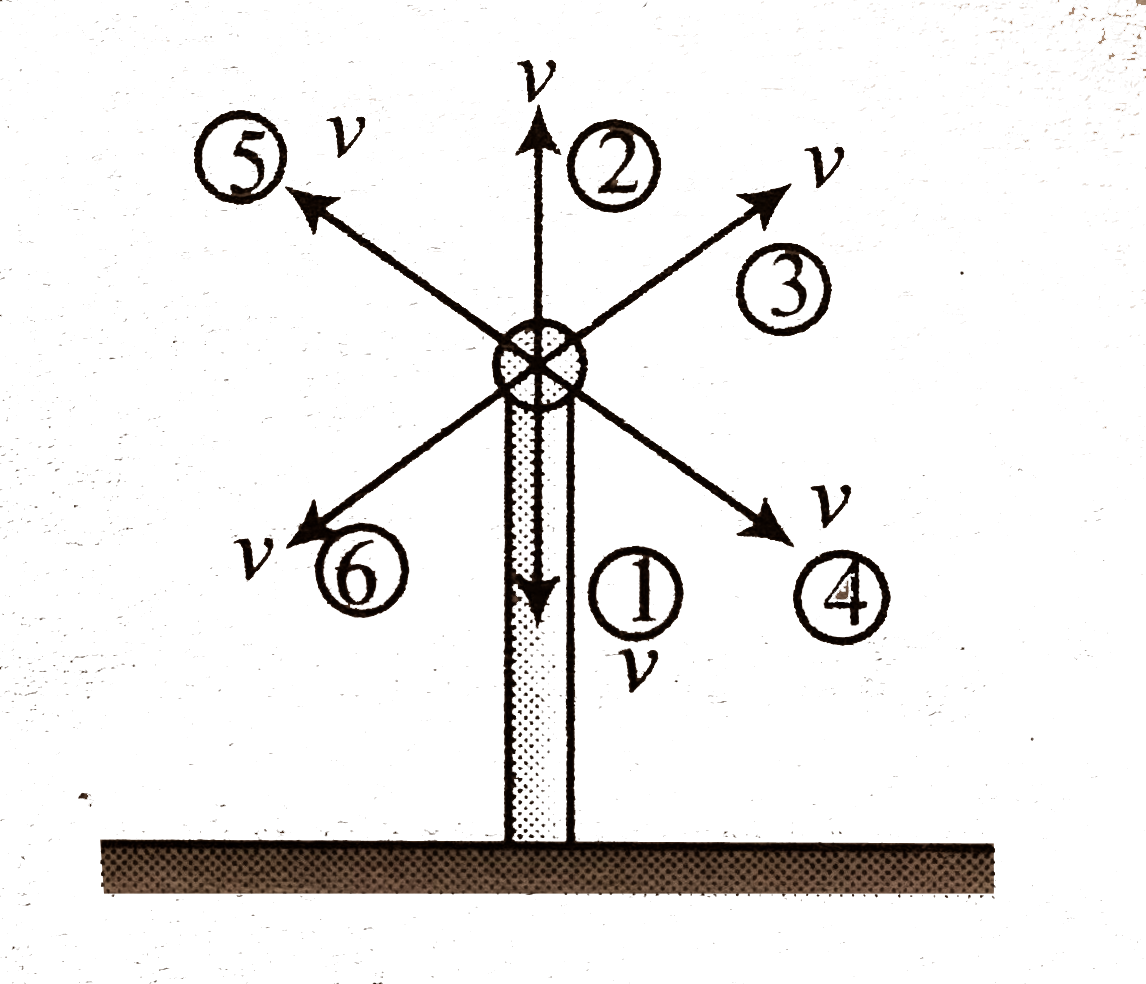
All the particles thrown with same initi...

All the particles thrown with same initial velocity would strike the ground.
.

A

with same speed.

B

simultaneously

C

time would be least for the particle thrown with velocity `v` downward i.e., particle `1`.

D

time would be maximum for the particle `2`.

Text Solution

Verified by Experts

The correct Answer is:

A, C, D

(a.,c.,d.) `(KE + PE)_f = (KE + PE)_i` in all situations.
Hence, `KE_f` is also equal as `PE_f = 0`. Hence, all the particles collide with the same speed.
`-h = vt_1 -(1)/(2) "gt"_1^2` [for first particle] …(i)
`-h = -vt_2 - (1)/(2) "gt"_1^2` [for second particle] ...(ii)
From Eq. (i) and Eq. (ii), `t_2 gt t_1`
`t_2` = maximum, `t_1` = minimum
i.e., options ( c) and (d) are correct.
Promotional Banner

Topper's Solved these Questions

  • KINEMATICS-2

    CENGAGE PHYSICS|Exercise Exercise Assertion - Reasoning|5 Videos
  • KINEMATICS-2

    CENGAGE PHYSICS|Exercise Exercise Comprehension|21 Videos
  • KINEMATICS-2

    CENGAGE PHYSICS|Exercise Exercise Single Correct|76 Videos
  • KINEMATICS-1

    CENGAGE PHYSICS|Exercise Integer|9 Videos
  • KINETIC THEORY OF GASES

    CENGAGE PHYSICS|Exercise Compression|2 Videos

Similar Questions

Explore conceptually related problems

A particle of mass m is released from a certain height h with zero initial velocity. It strikes the ground elastlcally (direction of its velocity is reversed but magnitude remains the same). Plot the graph between its kinetic energy and time till it returns to its initial position.

Two bodies are thrown with the same initial velocity at angles theta and (90^@ - theta) respectively with the horizontal, then their maximum height are in the ratio

A body dropped from a height h with initial velocity zero, strikes the ground with a velocity 3 m/s. Another body of same mass is thrown from the same height h with an initial velocity of 4 m/s. Find the final velocity of second mass, with which it strikes the ground.

A particle is thrown vertically upward from the ground with some velocity and it strikes the ground again in time 2 s. The maximum height achieved by the particle is : (g=10 m//s^(2))

A body is projected horizontally from the top of a tower with initial velocity 18 m s^-1 . It hits the ground at angle 45^@ . What is the vertical component of velocity when it strikes the ground ?

Assertion: In projectile motion horizontal velocity remains same but vertical velocity continously change and particle strikes the ground with same vertical velocity with which the particle was thrwon in vertical direction.

A stone is thrown upwards from the top of a tower with some initial speed and it reaches the ground in 16 seconds. Now it is thrown with the same initial speed downward and it reaches the ground in 9 sec . In how much time will it reach the ground if the stone is allowed to fall freely under gravity from the same place ?

A particle is thrown with velocity u at an angle prop from the horizontal. Another particle is thrown with the same velocity at an angle prop from the verticle. What will be the ratio of times of flight of two particles ?

An object is thrown vertically upward with a certain initial velocity in a world where the acceleration due to gravity is 19.6 m//s^(2) . The height to which it rises is _____ that to which the object would rise if thrown upward with the same initial velocity on the Earth. Neglect air resistance.
