Home
Class 11
PHYSICS
From a tower of height 40 m, two bodies ...

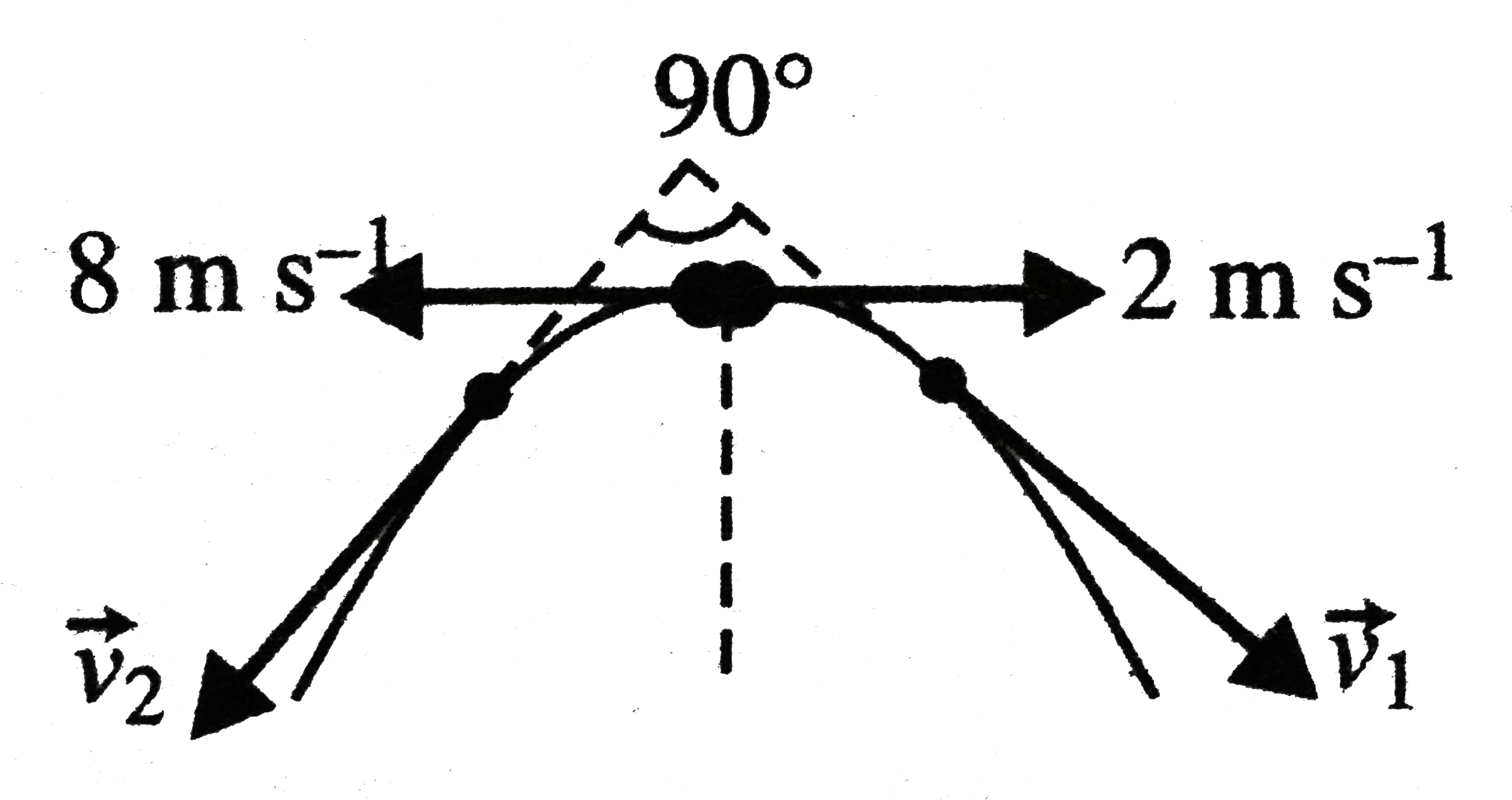
From a tower of height `40 m`, two bodies are simultaneously projected horizontally in opposite direction, with velocities `2 m s^-1 and 8 ms^-1`. respectively.
The horizontal distance between two bodies, when their velocity are perpendicular to each other, is.

A

1 m

B

0.5 m

C

2 m

D

4 m

Text Solution

Verified by Experts

The correct Answer is:
D

(d) Velocity of first body at any instant t, `vec v_1 = 2 hat i- "gt" hat j`
Velocity of second body at any instant
`vec v_2 = -8 hat i- "gt" hat j`
Since `vec v_1 _|_ vec v_2, i.e., vec v_1 . vec v_2 = 0`
`(2 hat i- "gt" hat j).(-8 hat i- "gt" hat j) = 0 rArr -16 + g^2 t^2 = 0`
`rArr t = sqrt((16)/(g^2)) rArr t = (4)/(10) = 0.4 s`
`vec S_1 = (2 xx 0.4) hat i, vec S_2 =(8 xx 0.4)(- hat i)`
`vec S_1 = 0.8 hat i and vec S_2 = -3.2 hat i`
Separation `= vec S_1 - (-vec S_2) = 0.8 hat i+ (3.2 hat i) = 4 hat i`
`vec S_1 = 2t hat i -(1)/(2) "gt"^2 hat j, vec S_2 = -8t hat i - (1)/(2) "gt"^2 hat j`
As `vec S_1 _|_ vec S_2, i.e., vec S_1 . vec S_2 = 0`
`-16t + (1)/(2) xx (1)/(2) g^2 t^2 = 0 rArr g^2 t^2 = 16 xx 4`
`rArr gt = 4 xx 2 rArr t = (8)/(10) = 0.8 s`.
.
Promotional Banner

Topper's Solved these Questions

  • KINEMATICS-2

    CENGAGE PHYSICS|Exercise Exercise Integer|9 Videos
  • KINEMATICS-2

    CENGAGE PHYSICS|Exercise Exercise Assertion - Reasoning|5 Videos
  • KINEMATICS-1

    CENGAGE PHYSICS|Exercise Integer|9 Videos
  • KINETIC THEORY OF GASES

    CENGAGE PHYSICS|Exercise Compression|2 Videos

Similar Questions

Explore conceptually related problems

From a tower of height 40 m , two bodies are simultaneously projected horizontally in opposite direction, with velocities 2 m s^-1 and 8 ms^-1 . respectively. The time taken for the displacement vectors of two bodies to be come perpendicular to each other is.

From a tower of height 40 m , two bodies are simultaneously projected horizontally in opposite direction, with velocities 2 m s^-1 and 8 ms^-1 . respectively. The time taken for the velocity vectors of two bodies to become perpendicular to each other is :

Two particles are thrown horizontally in opposite directions from the same point from a height h with velocities 4 ms^(-1) and 3 ms^(-1) . What is the separation between them when their velocities are perpendicular to each other?

Two particles are projected from a tower horizontally in opposite directions with velocities 10 m//s and 20 m//s . Find the time when their velocity vectors are mutually perpendicular. Take g=10m//s^2 .

From the top of tower of height 80 m , two stones are projected horizontally with velocities 20 m s^-1 and 30 m s^-1 in opposite directions, Find the distance between both the stones on reaching the ground ("in" 10^2 m) .

From the top of the tower, two balls are thrown horizontally in opposite directions with velocities u_(1) and u_(2) . Find the distacne between the balls at the moment when their velocity vectors becomes mutually perpendicular. (Assume the height of tower very large)

Two balls A and B are projected from the same position with horizontal velocity 20 ms^(-1) and 5 ms^(-1) as shown. The separation between these two bodies at the moment their velocities become perpendicular to each other is x m. The value of x is

Two trains, each 50 m long, are travelling in opposite directions with velocities 10 ms^-1 and 15 ms^-1 . The time of their crossing each other is.

Two particles of masses 2kg and 3kg are projected horizontally in opposite directions from the top of a tower of height 39.2m with velocities 5m//s and 10m//s respectively. The horizontal range of the centre of mass of two particles is

From the top of a tower of height 78.4 m two stones are projected horizontally with 10 m//s and 20 m//s in opposite directions. On reaching the ground, their separation is

CENGAGE PHYSICS-KINEMATICS-2-Exercise Comprehension
  1. A car is moving towards south with a speed of 20 m s^(-1). A motorcycl...

    Text Solution

    |

  2. A man can swim at a speed of 3 km h^-1 in still water. He wants to cro...

    Text Solution

    |

  3. A man can swim at a speed of 3 km h^-1 in still water. He wants to cro...

    Text Solution

    |

  4. To a stationary man, rain appears to be falling at his back at an angl...

    Text Solution

    |

  5. To a stationary man, rain appears to be falling at his back at an angl...

    Text Solution

    |

  6. From a tower of height 40 m, two bodies are simultaneously projected h...

    Text Solution

    |

  7. From a tower of height 40 m, two bodies are simultaneously projected h...

    Text Solution

    |

  8. From a tower of height 40 m, two bodies are simultaneously projected h...

    Text Solution

    |

  9. A ball is thrown from a point in level with velocity u and at a horizo...

    Text Solution

    |

  10. A ball is thrown from a point in level with velocity u and at a horizo...

    Text Solution

    |

  11. A 0.098-kg block slides down a frictionless track as shown in (Fig. )....

    Text Solution

    |

  12. A 0.098-kg block slides down a frictionless track as shown in (Fig. 5....

    Text Solution

    |

  13. A 0.098-kg block slides down a frictionless track as shown in (Fig. 5....

    Text Solution

    |

  14. A 0.098-kg block slides down a frictionless track as shown in (Fig. 5....

    Text Solution

    |

  15. A projectile is thrown with velocity v at an angle theta with the hori...

    Text Solution

    |

  16. A projectile is thrown with velocity v at an angle theta with the hori...

    Text Solution

    |

  17. A body is thrown at an angle theta0 with the horizontal such that it a...

    Text Solution

    |

  18. A particle is projected with a speed u at angle theta with the horizon...

    Text Solution

    |

  19. What is the radius of curvature of the parabola traced out by the proj...

    Text Solution

    |

  20. A particle is projected with a speed u at an angle theta to the horizo...

    Text Solution

    |

