Home
Class 11
PHYSICS
A particle slides along a track with ele...

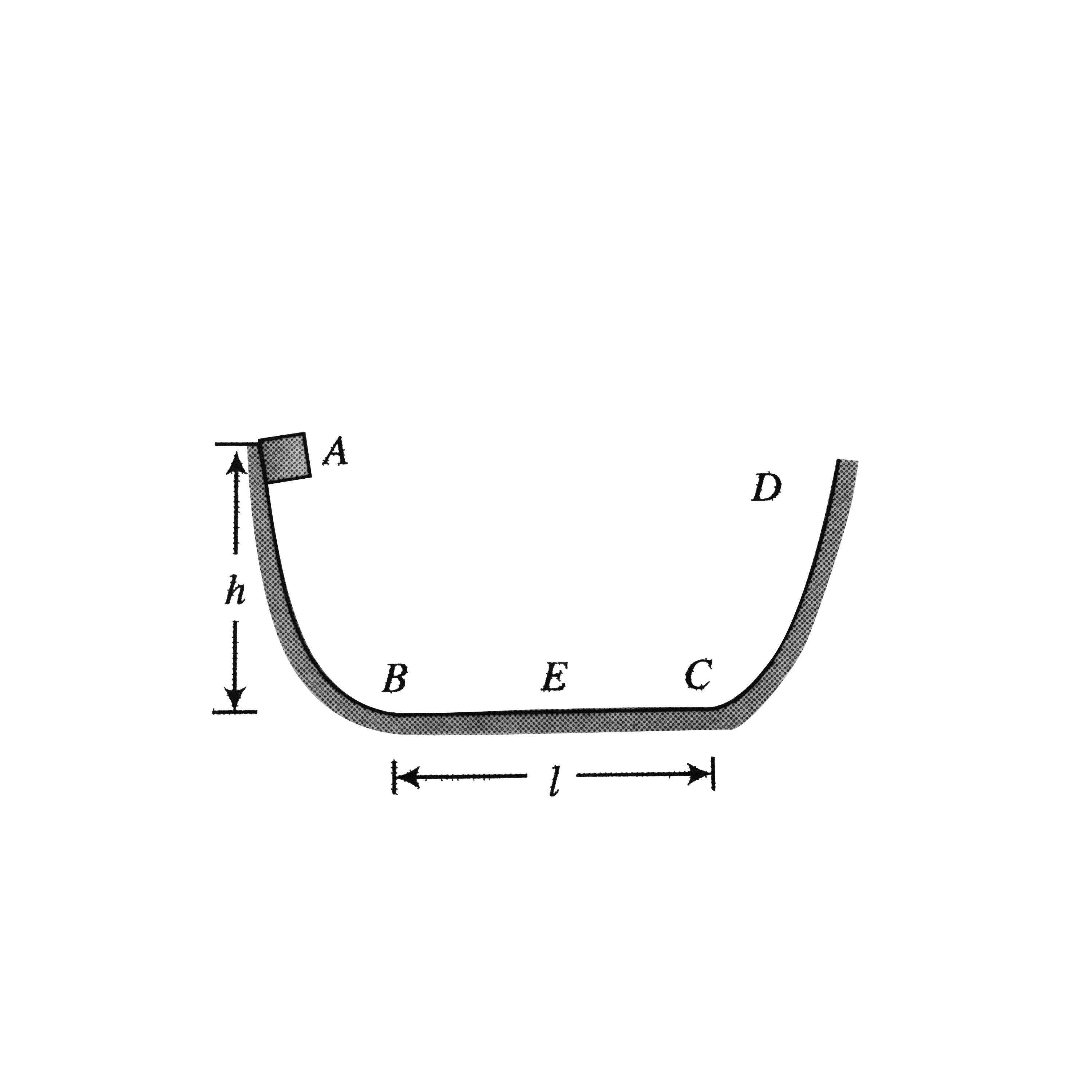
A particle slides along a track with elevated ends and a flat central part as shown in figure. The flat part has a length `l=3m`. The curved portions of the track are frictionless. For the flat part, the coefficient of kinetic friction is `mu_k=0.2`. The particle is released at point A which is at height `h=1.5m` above the flat part of the track. Where does the particle finally come to rest?

Text Solution

Verified by Experts

The particle will finally come to rest on the flat part. Hence, displacement of the particle along vertical is h. If `W_8` be the work done on the particle by the gravity, then
`W_g=mgh`(i)
where m is the mass of the particle.
If distance travelled by the particle on the flat part is `x`, the work done on the particle by the friction is
`W_f=-mumgx` (ii)
Since, initially, particle was at rest and finally it comes to rest again. Hence, change in its `KE` is zero.
From work-energy theorem, `W_g+W_f=DeltaKE`
`implies mgh-mumgx=0`
`impliesx=h/mu=1.5/0.2mimpliesx=7.5m`
Since `xgtl`, the particle will reach C and then will rise up till the remaining KE at C is converted into potential energy. It will then again descent to C and will have the same kinetic energy as it had when ascending but now will move from C to B. At B, same thing will be repeated (because `7.5lt2l`), and finally, the particle will stop at E such that
`BC+CB+BE=7.5`
`BE=7.5-6=1.5m`
Promotional Banner

Topper's Solved these Questions

  • WORK, POWER & ENERGY

    CENGAGE PHYSICS|Exercise Solved Examples|15 Videos
  • WORK, POWER & ENERGY

    CENGAGE PHYSICS|Exercise Exercise 8.1|25 Videos
  • VECTORS

    CENGAGE PHYSICS|Exercise Exercise Multiple Correct|5 Videos

Similar Questions

Explore conceptually related problems

A small block slides along a track with elevated ends and a flat central part as shown in figure. The flat portion BC has a length l=3.0 m , The curved portions of the track are frictionless. For the flat part, the coefficient of kinetic friction is mu_(k) = 0.20 , the particle is releast at point A which is at height h = 15 m above the flat part of the track. Where does the block finally comes to rest?

A block slides down a curved frictionless track and then up an inclined plane as in figure. The coefficient of kinetic friction between the block and incline is mu_k . Find the maximum height reached by the clock.

A 0.5kg block slides from the point A on a horizontal track with an initial speed 3 m//s towards a weightless horizontal spring of length 1m and force constant 2N//m. The part AB of the track is frictionless and the part BC has the confficient of static and kinetic friction as 0.20 respectively. If the distancences AB and BD are 2m and 2.14m respectively, find total distance through which the block moves before it comes to rest completely. (g=10 m//s^(2) ).

A particle of mass m slides along a curved-flat-curved track. The curved portions of the track are smooth. If the particle is released at the top of one of the curved portions, the particle comes to rest at flat portion of length l and of mu=mu_(ki n etic) after covering a distance of

A track has two inclined surface AB and DC each of length 3 m and angle of inclination of 30^@ with the horizontal and a central horizontal part of length 4m shown in figure. A block of mass 0.2 kg slides from rest from point A. The inclined surfaces are frictionless. If the coefficient of friction between the block and the horizontal flat surface is 0.2, where will the block finally come to rest ? [in 10^(-1) m ]

A particle of mass m slides on a frictionaless surface ABCD, starting from rest as shown in figure. The part BCD is a circular arc. If it looses contact at point P, the maximum height attained by the particle from point C is

A small block slide along a path that is without friction until the block reaches the section l=3m, which begains at height h=3m on a flat incline of angle 37° , as shown. In that section, the coefficient of kinetic friction is 0.50. The block passes through point A with a speed of sqrt(136) m/s. Find the speed of the block as it passes through point B where the friction ends, in m/s .(take g=10m/ s^(2) )
