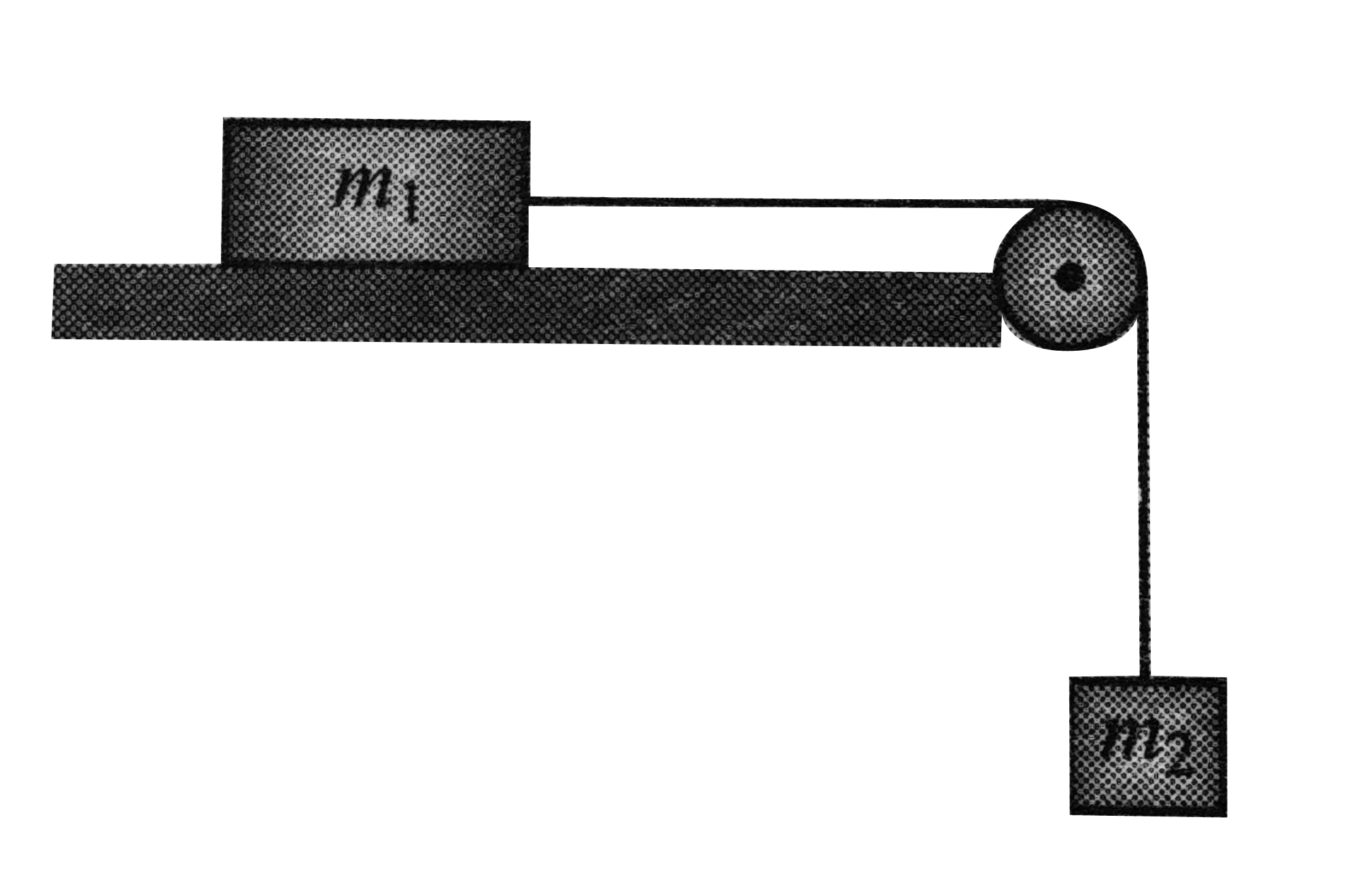
First we will solve the problem by the force method and then by the work-energy method. This will give you an opportunity to compare these two methods and sharpen your skills in selecting the method to be used for solving a prolem.
Force method: Let the acceleration of `m_1` be a horizontally towards right. The acceleration of `m_2` will be a vertically downwards (pulley constraint). Application of `sumvecF=mveca` to `m_1` and `m_2` (see the free body diagrams for `m_1` and `m_2` in figure shows
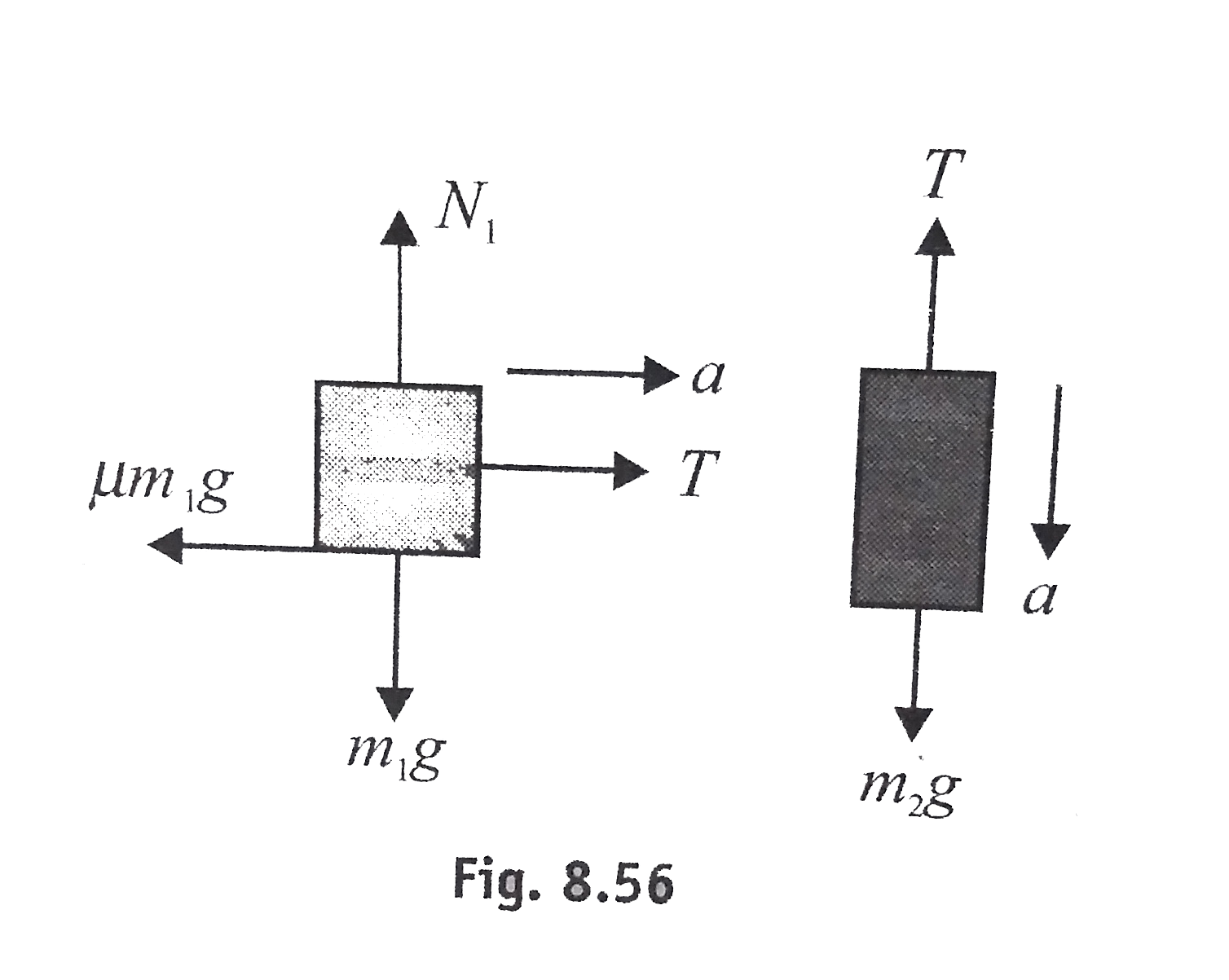
`T-mum_1g=m_1a` and `m_2g-T=m_2a`
Solving these equations for a, we get `a=((m_2-mum_1))/(m_1+m_2)g`
Using `s=ut+(1//2)at^2`, we find that the blocks take time.
`t=sqrt((2L(m_1+m_2))/((m_2-mum_1)g))`
to cover the ditance L, and from `v=u+at`, they will have the speed
`v=0+((m_2-mum_1)g)/(m_1+m_2)xxsqrt((2L(m_1+m_2)g)/((m_2-mum_1)g))`
`=sqrt((2Lg(m_2-mum_1))/(m_2+m_1))`
Work-energy method: The essence of the process in terms of energy considerations is that `m_2` loses potential energy of amount `m_2gL` while coming down by L, and the loss of potential energy of `m_2` appears partly in `m_1` and `m_2` in the form of kinetic energy and is partly used up as as work done against friction.
`m_2gL=1/2(m_1+m_2)v^2+mum_1gL`
`implies(m_2-mum_1)gL=1/2(m_1+m_2)v^2`
`impliesv=sqrt((2(m_2-mum_1)gL)/(m_1+m_2))`