Home
Class 11
PHYSICS
A block of mass m is slowly lowered from...

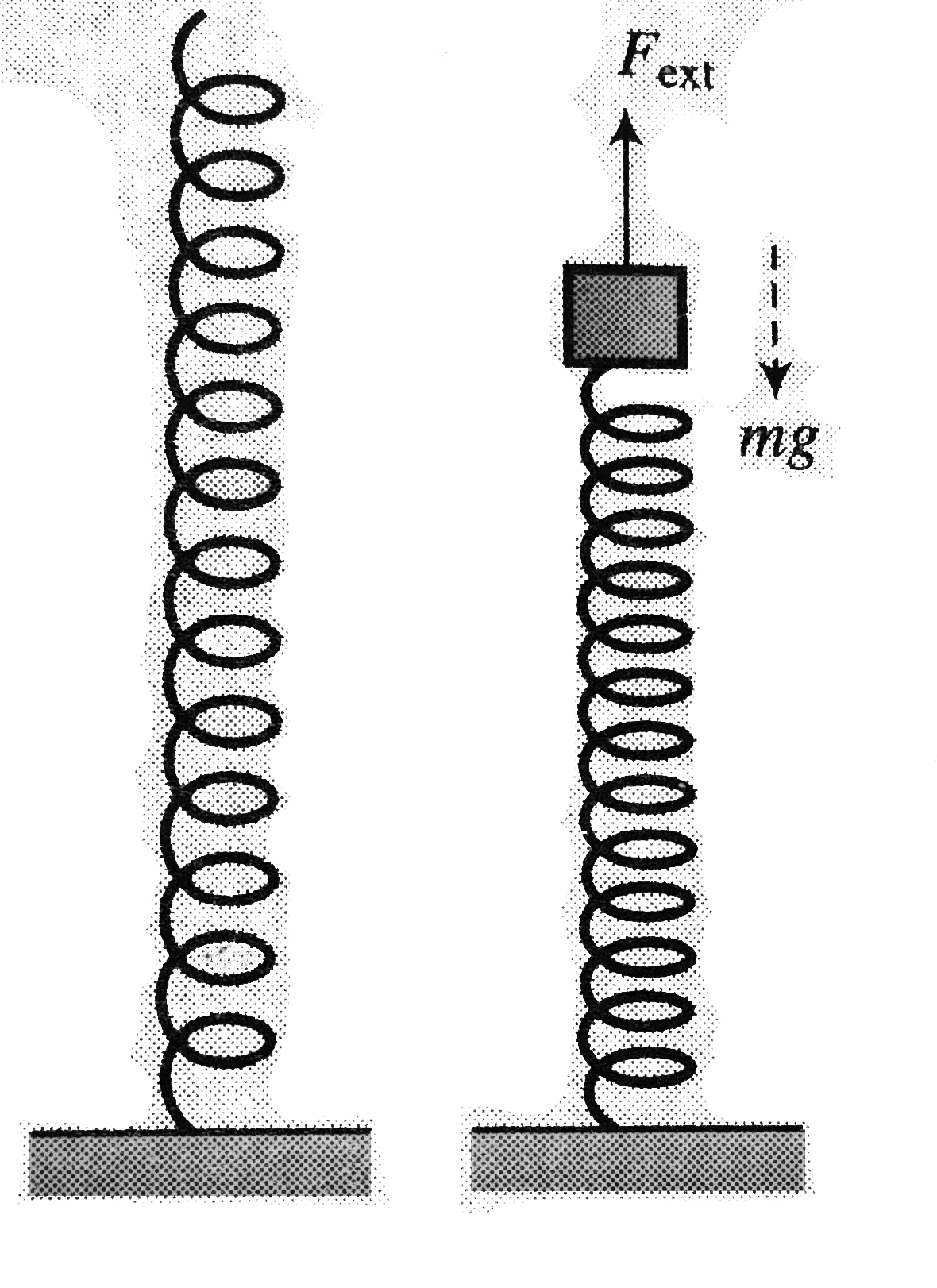
A block of mass m is slowly lowered from a point where it just touches a vertical fixed spring of stiffness k, till it remains stationary after the applied force is withdrawn. Find the work done by the external agent(a) in compressing the spring by a distance x and (b) bringing the block to its stable equilibrium position.

Text Solution

Verified by Experts

a. As the block is moving down, the spring pushes it up with a force `F_(sp)=kx`. The work done by the spring is
`W_(sp)=-1/2kx^2`
The work done by gravity is `W_gr=mgx`
The block does not change its kinetic energy as it is lowered slowly, `DeltaK=0`
Assuming `W_(ext)` as the work done by the applied external force by applying work-energy theorem, we have
Work done by total forces is equal to change in kinetic energy of the system.
`W_(total)=DeltaK`
`W_(ext)=W_(sp)+W_(gr)=DeltaK`
Substituting `W_(sp)=-1/2kx^2`, `W_(gr)=mgx`, and `DeltaK=0`, we
have `W_(ext)-1/2kx^2+mgx=0`
b. When the block remains at rest under the action of gravity and spring force, as the continuously increasing spring force `kx` will nullify the gravity force `mg`, we have `kx=mg`.
This gives `x=mg//k` which corresponds to stable euilibrium position. Now substituting `x=mg//k` in the expression,
`W_(ext)=1/2kx^2-mgx`, we have `W_(ext)=-(m^2g^2)/(2k)`
Promotional Banner

Topper's Solved these Questions

  • WORK, POWER & ENERGY

    CENGAGE PHYSICS|Exercise Solved Examples|15 Videos
  • WORK, POWER & ENERGY

    CENGAGE PHYSICS|Exercise Exercise 8.1|25 Videos
  • VECTORS

    CENGAGE PHYSICS|Exercise Exercise Multiple Correct|5 Videos

Similar Questions

Explore conceptually related problems

A block of mass m is connected rigidly with a smooth wedge (plank) by a light spring of stiffness k. If the wedge is moved with constant velocity v_0 , find the work done by the external agent till the maximum compression of the spring.

A body of mass m dropped from a certain height strikes a light vertical fixed spring of stifness k. the height of its fall before touching the spring the if the maximum compression of the spring the equal to (3 mg)/k is

A block of mass m is moving with an initial velocity v_0 towards a stationary spring of stiffness k attached to the wall as shown in figure a. Find the maximum compression in the spring. b. Is the work done by the spring negative or positive?

A block of mass m is slowly pulled along a curved surface from position 1 and 2. If the coefficient of kinetic friction between the block and surface is mu , find the work done by the applied force.

A spring of spring constasnt 50 N/m is compressed from its natural position through 1 cm. Find the work done by the work done by the spring force on the agency compressing the spring.

A block of mass m initially at rest is dropped from a height h on to a spring of force constant k . the maximum compression in the spring is x then

A block of mass m is released from a height h from the top of a smooth surface. There is an ideal spring of spring constant k at the bottom of the track. Find the maximum compression in the spring (Wedge is fixed)

A small block of mass m is kept on a bigger block of mass M which is attached to a vertical spring of spring constant k as shown in the figure. The system oscilates verticaly. a.Find the resultant force on the smaller block when it is displaced through a distance x above its equilibrium position. b. find the normal force on the smaller blok at this position. When is this force smallest smaller block at this position. When is this force smallest in magnitude? c. What can be the maximum amplitude with which the two blocks may oscillate together?

A block of mass m is suddenly released from the top of a spring of stiffness constant k. a. Find the acceleration of block just after release. b. What is the compression in the spring at equilibrium. c. What is the maximum compression in the spring. d. Find the acceleration of block at maximum compression in the spring.
