Home
Class 11
PHYSICS
A block of mass m is welded with a light...

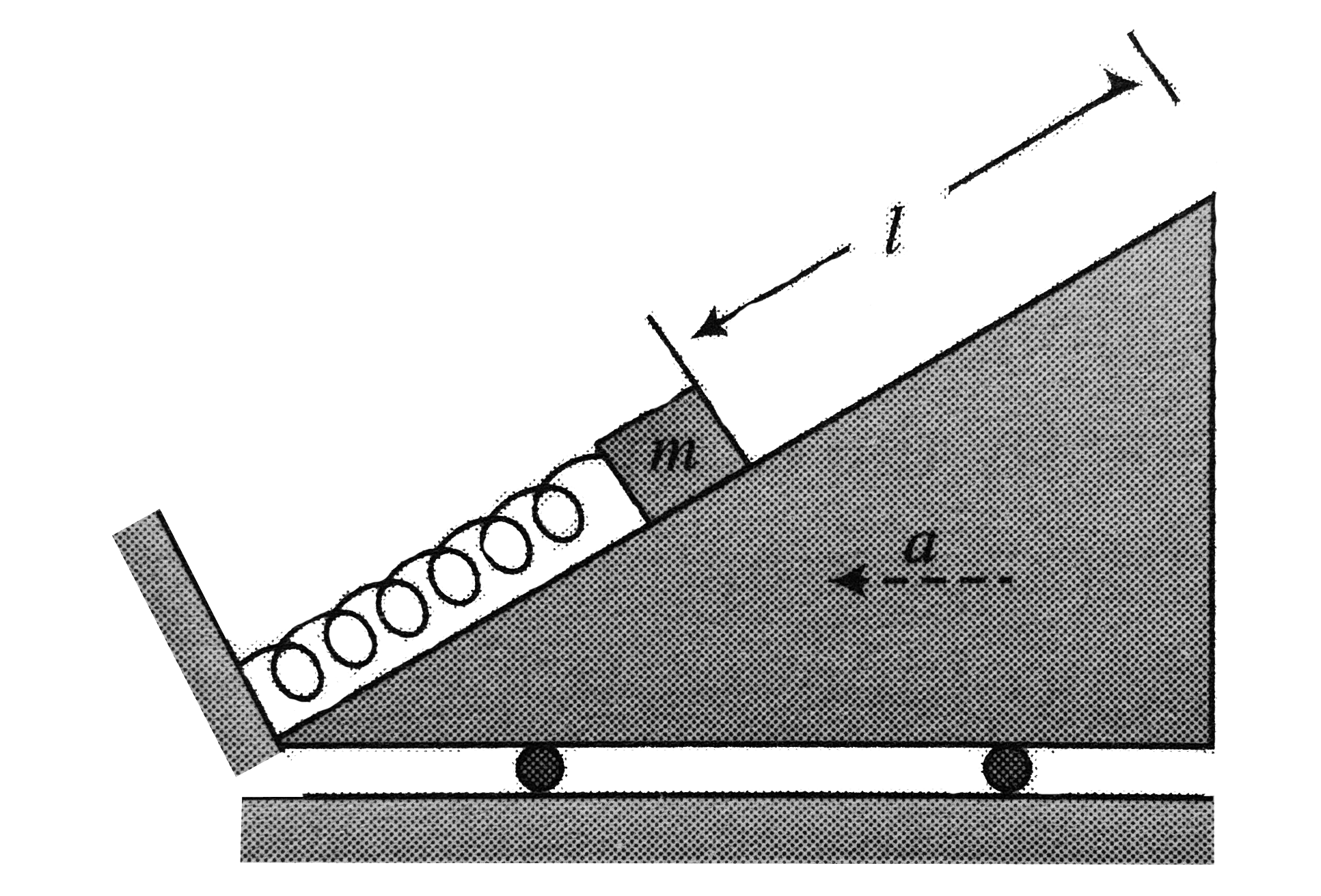
A block of mass m is welded with a light spring of stiffness k. The spring is initially relaxed. When the wedge fitted moves with an acceleration a, as shown in figure. `8.60`, the block slides through a maximum distance `l` relative to the wedge. If the coefficient of kinetic friction between the block and the wedges is `mu`, find the maximum deformation `l` of the spirng by using work-energy theorem.

Text Solution

Verified by Experts
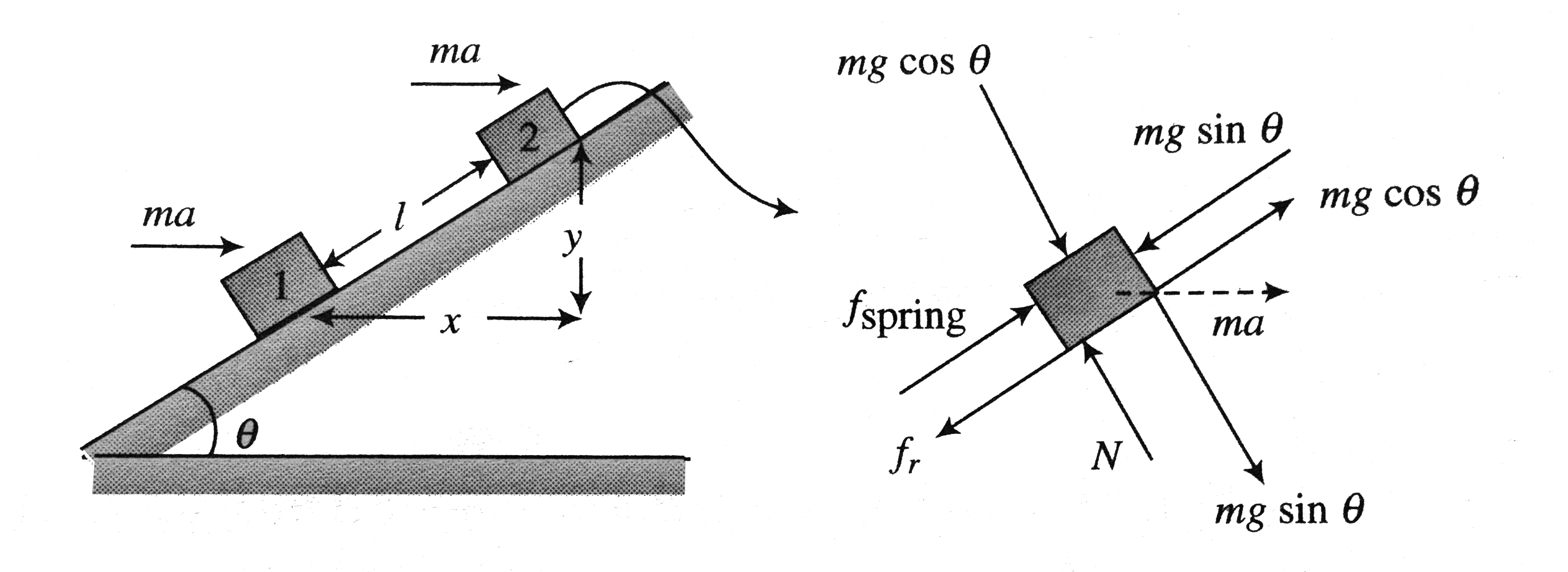
In this case, we are given the block slides through a distance `l` relative to the wedge. We can apply work-energy theorem from the frame of reference of wedge.

While the block is displaced from point 1 to point 2, work done by all the forces are given as follows:
Work: `W_(gr)=-mglsin theta`, `W_(sp)=(-Kl^2)/(2)`
`W_f=(muN)*l`
`N=mg cos theta+ma sin theta`
`W_f=-mu mgl cos theta-mu ma sin theta`
and `W_(pseudo)=(ma cos theta)l= mal cos theta`
W-E theorem: Summing upall workds, the total done is
`W_(t otal)=W_(gr)+W_(sp)+W_f+W_(pseudo)`
`W=-(mgl sin theta)/(1)-(mu mgl cos theta)/(3)+(mal cos theta)/(4)-(1/2kl^2)/(2)+Fl-(mu mal sin theta)/(3)`
Since the block was at rest at 1 and will remain at rest relative to the wedge, we can write `DeltaK=0` (relative to the wedge). Using work-energy theorem relative to the wedge, we have `W=DeltaK=0`.
Substituting `W=0`, we have
`-mg//sintheta-1/2kl^2-mumgcostheta-mumalsintheta+malcostheta=0`
`l=2/k[ma(costheta-musintheta)-mg(sintheta+mucostheta)]`
`=(2m)/(k)[a(costheta-musintheta)-g(sintheta+mucostheta)]`
Promotional Banner

Topper's Solved these Questions

  • WORK, POWER & ENERGY

    CENGAGE PHYSICS|Exercise Solved Examples|15 Videos
  • WORK, POWER & ENERGY

    CENGAGE PHYSICS|Exercise Exercise 8.1|25 Videos
  • VECTORS

    CENGAGE PHYSICS|Exercise Exercise Multiple Correct|5 Videos

Similar Questions

Explore conceptually related problems

A block of mass m is placed on the rough incline of a wedge of mass M and inclination alpha to the horizontal. Calculate the maximum and minimum acceleration that can be imparted to the wedge so that the block may remain stationary relative to the wedge. The coefficient iof friction between the block and the wedge is mu .

A block of mass m is connected with a rigid wall by light spring of stiffness k . Initially the spring is relaxed. If the block is pushed with a velocity v_0 , it oscillates back and forth and stops. Assuming mu as the coefficient of kinetic friction between block and ground, find the work done by friction till the block stops.

A block of mass m is moving with a speed v on a horizontal rought surface and collides with a horizontal monted spring of spring constant k as shown in the figure .The coefficient of friction between the block and the floor is mu The maximum cobnpression of the spring is

Two blocks of Masses M and 2M are connected by a spring of stiffness k .The coefficient of friction between the blocks and the surface is mu Find the minimum constant force F to be applied to 2m in order to slide the mass M .

Two blocks of mass m and 2m are arranged on a wedge that is fixedd on a horizontal surface. Friction coefficient between the block and wedge are shown . Find the magnitude of acceleration of two blocks.

A smooth wedge of mass M is pushed with an acceleration a=gtantheta and a block of mass m is projected down the slant with a velocity v relative to the wedge. Q. The normal reaction between wedge and block is:

Figure shows an irregular wedge of mass m placed on a smooth horizontal surface. Part BC is rough. If the coefficient of friction between the block and wedge is mu , and the block comes to rest with respect to wedge at a point E on the rough surface then BE will be

