Home
Class 11
PHYSICS
A 4.00-kg particle moves from the origin...

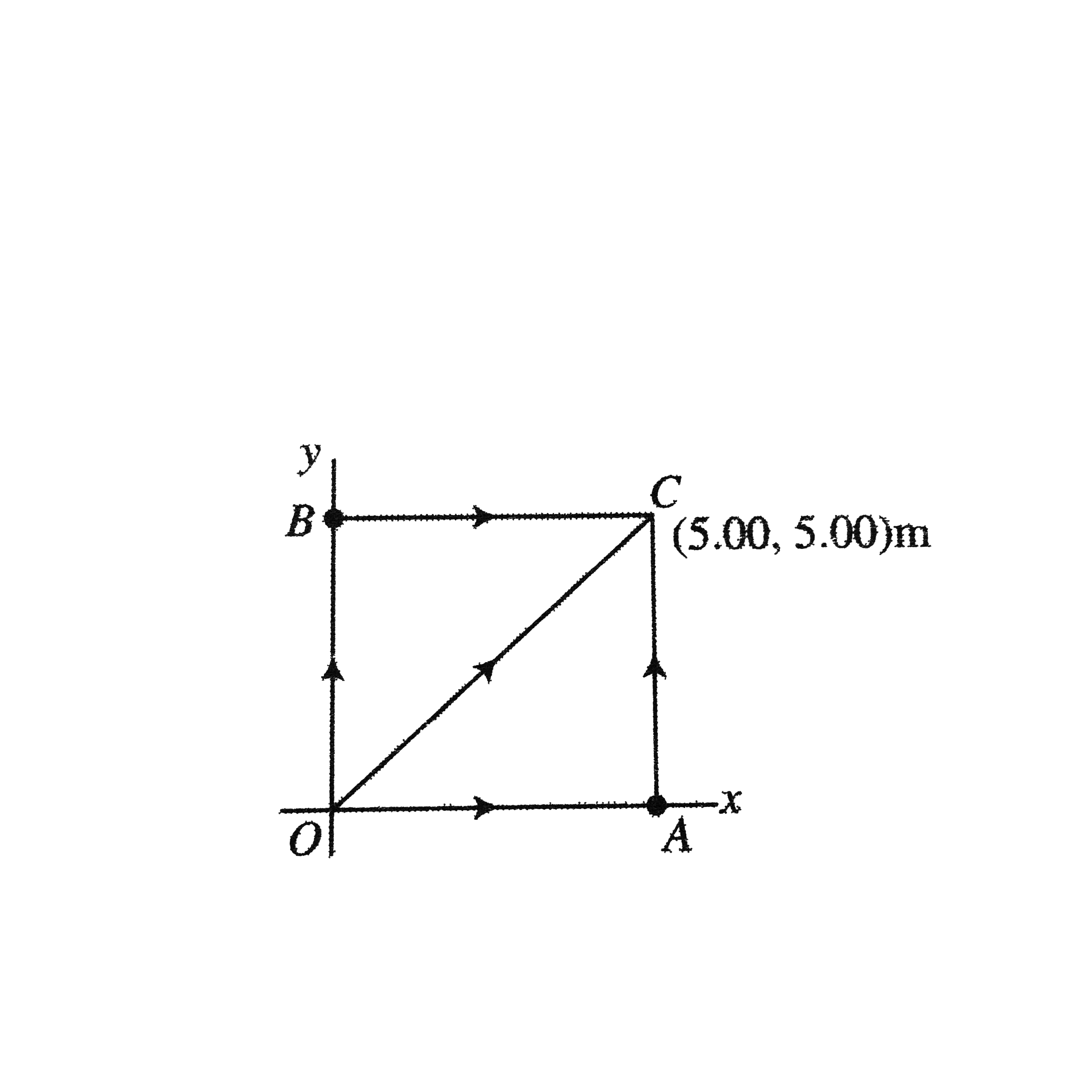
A `4.00-kg` particle moves from the origin to position C, having coordinate `x=5.00m` and `y=5m`. One force on the particle is the gravitational force acting in the negative y direction. Using equation `W=FDeltarcostheta=vecF.Deltavecr`, calculate the work done by the gravitional force on the particle as it goes from O to C along (a) OAC, (b) OBC, and (c) OC. Your results should all be identical. Why?

Text Solution

Verified by Experts

`F_g=mg=(4.00kg)(10.0ms^-2)=40.0N`
a. Work done along OAC=Work along OA+Work along AC
`=F_(g)(OA)cos 90.0^@+F_(g) (AC)cos 180^@`
`=(40.0N)(5.00m) cos 90^@+(40.0N)(5.00m)cos180^@=-200J`
b. Work done along OBC=W along OB+W along BC
`=(40.0)(5.00m)cos180^@+(40.0N)(5.00m)cos90.0^@=-200J`
c. Work done along `OC=F_(g)OCcos135^@`
`=(40.0N)(5.00xxsqrt2m)(-1/sqrt2)=-200J`
Work done is same in all cases because gravitational force is a conservative force.
Promotional Banner

Topper's Solved these Questions

  • WORK, POWER & ENERGY

    CENGAGE PHYSICS|Exercise Solved Examples|15 Videos
  • WORK, POWER & ENERGY

    CENGAGE PHYSICS|Exercise Exercise 8.1|25 Videos
  • VECTORS

    CENGAGE PHYSICS|Exercise Exercise Multiple Correct|5 Videos

Similar Questions

Explore conceptually related problems

Force acting on a particle varies with x as shown in figure. Calculate the work done by the force as the particle moves from x = 0 to x = 6.0 m.

Calculate the work done by the force vec(F) = y hat(i) to move the particle from (0,0) to (1,1) in the following condition (a) y = x (b) y = x^(2)

A force acting on a particle moving in the x-y plane is given by vecF=(2yhati+x^2hatj)N , where x and y are in meters. The particle moves from the origin to a final position having coordinates x=5.00m as shown in figure. Calculate the work done by vecF on the particle as it moves along (a) OAC, (b) OBC, and (c) OC. (d) Is vecF conservative or non-conservative? Explain.

A particle of mass m=5.00kg is released from point A and it slides on the frictionless track shown in figure. Determine (a) the particle's speed at points B and C and (b) the net work done by the gravitational force as the particle moves from A to C.

A particle moves along x -axis under the action of a position dependent force F = (5x^(2) -2x) N . Work done by forces on the particle when it moves from origin to x = 3m is

A particle moves along x - axis under the action of a position dependent force F=(5x^(2)-2x)N . Work done by force on the particle when it moves from origin to x = 3 m is

A force of F=(0.5x+12)N acts on a particle. If x is in metre, calculate the work done by the force during the displacement of the particle from x = 0 to x = 4 m

A force F is related to the position of a particle by the relation F=(10x^(2))N . Find the work done by the force when the particle moves from x=2m to x=4m .

A block of mass 5 kg initially at rest at the origin is acted upon by a force along the positive X-direction represented by F=(20+5x) N . Calculate the work done by the force during the displacement of the block from x = 0 to x = 4m .

Four particles A,B, C and D each of mass m are kept at the corners of a square of side L. Now the particle D is taken to infinity by an external agent keeping the other particles fixed at their respective positions . The work done by the gravitational force acting on the particle D During its movement is
