Home
Class 11
PHYSICS
A force acting on a particle moving in t...

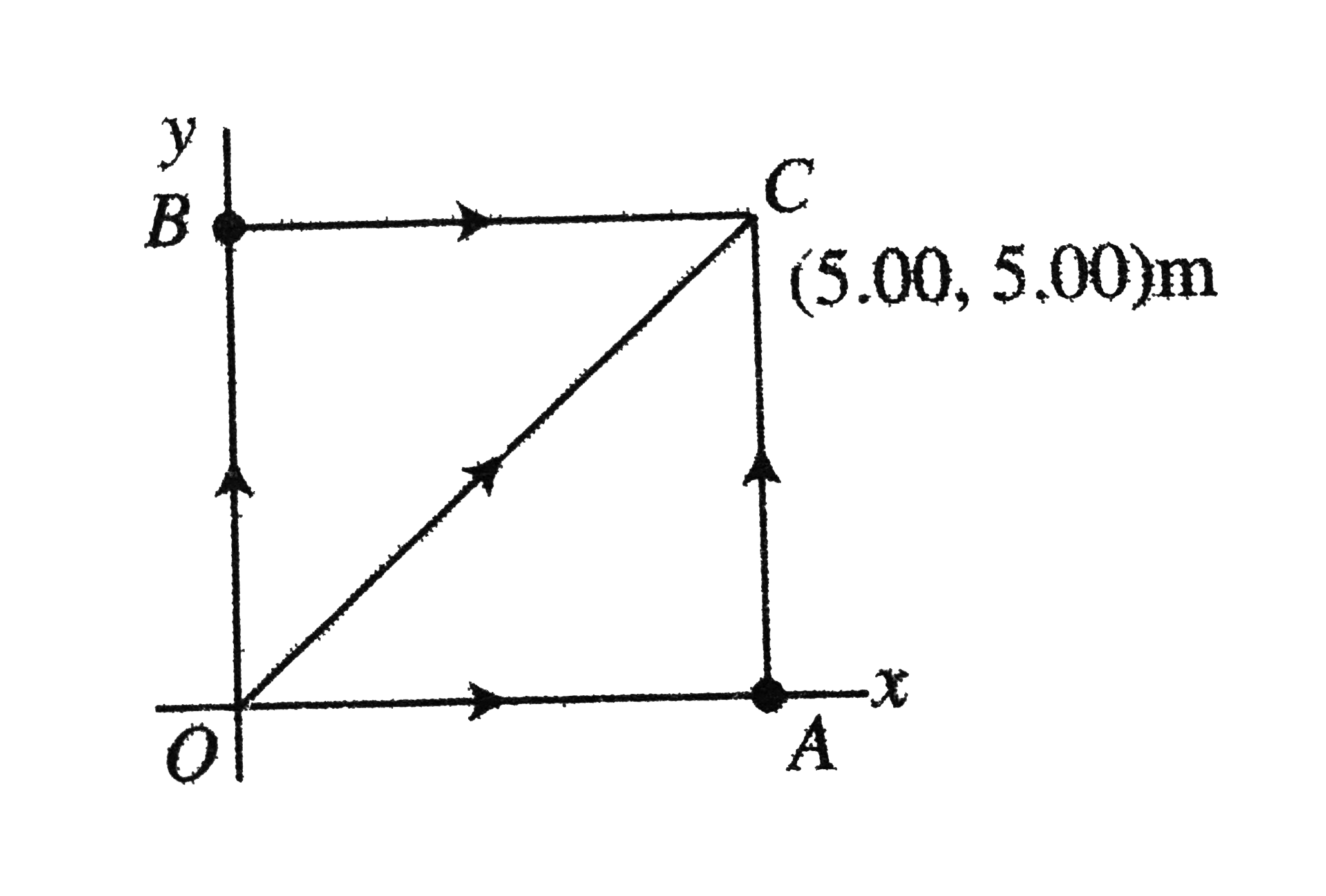
A force acting on a particle moving in the x-y plane is given by `vecF=(2yhati+x^2hatj)N`, where x and y are in meters. The particle moves from the origin to a final position having coordinates `x=5.00m` as shown in figure. Calculate the work done by `vecF` on the particle as it moves along (a) OAC, (b) OBC, and (c) OC. (d) Is `vecF` conservative or non-conservative? Explain.

Text Solution

Verified by Experts

a. For each of the paths from O to C, the work done is given by
`W=intoversetrarrF*vec(ds)`
Here `oversetrarrF=(2yhati+x^2hatj)` and `oversetrarr(ds)=(dxhati+dyhatj)`
Hence `W=int(2yhati+x^2hatj)(dxhati+dyhatj)`
`implies W=underset0overset5int2ydx+underset0overset5intx^2dy` ...(i)
The path OAC can be break up into two paths, from O to A and then from A to C.
First considering path O to A, in this path `y=0`, hence from equation (i) it is clear `W_(OA)=0`
Now consider path A to C, in this path x is constant (i.e., `dx=0`) and is equal to `5m`. From equation (i)
`W_(AC)=x^2underset0overset5intdy=(5)^2[y]_0^5=125J`
Hence total work done `W_(OAC)=0+125=125J`
b. Now consider the path OBC, this path also break up into two paths O to B and then B to C.
Considering path O to B, in this path `x=0`, hence from equation (i) it is clear `W_(OB)=0`.
Now considering path B to C, in this path y is constant (i.e. `dy=0`) from equation (i)
`W_(BC)=2yunderset0overset5intdx=2xx5xx[x]_0^5=50J`
Hence total work done in this path, `W_(OBC)=0+50=50J`
c. Motion of the particle from O to C, in this path both x and y are charging. In this path `x=yimpliesdx=dy`
From equation (i),
`W_(OC)=underset0overset5int(2x+x)^2dx=2[x^2/2]_0^5+[x^3/3]_0^5`
`=25+1/3xx125=200/3J`
d. We have calculated the work done from O to C in three different paths which is not same, hence the force F is a non-conservative force.
Promotional Banner

Topper's Solved these Questions

  • WORK, POWER & ENERGY

    CENGAGE PHYSICS|Exercise Solved Examples|15 Videos
  • WORK, POWER & ENERGY

    CENGAGE PHYSICS|Exercise Exercise 8.1|25 Videos
  • VECTORS

    CENGAGE PHYSICS|Exercise Exercise Multiple Correct|5 Videos

Similar Questions

Explore conceptually related problems

Force acting on a particle varies with x as shown in figure. Calculate the work done by the force as the particle moves from x = 0 to x = 6.0 m.

A force acting on particle is given by vecF=(3x^2hati+4yhatj)N . The change in kinetic energy of particle as it moves from (0,2m) to (1m,3m) is

Force acting on a particle moving in the x-y plane is vecF=(y^2hati+xhatj)N , x and y are in metre. As shown in figure, the particle moves from the origin O to point A (6m, 6m) . The figure shows three paths, OLA, OMA, and OA for the motion of the particle from O to A. Work done for motion along path OA is nearly

Force acting on a particle moving in the x-y plane is vecF=(y^2hati+xhatj)N , x and y are in metre. As shown in figure, the particle moves from the origin O to point A (6m, 6m) . The figure shows three paths, OLA, OMA, and OA for the motion of the particle from O to A. Which of the following is correct?

Force acting on a particle moving in the x-y plane is vec F=(y^(2) hat i + x hat j) N, x and y are in metre. As shown in fig. the particle moves from the origin O to point A(6m,6m) . The figure shows three paths, OLA,OMA and OA for the motion of the particle from O to A . Work done for motion along path OA is nearly

Force acting on a particle moving in the x-y plane is vec F=(y^(2) hat i + x hat j) N, x and y are in metre. As shown in fig. the particle moves from the origin O to point A(6m,6m) . The figure shows three paths, OLA,OMA and OA for the motion of the particle from O to A . Along which of the three paths is the work done maximum.

The potential energy of a particle of mass 1 kg moving in X-Y plane is given by U=(12x+5y) joules, where x an y are in meters. If the particle is initially at rest at origin, then select incorrect alternative :-

A force F acting on a particle varies with the position x as shown in figure. Find the work done by this force in displacing the particle from

A particle is moved foom the orgin A, back to the origin, along the path ABCDEFA as shown in figure (A) Find the work done by the force vecF=y hati+zhatj+xhatk acting on the particle, in the round trip? (B) Is the force given in part (A) conservative?

Force acting on a particle moving in the x-y plane is vecF=(y^2hati+xhatj)N , x and y are in metre. As shown in figure, the particle moves from the origin O to point A (6m, 6m) . The figure shows three paths, OLA, OMA, and OA for the motion of the particle from O to A. Now consider another situation. A force vecF=(4hati+3hatj)N acts on a particle of mass 2kg . The particle under the action of this force moves from the origin to a point A (4m, -8m) . Initial speed of the particle, i.e., its speed at the origin is 2sqrt6ms^-1 . Figure shows three paths for the motion of the particle from O to A. Speed of the particle at A will be nearly
