Home
Class 11
PHYSICS
A chain of length l and mass m lies of t...

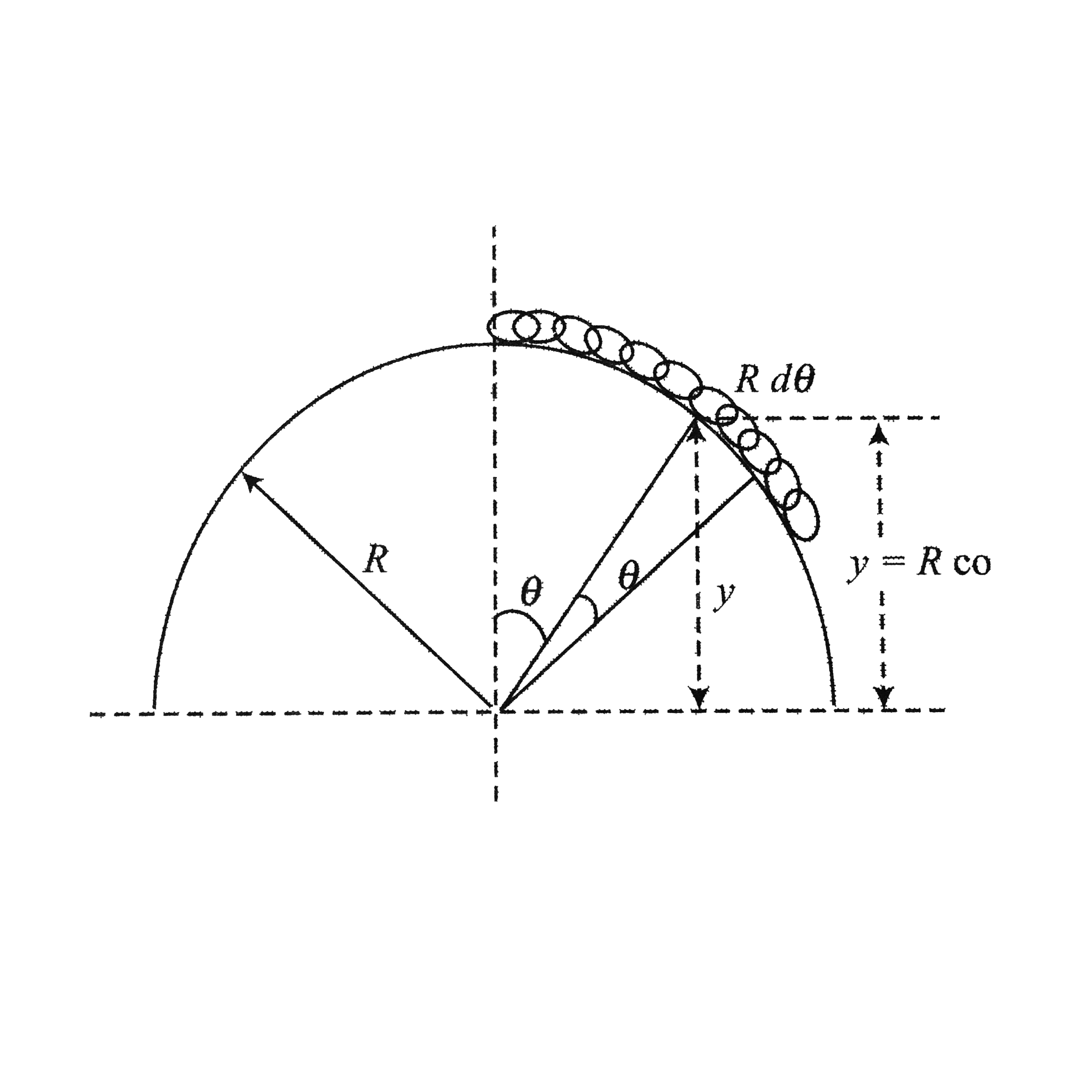
A chain of length l and mass m lies of the surface of a smooth hemisphere of radius `Rgtl` with one end tied to the top of the hemisphere. Taking base of the hemisphere as reference line, find the gravitational potential energy of the chain.

Text Solution

Verified by Experts

The mass is distributed in chain uniformly along its length.
Choose a small element of chain of width `dtheta` at an angle `theta` from the vertical.
The mass of the element, `dm=(m/lRd theta)`
The gravitational potential energy of the element `dU=(dm)gy`
Thus, the gravitational potential energy of whole chain
`U=int(dm)gy`
`=underset0overset((l//R))int(m/lRd theta)g(Rcostheta)`
`=(mR^2g)/(l)underset0overset((l/R))intcosthetad theta`
`=(mgR^2)/(l)|sintheta|_0^(l//R)=(mgR^2)/(l)sin(l/R)`
Promotional Banner

Topper's Solved these Questions

  • WORK, POWER & ENERGY

    CENGAGE PHYSICS|Exercise Solved Examples|15 Videos
  • WORK, POWER & ENERGY

    CENGAGE PHYSICS|Exercise Exercise 8.1|25 Videos
  • VECTORS

    CENGAGE PHYSICS|Exercise Exercise Multiple Correct|5 Videos

Similar Questions

Explore conceptually related problems

AS chain of length l and mass m lies o the surface of a smooth sphere of radius Rgtl with one end tied to the top of the sphere. a.Find the gravitational potential energy of the chain with reference level at the centre of the sphere. B. suppose the chin is released and slides down the sphere. Find the kinetic eneergy of the chain, when it has slid through an angle theta c. find the tangential acceleration (dv)/(dt) of the chain when the chain starts sliding down.

A chain of length l = pi R//4 is placed. On a smooth hemispherical surface of radius R with one of its ends fixed at the top of the sphere. Mass of chain is sqrt(pi kg) and R = 1m.(g = 10 m//s^(2)) . The gravitational potential energy of the chain considering reference level at the base of hemisphere is

A uniform chain of mass m and length llt(piR)/(2) is placed on a smooth hemisphere of radius R with on of its ends fixed at the top of the sphere. (a) Find the gravitational potential energy of chain assuming base of hemisphere as reference. (b) what will be the tangential acceleraion of the chain when it starts sliding down. (c ) If the chain slides down the sphere, find the kinetic energy of the chain when it has slipped through an angle beta .

A chain of length l = pi R//4 is placed. On a smooth hemispherical surface of radius R with one of its ends fixed at the top of the sphere. Mass of chain is sqrt(pi kg) and R = 1m.(g = 10 m//s^(2)) . The tangential acceleration of the chain when its starts sliding down.

The total surface area of a hemisphere is 3768cm2. Find the radius of the hemisphere. (Take pi =3.14 )

A chain of length l is placed on a smooth spherical surface of radius R with one of its ends fixed at the top of the sphere. What will be the acceleration of the each element of the chain when its upper end is released? It is assumed that the length of the chain l<((piR)/2) .

A chain of length l is placed on a smooth spherical surface of radius R with one of its ends fixed at the top of the sphere. What will be the acceleration w of each element of the chain when its upper end is released? It is assumed that the length of the chain llt1/2piR .

A particle of mass m initially at rest starts moving from point A on the surface of a fixed smooth hemisphere of radius r as shown. The particle looses its contact with hemisphere at point B.C is centre of the hemisphere. The equation relating theta and theta' is .

A particle of mass m is released from the top of a smooth hemisphere of radius R with the horizontal speed mu . Calculate the angle with verticle where it loses contact with the hemisphere.

A chain of length l = pi R//4 is placed. On a smooth hemispherical surface of radius R with one of its ends fixed at the top of the sphere. Mass of chain is sqrt(pi kg) and R = 1m.(g = 10 m//s^(2)) . If the chain sliped down the sphere, kinetic energy of the chain when it has sliped through an angle theta = (pi)/(4) .
