Home
Class 11
PHYSICS
A chain of length L and mass M is held o...

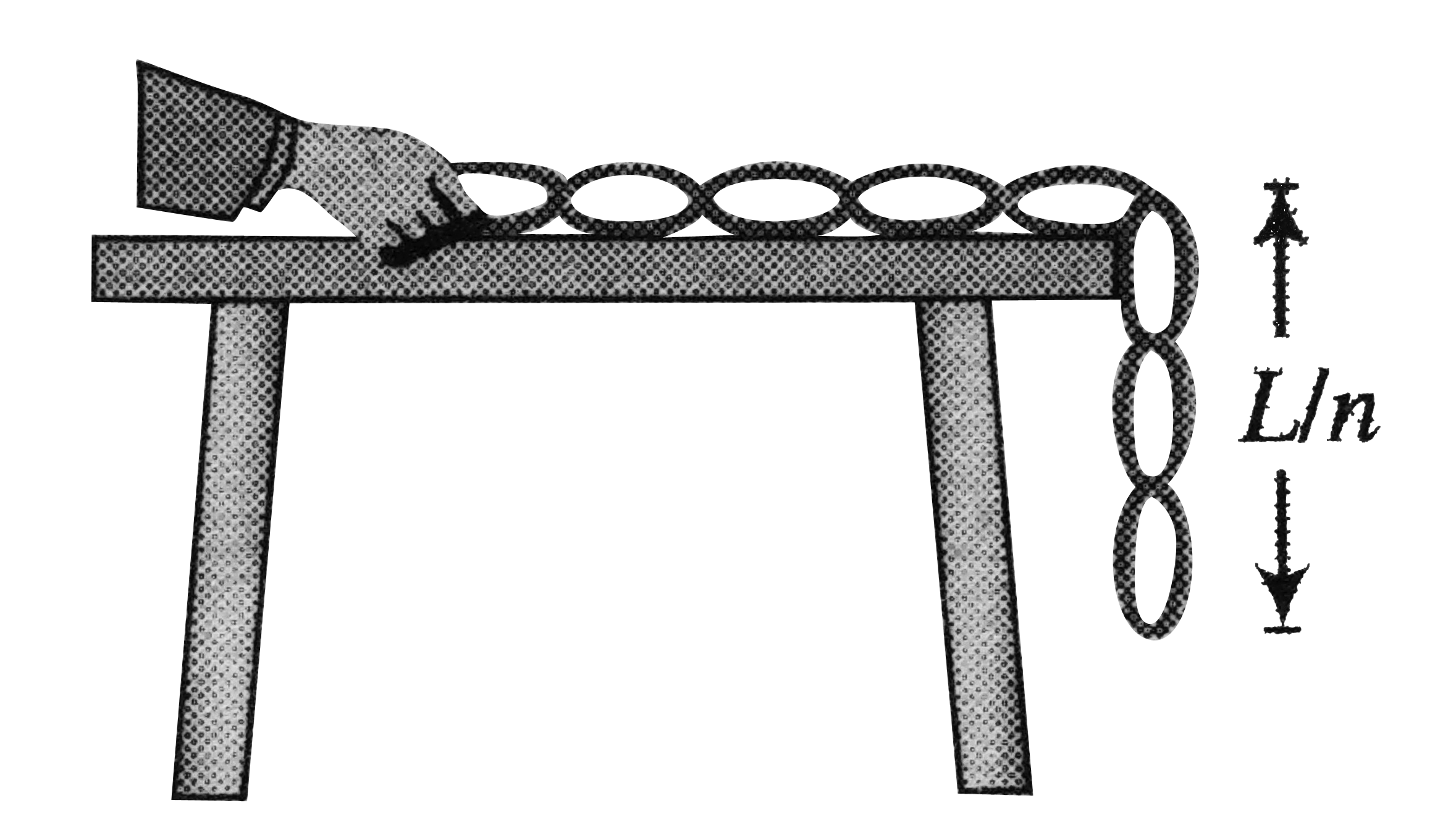
A chain of length L and mass M is held on a frictionless table with `(1//n)th` of its length hanging over the edge. When the chain is released, find the velocity of chain while leaving the table.

Text Solution

Verified by Experts
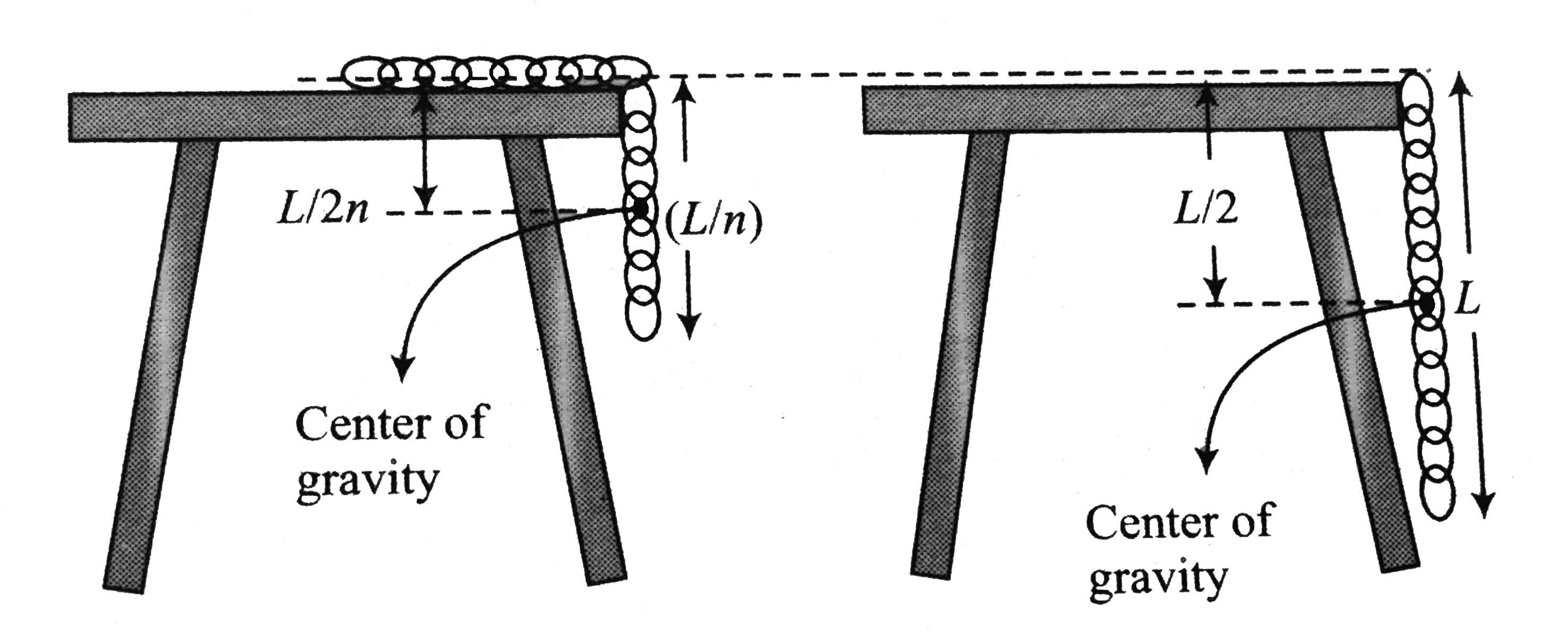
Taking surface of table as a reference level (zero potential energy)

Potential energy of chain when `1//nth` length hanging from the edge `U_(i nitial)=(-MgL)/(2n^2)`
Potential energy of chain when it leaves the table,
`U_(i nitial)=-(MgL)/(2)`
Using conservation of mechanical energy
`DeltaK+DeltaU=0`
or Kinetic energy of chain = Loss in potential energy
`implies 1/2Mv^2=(MgL)/(2)-(MgL)/(2n^2)`
`=(MgL)/(2)[1-(1)/(n^2)]`
Therefore, velocity of chain `v=sqrt(gL(1-(1)/(n^2)))`
Promotional Banner

Topper's Solved these Questions

  • WORK, POWER & ENERGY

    CENGAGE PHYSICS|Exercise Solved Examples|15 Videos
  • WORK, POWER & ENERGY

    CENGAGE PHYSICS|Exercise Exercise 8.1|25 Videos
  • VECTORS

    CENGAGE PHYSICS|Exercise Exercise Multiple Correct|5 Videos

Similar Questions

Explore conceptually related problems

A uniform chain has a mass m and length l . It is held on a frictionless table with one - sixth of its length hanging over the edge. The work done in just pulling the hanging part back on the table is :

A uniform chain of length l and mass m is placed on a smooth table with one-fourth of its length hanging over the edge. The work that has to be done to pull the whole chain back onto the table is :

A chain is held on a frictionless table with 1//n th of its length hanging over the edge. If the chain has a length L and a mass M, how much work is required to pull the hanging part back on the table?

A uniform chain of mass m and length l is lying on a horizontal table with one-third of its length hanging over the edge of the table. What is the speed of the chain, when it just loses contact with the table?

A chain of mass M is placed on a smooth table with 1/n of its length L hanging over the edge. The work done in pulling the hanging portion of the chain back to the surface of the table is:

A uniform chain of length l is placed on a smooth horizontal table, such that half of its length hangs over one edge. It is releasedfrom rest, the velocity with which it leaves the table is

A uniform chain is held on a frictionless table with one third of its length hanging over the edge. IF the chain has a length l and a mass m, how much work is required to pull the hanging part back on the table ?

A uniform chain of mass m and length l is lying on a horizontal table with one-third of its length hanging over the edge of the table. If the chain is limiting equlibrium, what is the coefficient of friction for the contact between table and chain?

A uniform chain of mass m and length l is placed on a smooth table so that one - third length hanges freely as shown in the figure. Now the chain is released, with what velocity chain slips off the table?

