Home
Class 11
PHYSICS
A particle of mass m is kept on the top ...

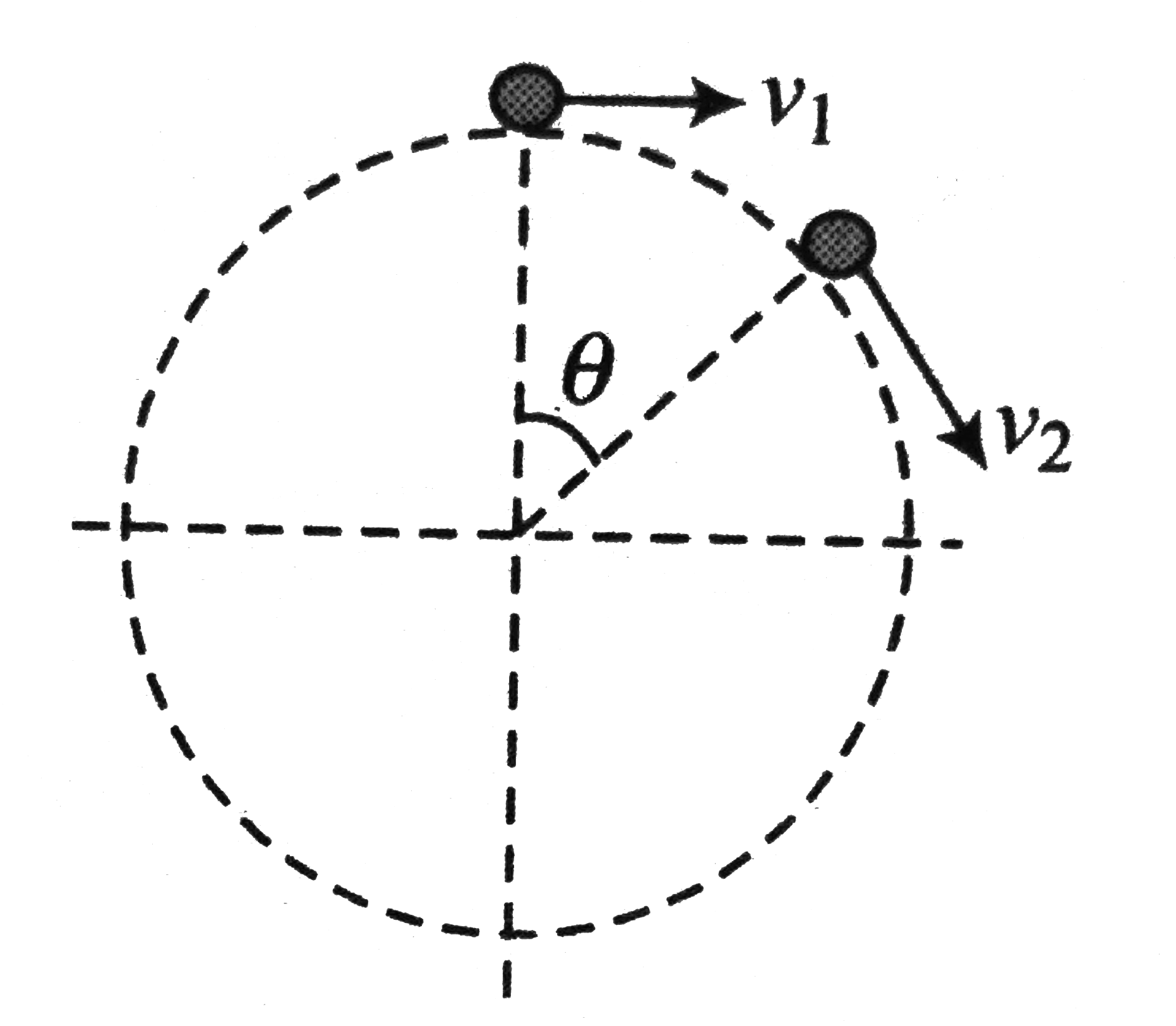
A particle of mass m is kept on the top of a smooth sphere of radius R. It is given a sharp impulse which imparts it a horizontal speed v. a. find the normal force between the sphere and the particle just after the impulse. B. What should be the minimum value of v for which the particle does not slip on the sphere? c. Assuming the velocity v to be half the minimum calculated in part, d. find the angle made by the radius through the particle with the vertical when it leaves the sphere.

Text Solution

Verified by Experts
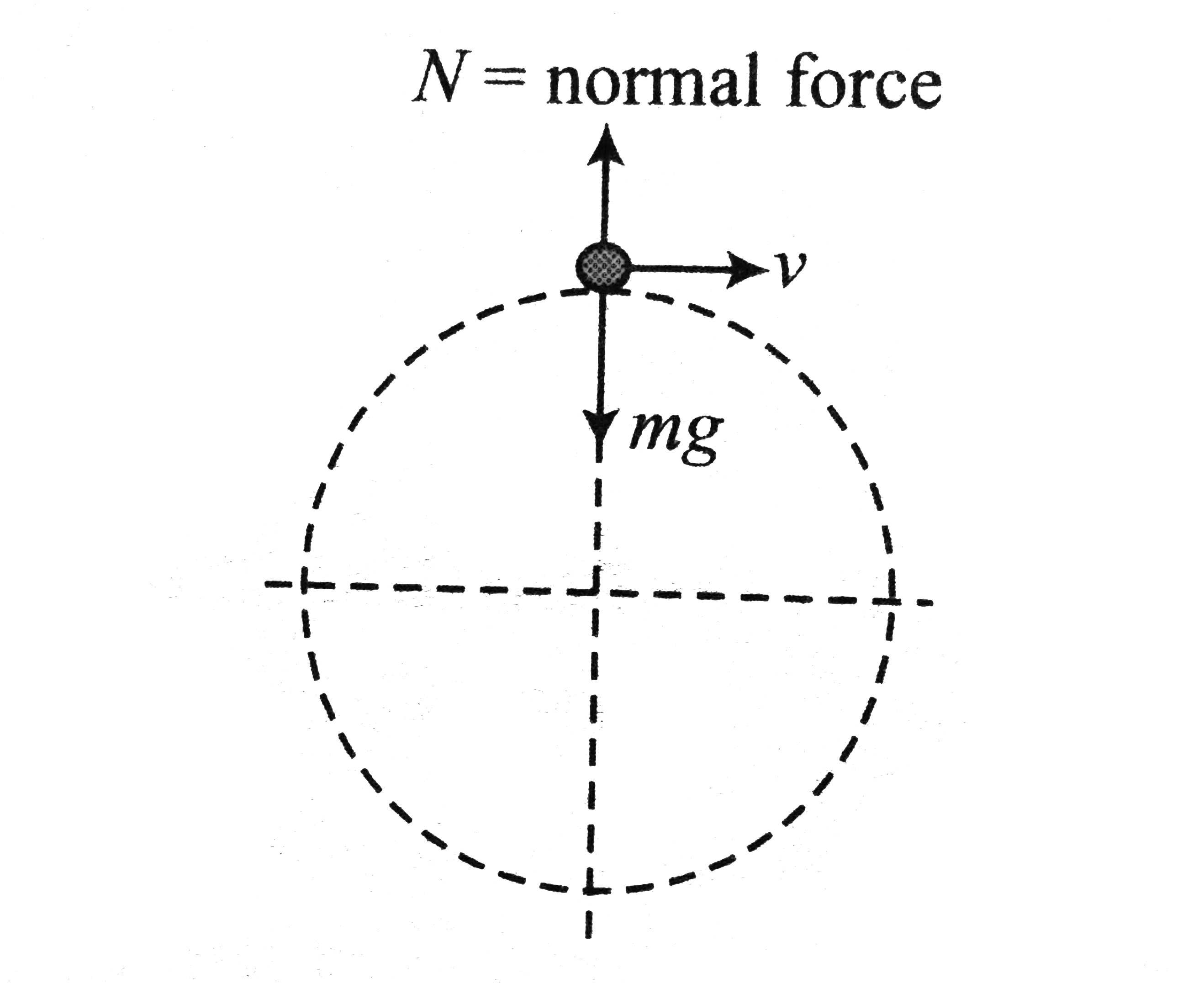
a. Radius=R, horizontal speed=v
From the free body diagram
`mg-N=(mv^2)/(R)`
`impliesN=mg-(mv^2)/(R)`

When the particle is given maximum velocity so that the particle does not slip on the sphere.
`Nge0`
`(mv^2)/(R)=mg`
`v=sqrt(gR)`

c. If the body is given velocity `v_1` at the top such that
`v_1=(sqrt(gR))/(2)impliesv_1^2=(gR)/(4)`
Let the velocity be `v_2` when it leaves contact with the surface
So, `(mv_2^2)/(R)=mg cos theta`
`implies v_2^2=Rgcostheta` (i)
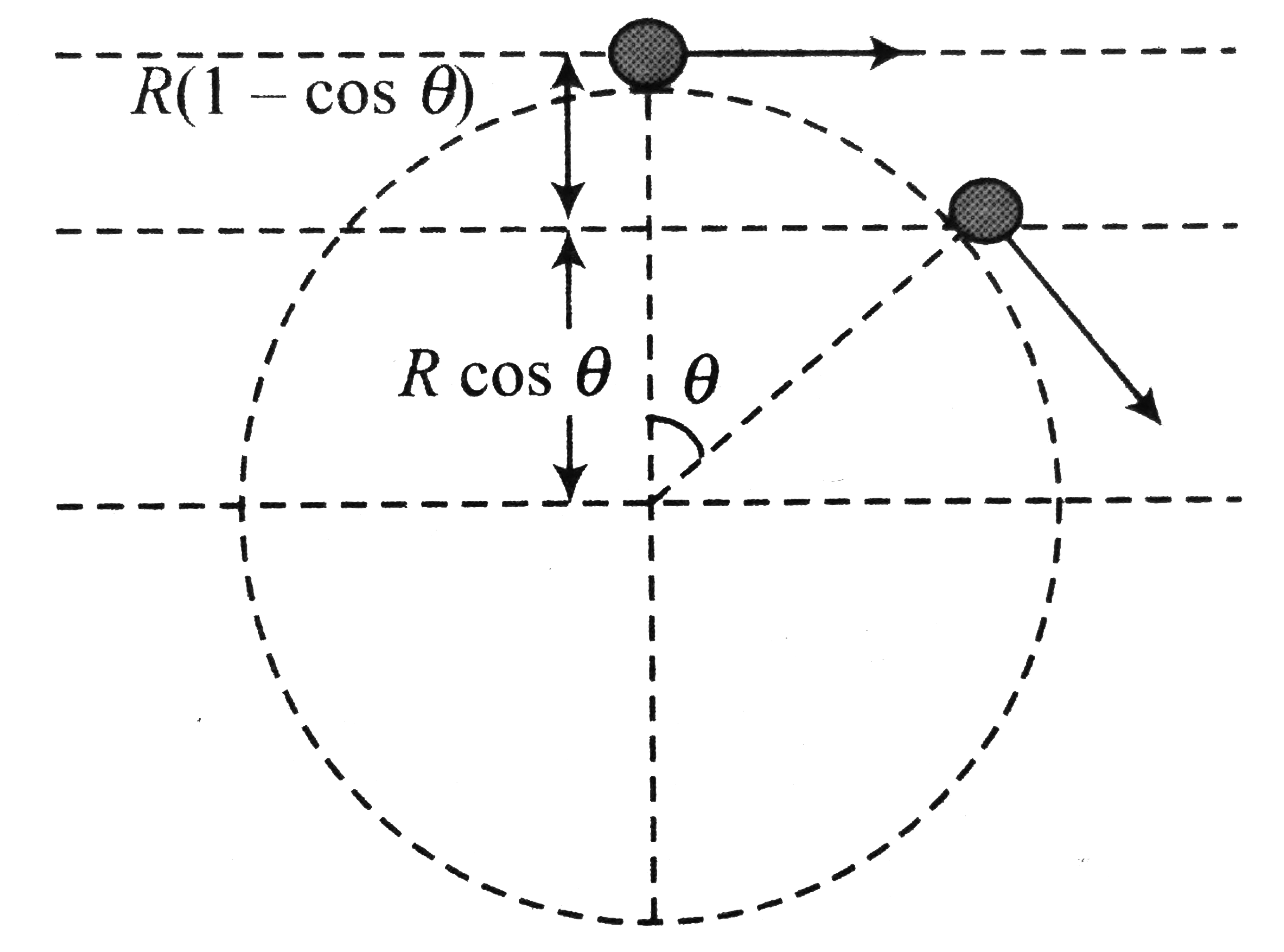
Again `(1/2)mv_2^2-(1/2)mv_1^2=mgR(1-costheta)`
`impliesv_2^2=v_1^2+2gR(1-costheta)` (ii)
From equation (i) and (ii),
`Rgcostheta=((Rg)/(4))=2gR(1-costheta)`
`implies cos theta=(1/4+2-2cos theta)`

`implies3costheta(9/4)`
`implies theta=cos^-1(3/4)`
Promotional Banner

Topper's Solved these Questions

  • WORK, POWER & ENERGY

    CENGAGE PHYSICS|Exercise Solved Examples|15 Videos
  • WORK, POWER & ENERGY

    CENGAGE PHYSICS|Exercise Exercise 8.1|25 Videos
  • VECTORS

    CENGAGE PHYSICS|Exercise Exercise Multiple Correct|5 Videos

Similar Questions

Explore conceptually related problems

A particle of mass m is kept on the top of a smooth sphere of radius LR. It is given a sharp impulse whichimparts it a horizontal speed v. a. find thenormal force between the sphere and the particle just after the impulse. B. What should be the minimum value of v for which the particle does not slip on the sphere? c. Assuming the velocity v to be half the minimum calculated in part, d. find teh angle made by the radius through the particle with the vertical when it leaves the sphere.

A particle of mass 1 kg is kept on the surface of a uniform sphere of mass 20 kg and radius 1.0 m . Find the work to be done against the gravitational force between them to take the particle away from the sphere.

A particle rests on the top of a smooth hemisphere of radius r . It is imparted a horizontal velocity of sqrt(etagr) . Find the angle made by the radius vector joining the particle with the vertical at the instant the particle losses contact with the sphere.

Consider a case of fixed smooth sphere of radius R . A block of mass m is placed at the most poit of the sphere . A sharp impulse is applied on the block to impart it a speed v . What is the normal reaction between block and the sphere just after the impulse is applied ?

A particle of mass m is moving with a uniform velocity v_(1) . It is given an impulse such that its velocity becomes v_(2) . The impulse is equal to

A particle of mass m is kept on a fixed , smooth sphere of radius R at a position, where the rdius thrugh the particle makes an angle of 30^0 with the vertical. The particle is releases from this positon. a. What is the force exerted by the sphere on teh particle just after the release? b. Find the distance travelled by the particle before it leaves contact with the sphere.

A particle of mass m starts to slide down from the top of the fixed smooth sphere. What is the tangential acceleration when it break off the sphere ?

A heavy particle of mass m is in motion on a smooth surface of hemisphere of radius R and there is no friction. At the initial instant the particle is at the topmost point A and has an initial velocity v_(0) At what point will the particle leave the surface of the hemisphere ? Also determine the value of v_(0) for which the particle will leave the sphere at the initial instant.