Home
Class 11
PHYSICS
A block is tied to one end of a light st...

A block is tied to one end of a light string of length 1 whose other end is fixed to a rigid support. The block is given a speed of `sqrt(7gl//2)` from the lowermost position. Find the height and speed at which the block leaves the circle. Also find the maximum height to which it rises finally.

Text Solution

Verified by Experts
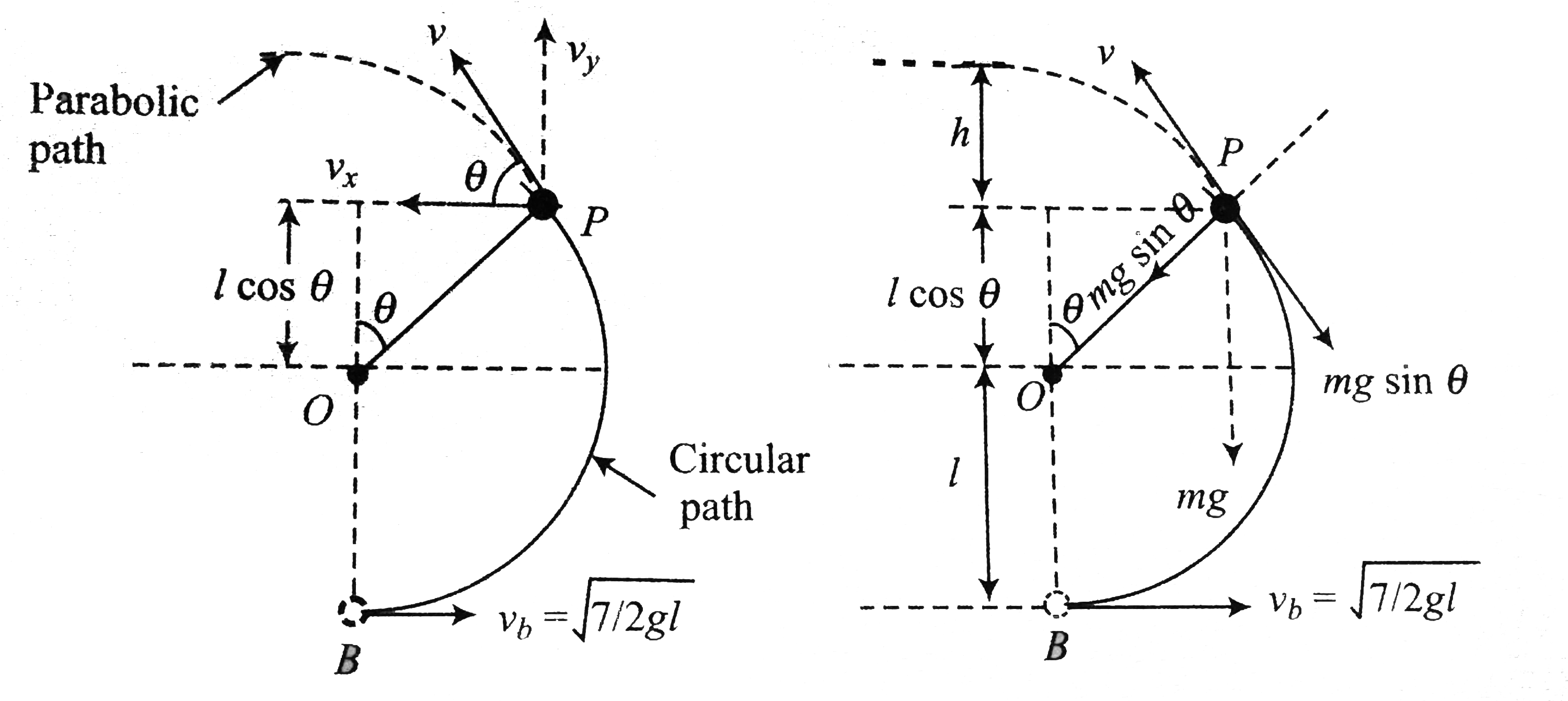
As velocity of the block `v_bsqrt(2gl)ltv_bltsqrt(5gl)`.
The block will leave the circle at some point P, where the radius OP makes an angle `theta` with the upward vertical.

From A to P,
`DeltaK+DeltaU=0` or `DeltaK=-DeltaU`
Loss in KE=Gain in GPE
`1/2mv_b^2-1/2mv^2=mg(l+lcostheta)` (i)
From the force diagram: `T+mgcos=(mv^2)/(l)`
As the block leaves the circle at P, `T=0`.
`mgcostheta=(mv^2)/(l)` (ii)
Putting the value of `v^2` from (ii) in (i) ,
`1/2mv_b^2-1/2m(glcostheta)=mgl(1+costheta)`
`implies1/2m(7/2gl)=(mgl)/(2)(2+3costheta)`
`impliescostheta=1/2impliestheta=60^@`
Hence, the block leaves the circle and string slack at a height `h=l+lcos60^@=1.5l` from the bottom. The velocity at that moment v is `v=sqrt(l_gcostheta)=sqrt(l_g/2)`
After the string becomes slack, the block moves as a projectile in parabolic path. Now, further height attained
`=(v^2sin^2theta)/(2g)=(lg)/(4g)(3/4)=(3/16)l`
Thus, total height attained from the bottom is
`3/2l+3/16l=27/16l`
Promotional Banner

Topper's Solved these Questions

  • WORK, POWER & ENERGY

    CENGAGE PHYSICS|Exercise Solved Examples|15 Videos
  • WORK, POWER & ENERGY

    CENGAGE PHYSICS|Exercise Exercise 8.1|25 Videos
  • VECTORS

    CENGAGE PHYSICS|Exercise Exercise Multiple Correct|5 Videos

Similar Questions

Explore conceptually related problems

A block of mass 1kg is tied to a string of length 1m the other end of which is fixed The block is moved on a smooth horizontal table with constant speed 10ms^(-1) . Find the tension in the string

A small block of mass m is attached to free end of a spring of force cosntant k , whose other end is fixed to a rigid support . The block is lying on a frictionless horizontal plane and it starts movi0ng away from fixed end of the spring a\t t= 0 with intial velocity u When the speed of the block is 0.6mu it collides with a fixed heavy mass elastically. After the collision with a fixed heavy mass elastically . Aftere the collision the time at which the block passes through its equilibrium position for the first time is close to

A stone is tied to one end of a light inexensible string of length l and made to roate on a vertical circle keeping other end of the spring at the centre. If speed of stone at the highest point is v(v gt sqrt(gl)) then its speed at the lowest point is

A block of mass m is attached to one end of a mass less spring of spring constant k. the other end of spring is fixed to a wall the block can move on a horizontal rough surface. The coefficient of friction between the block and the surface is mu then the compession of the spring for which maximum extension of the spring becomes half of maximum compression is .

One end of a rope is fixed at a point on the ceiling the other end is held close to the first end so that the rope is folded. The second end is released from this position. Find the speed at which the fold at F is descending at the instant the free end of the rope is going down at speed V.

A block A of mass m_(1) is placed on a horizontal frictionless table. It is connected to one end of a light spring of force constant k whose other end is fixed to a wall. A small block B of mass m_(2) is placed on block A. The coefficient of static friction between the blocks is mu . The system is displaced slightly from its equilibrium position and released. What is the maximum amplitude of the resulting simple harmonic motion of the system so that the upper block does not slip over the lower block ?

A block of mass 1 kg is attached to one end of a spring of force constant k = 20 N/m. The other end of the spring is attached to a fixed rigid support. This spring block system is made to oscillate on a rough horizontal surface (mu = 0.04) . The initial displacement of the block from the equilibrium position is a = 30 cm. How many times the block passes from the mean position before coming to rest ? (g = 10 m//s^(2))

A block of mass m, lying on a smooth horizontal surface, is attached to a spring (of negligible mass) of spring constant k. The other end of the spring is fixed, as shown in the figure. The block is initally at rest in its equilibrium position. If now the block is pulled withe a constant force F, the maximum speed of the block is :

A 2 kg block A is attached to one end of a light string that passes over an an ideal pulley and a 1 kg sleeve B slides down the other part of the string with an acceleration of 5m//s^(2) with respect to the string. Find the acceleration of the block, acceleration of sleeve and tension in the steing. [g=10m//s^(2)]

