Home
Class 11
PHYSICS
An insect of mass m moves up along a han...

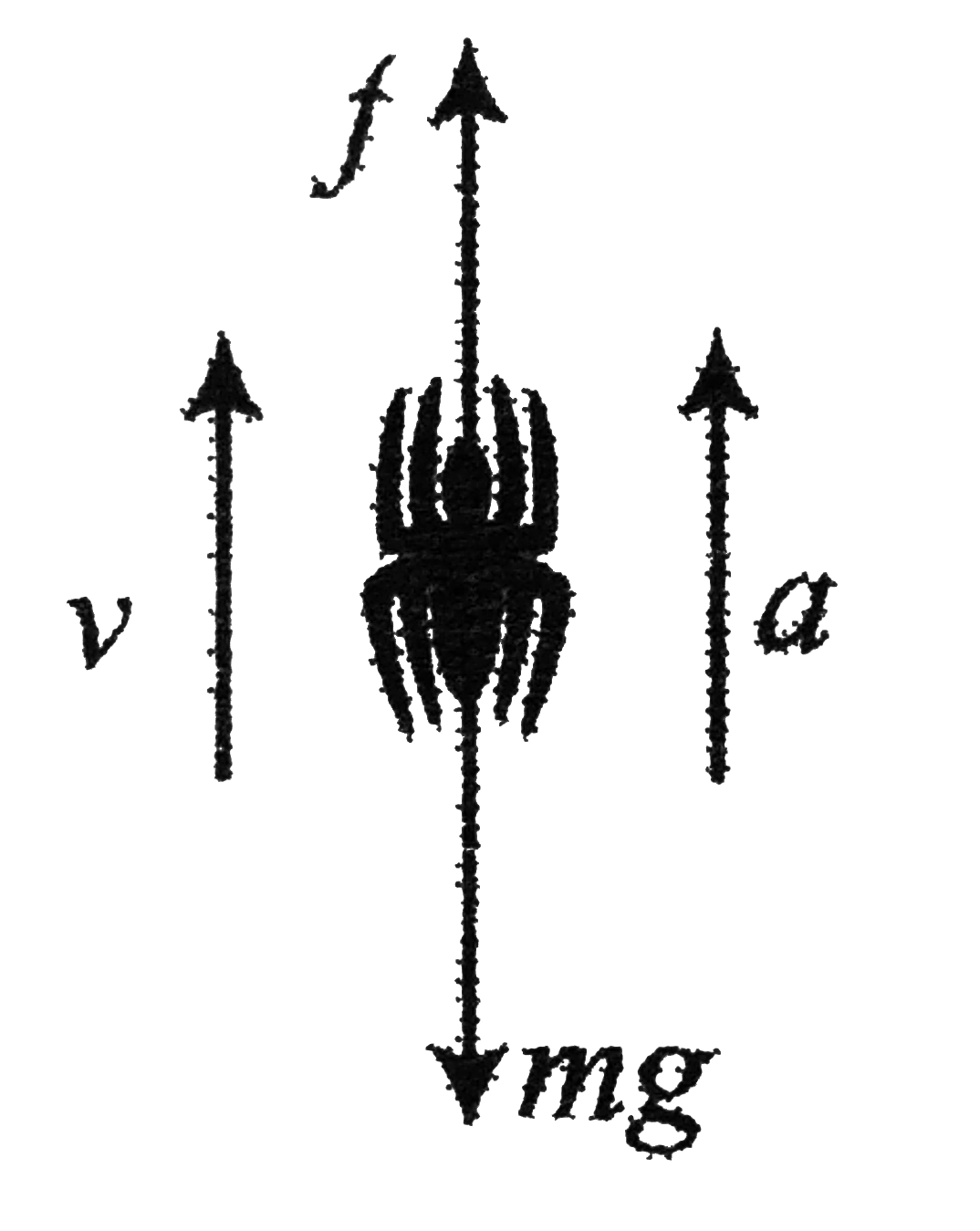
An insect of mass m moves up along a hanging stationary thread, with acceleration a. Find the power delivered by the gravity after a time t.

Text Solution

Verified by Experts

Power delivered by gravity at any instant is
`P_g=mvecg*vecv`
where v is the instantaneous velocity of the insect.
Since the insect moves with an upward acceleration a, `v=at`.
Substituting `v=at` in the above expression, we have
P_g=-mgat`
Promotional Banner

Topper's Solved these Questions

  • WORK, POWER & ENERGY

    CENGAGE PHYSICS|Exercise Solved Examples|15 Videos
  • WORK, POWER & ENERGY

    CENGAGE PHYSICS|Exercise Exercise 8.1|25 Videos
  • VECTORS

    CENGAGE PHYSICS|Exercise Exercise Multiple Correct|5 Videos

Similar Questions

Explore conceptually related problems

A body is thrown with a velocity v_0 at an angle theta_0 with horizontal. Find the (a) instantaneous power delivered by gravity after a time t measured from the instant of projection and (b) average power delivered by gravity during the time t.

A particle of mass 2kg starts to move at position x=0 and time t=0 under the action of force F=(10+4x)N along the x- axis on a frictionless horizontal track . Find the power delivered by the force in watts at the instant the particle has moved by distance 5m .

A block of mas 2.0 kg is pulled up on a smooth incline of angle 30^0 with the horizontal. If the block moves wth an acceleration of 1.0 m/s^2 , find the power delivered by the pulling force at a time 4.0 s after the motion starts. What is the average power delivered during the 4.0 s after the motion starts?

A block of mass 3 kg is pulled up on a smooth incline of angle 37^@ with the horizontal. If the block moves with an acceleration 2(m)//(s^2) , find the power delivered by the pulling force at time 5 s after the motion starts. What is the average power delivered during the 5.0 s after the motion starts?

A body is initially at rest. It undergoes one dimensional motion with constant acceleration. The power delivered to it at time t is proportional to

A paricle of mass m moves along a circle of radius R with a normal acceleration varying with time as w_n=at^2 , where a is a constant. Find the time dependence of the power developed by all the forces acting on the particle, and the mean value of this power averaged over the first t seconds after the beginning of motion.

A horizontal constant force F pulls a block of mass m placed on a horizontal surface. If the coefficient of kinetic friction between the block and ground is mu , find the power delivered by the external agent after a time agent after a time t measured from the beginning of action of the force.

A particle of mass m moves along a circle of radius R with a normal acceleration varying with time as a_(N)=kt^(2) where k is a constant. Find the time dependence of power developed by all the forces acting on the particle and the mean value of this power averaged over the first t seconds after the beginning of the motion.
