Home
Class 11
PHYSICS
A block of mass m is connected rigidly w...

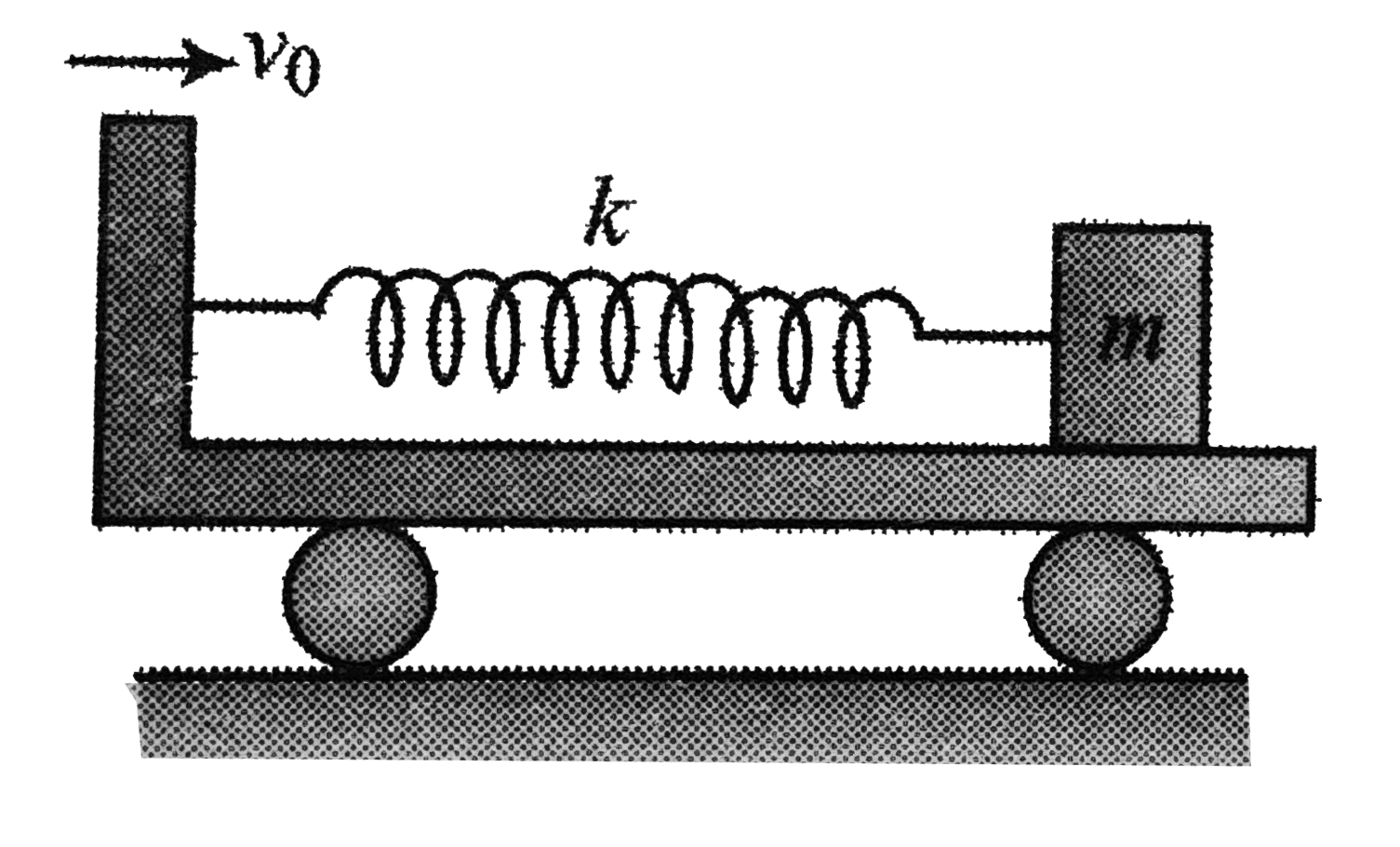
A block of mass m is connected rigidly with a smooth wedge (plank) by a light spring of stiffness k. If the wedge is moved with constant velocity `v_0`, find the work done by the external agent till the maximum compression of the spring.

Text Solution

Verified by Experts
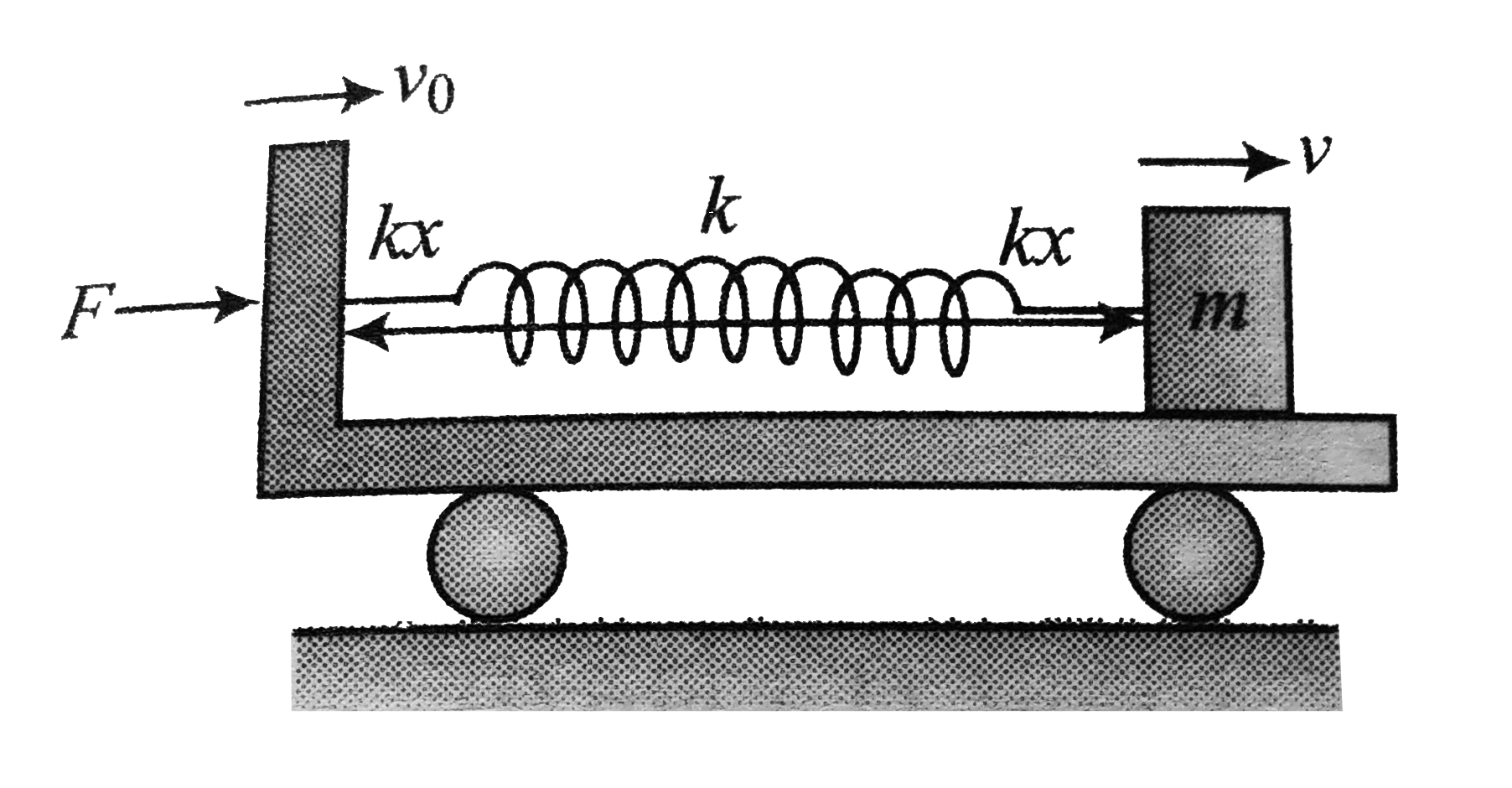
Let us take wedge+spring+block, as a system. The forces responsible for performing work are spring force `kx(larr)` and the external force `F(rarr)`.

Applying `W-E` theorem for block+spring+plank relative to ground:
We have `W_(ext)+W_(sp)=DeltaK`,
Where `W_(sp)` the total work done by the spring on wedge and block `=-1/2kx^2` and `DeltaK` is the change in KE of the block (because the plank does not change its kinetic energy).
Then, `W_(ext)=1/2kx^2+DeltaK`
As the block was initially stationary, it will acquire a velocity `v_0` equal to that of the plank at the time of maximum compression of the spring. The change in kinetic energy of the block relative to ground is
`DeltaK=1/2mv_0^2`
Substituting `DeltaK` in the above equation, we have
`W_(ext)=1/2kx^2+1/2mv_0^2`
Applying `W-E` theorem for block+spring+plank relative to the plank:
Now we need to find x. For this, let us climb onto the plank. Since the plank moves with constant velocity, there is no pseudo force acting on the block. Then the net work done on the system (block+plank) is due to the spring, can be given as
`W_(sp)=-1/2kx^2`
As the relative velocity between the observer (plank) and block decrease from `v_0` to zero at the time of maximum compression of the spring, the change in kinetic energy of the block is
`DeltaK=-1/2mv_0^2`. Applying work-energy theorem, we have
`W=DeltaK`, where `W=-1/2kx^2` and `DeltaK=-1/2mv_0^2`
This gives `1/2kx^2=1/2mv_0^2`
Substituting `1/2kx^2=1/2mv_0^2` from Eq. (ii) and Eq. (i), we have
`W_(ext)=mv_0^2`
Promotional Banner

Topper's Solved these Questions

  • WORK, POWER & ENERGY

    CENGAGE PHYSICS|Exercise Exercise 8.1|25 Videos
  • WORK, POWER & ENERGY

    CENGAGE PHYSICS|Exercise Exercise 8.2|25 Videos
  • WORK, POWER & ENERGY

    CENGAGE PHYSICS|Exercise Archives (integer)|4 Videos
  • VECTORS

    CENGAGE PHYSICS|Exercise Exercise Multiple Correct|5 Videos

Similar Questions

Explore conceptually related problems

A block of mass m is connected with a rigid wall by light spring of stiffness k . Initially the spring is relaxed. If the block is pushed with a velocity v_0 , it oscillates back and forth and stops. Assuming mu as the coefficient of kinetic friction between block and ground, find the work done by friction till the block stops.

A block of mass m is slowly lowered from a point where it just touches a vertical fixed spring of stiffness k, till it remains stationary after the applied force is withdrawn. Find the work done by the external agent(a) in compressing the spring by a distance x and (b) bringing the block to its stable equilibrium position.

A block of mass m is placed at the bottom of a massless smooth wedge which if placed on a horizontal surface. When we push the wedge with a constant force, the block moves up the wedge. Find the work done by the external agent when the block has a speed v and is reaches the top of the wedge.

A block of mass 'm' is attached to a spring in natural length of spring constant 'k' . The other end A of the spring is moved with a constat velocity v away from the block . Find the maximum extension in the spring.

A sphere of mass m and radius R rolls without sliding on a horizontal surface. It collides with a light spring of stiffness K with a kinetic energy E . If the surface ( AB ) under the spring is smooth, find the maximum compression of the spring.

A block of mass m is suddenly released from the top of a spring of stiffness constant k. a. Find the acceleration of block just after release. b. What is the compression in the spring at equilibrium. c. What is the maximum compression in the spring. d. Find the acceleration of block at maximum compression in the spring.

In an ideal pulley particle system, mass m_2 is connected with a vertical spring of stiffness k . If mass m_2 is released from rest, when the spring is underformed, find the maximum compression of the spring.

In the figure shown the spring is compressed by 'x_(0)' and released . Two block 'A' and 'B' of masses 'm' and '2m' respectively are attached at the ends of the spring. Blocks are kept on a smooth horizontal surface and released. Find the work done by the spring on 'A' by the time compression of the spring reduced to (x_(0))/(2) .

Two blocks A and B of masses m and 2m are connected by a massless spring of natural length L and spring constant k . The blocks are intially resting on a smooth horizontal floor with the spring at its natural length , as shown . A third identical block C of mass m moves on the floor with a speed v_(0) along the line joining A and B and collides elastically with A . FInd (a) the velocity of c.m. of system (block A + B + spri ng) and (b) the minimum compression of spring.

A block of mass m moving with a velocity v_(0) on a smooth horizontal floor collides with a light spring of stiffness k that is rigidly fixed horizontally with a vertical wall. If the maximum force imparted by the spring on the block is F, then: (A) F prop sqrt(m) " " (B) F prop sqrt(k) (C) F prop v_(0) " " (D) None of these

