Home
Class 11
PHYSICS
A particle is suspended vertically from ...

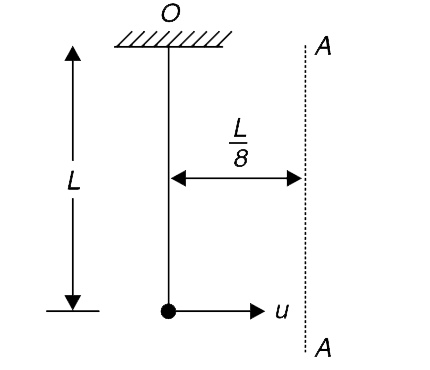
A particle is suspended vertically from a point O by an inextensible mass less string of length L. A vertical line AB is at a distance of `L/8` from O as shown in figure. The particle is given a horizontal velocity u. At some point, its motion ceases to be circular and eventually the object passes through the line AB. At the instant of crossing AB, its velocity is horizontal. Find u.

Text Solution

Verified by Experts
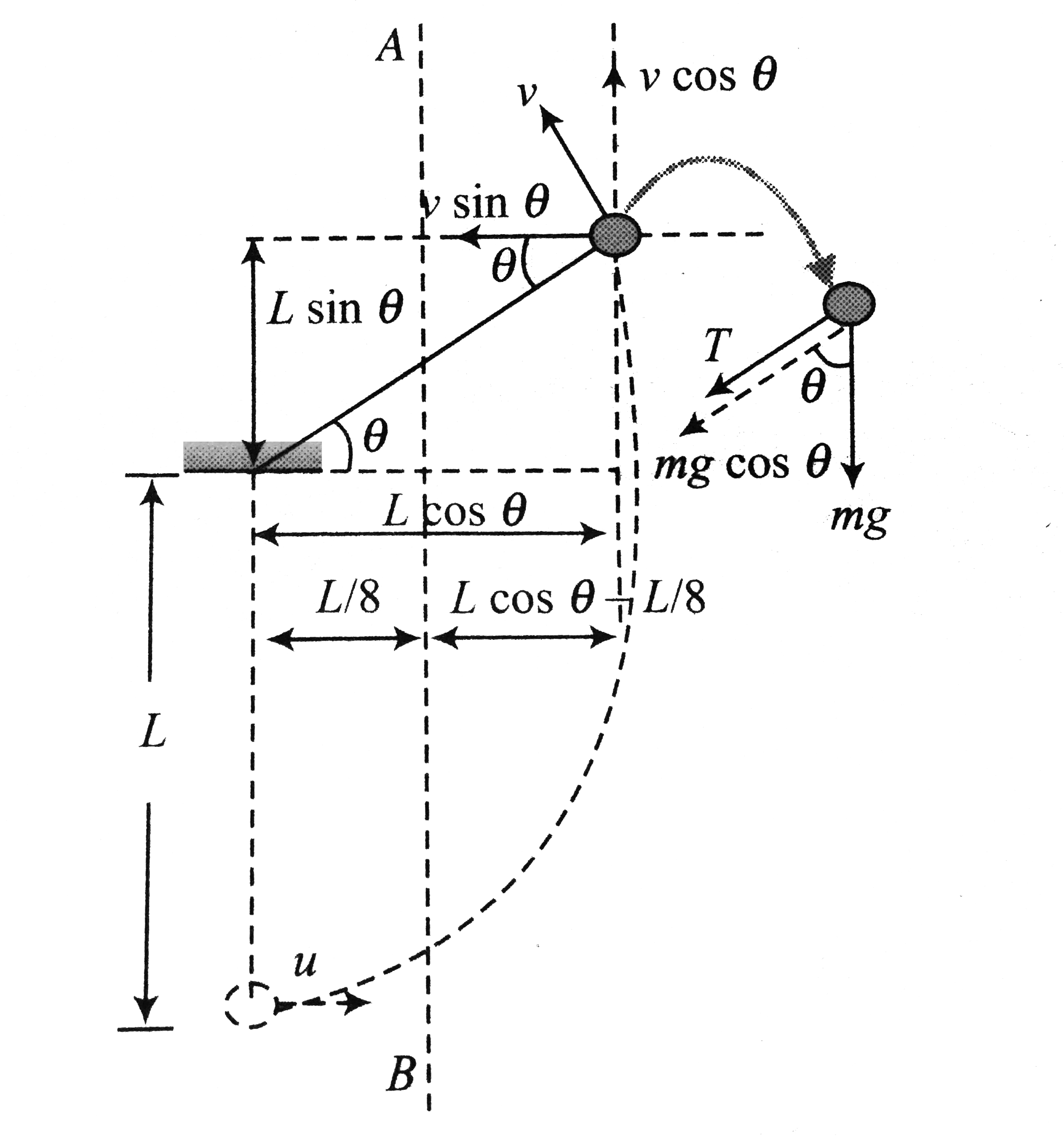
It is clear from the statement of the problem that the particle has the circular path before it crosses the line AB second time, during its upward motion.

Let us assume that the particle have the circular path at P and v is the velocity of the particle at P. Then, conservation of mechanical energy at P and at the lowest point yields:
`1/2u^2=1/2mv^2+mgL(1+sintheta)`
`mu^2=2gL(1+sintheta)+mv^2` (i)
At point `T+mg sin theta=(mv^2)/(L)`.
If T becomes zero:
`v^2=gLsintheta` (ii)
After having the circular path, the particle moves along a parabolic trajectory as a projectile.
As it is given that velocity of the particle when it crosses AB is horizontal, it is clear that, when it is crossing AB, it is passing through its highest point in the parabolic path.
Hence, half of the range of this projectile path `=Lcostheta-L/8`
As projection angle of the particle with respect to horizontal time at
`P=(90^@-theta)`, therefore, maximum range `=(v^2sin2(90^@-theta))/(8)`
Hence, `1/2xx(v^2sin2(90^@-theta))/(g)=Lcostheta-L/8` (iii)
From Eq. (ii) and (iii): `costheta=1/2impliestheta=60^@`
Using this information and (I) and (ii),
`u=sqrt([(4+3sqrt3)/(2)gL])`
Promotional Banner

Topper's Solved these Questions

  • WORK, POWER & ENERGY

    CENGAGE PHYSICS|Exercise Exercise 8.1|25 Videos
  • WORK, POWER & ENERGY

    CENGAGE PHYSICS|Exercise Exercise 8.2|25 Videos
  • WORK, POWER & ENERGY

    CENGAGE PHYSICS|Exercise Archives (integer)|4 Videos
  • VECTORS

    CENGAGE PHYSICS|Exercise Exercise Multiple Correct|5 Videos

Similar Questions

Explore conceptually related problems

A particle of mass m is suspended from a ceiling through a string of length L. The particle moves in a horizontal circle of radius r such that r =L/(sqrt2) . The speed of particle will be :

As shown in figure, a particle of mass m is performing vertical circular motion. The velocity of the particle is increased, then at which point will the string break?

A particle of mass m is suspended from a fixed O by a string of length L. At t = 0 , it is displaced from its equilibrium position and released. The graph which shows the variation of the tension T in the string with time t is :

A particle of mass m is suspended from point O and undergoes circular motion in horizontal plane as conical pendulum as shown in figure.

A particle suspended from a fixed point, by a light inextensible thread of length L is projected horizontally from its lowest position with velocity 7gL . The thread will slack after swinging through an angle , such that  equal

A particle of mass m is attached to one end of a light inextensible string and the other end of the string is fixed in vertical plane as shown. Particle is given a horizontal velocity u = sqrt((5)/(2)gl) The tension in the string at an instant when acceleration of the particle is horizontal and sqrt(3)g is

A particle of mass m is suspended from a fixed point O by a string length l.At t=0, it is displaced from its equilibrium position and released.If T is the tension in the string with time t, then the correct graph is

A particle of mass m is attached to one end of a light inextensible string and the other end of the string is fixed in vertical plane as shown. Particle is given a horizontal velocity u = sqrt((5)/(2)gl) The maximum angle made by the string with downward vertical is

