Home
Class 11
PHYSICS
Find how much mass m will rise if 4m fal...

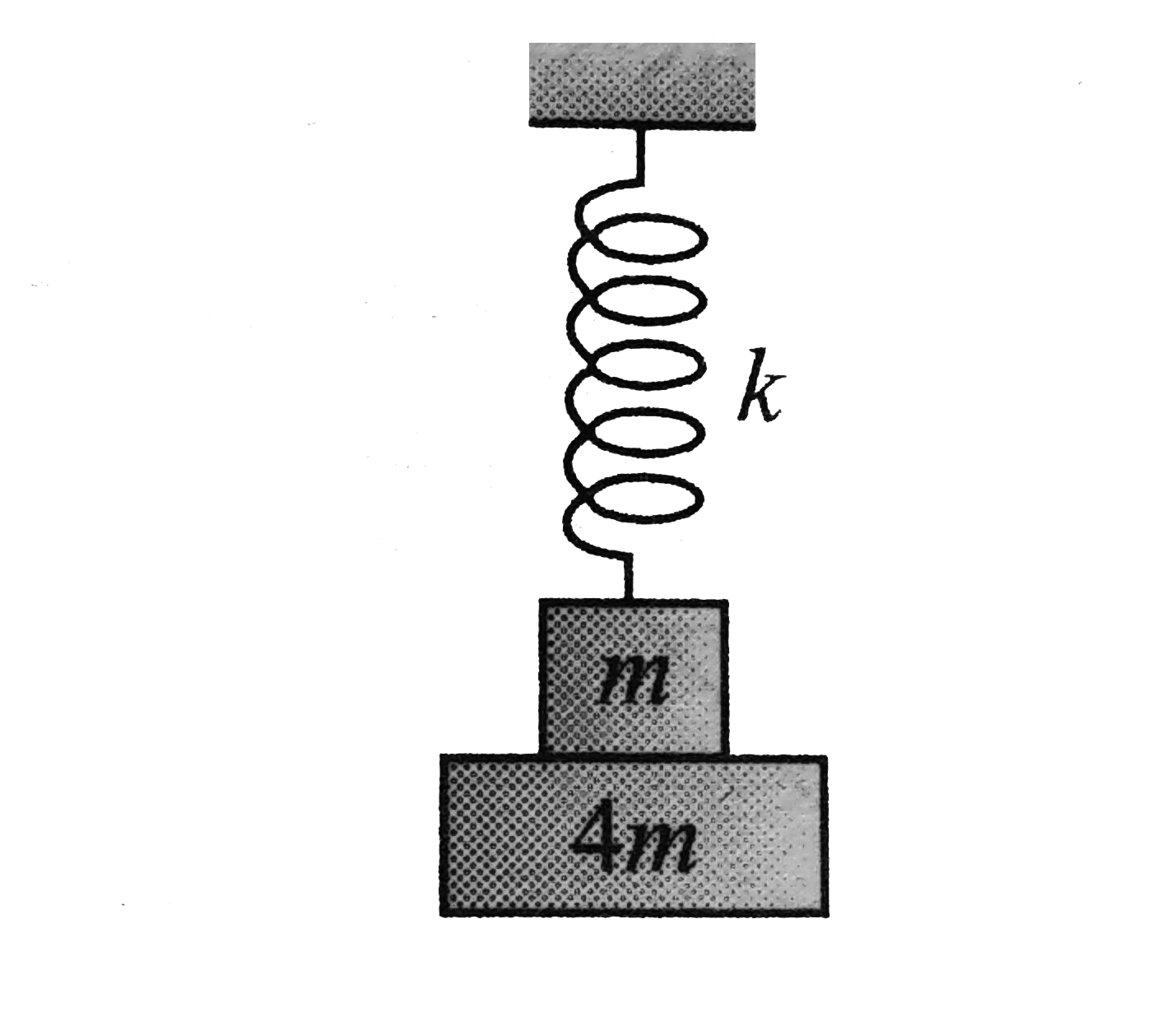
Find how much mass `m` will rise if `4m` falls away. Blocks are at rest and in equilibrium.

Text Solution

Verified by Experts

The correct Answer is:

`(8mg)/(k)`

Applying WET on block of mass m
`W_g+W_(sp)=K_f-K_i`
Let finally displacement of block from equilibrium is x.
`-mg((5mg)/(k)+x)+1/2k((25m^2g^2)/(k^2))-1/2kx^2=0`
`1/2kx^2+mgx-(15m^2g^2)/(2k)=0`
`x=(3mg)/(k)`
Displacement from initial is `(5mg)/(k)+(3mg)/(k)=(8mg)/(k)`
Promotional Banner

Topper's Solved these Questions

  • WORK, POWER & ENERGY

    CENGAGE PHYSICS|Exercise Single Correct|100 Videos
  • WORK, POWER & ENERGY

    CENGAGE PHYSICS|Exercise Multiple Correct|25 Videos
  • WORK, POWER & ENERGY

    CENGAGE PHYSICS|Exercise Exercise 8.5|15 Videos
  • VECTORS

    CENGAGE PHYSICS|Exercise Exercise Multiple Correct|5 Videos

Similar Questions

Explore conceptually related problems

Find how much m will rise if 4m falls away. Block are at rest and in equilibrium.

A block of mass M is tied to a spring of force constant K and the system is suspended vertically. Consider three situations shown in fig. (a), (b) and (c). (a) In fig. (a), an insect of mass M is clinging to the block and the system is in equilibrium. The insect leaves the block and falls. Find the amplitude of resulting oscillations. (b) In fig. (b), an insect of mass M is resting on the top of the block and the system is in equilibrium. The insect suddenly jumps up with a speed u=gsqrt((M)/(K)) and the block starts oscillating. Find amplitude of oscillation assuming that the insect never falls back on the block (c) In fig. (c), an insect of mass M falls on the block this in equilibrium. The insect hits the block with velocity u=gsqrt((M)/(K)) while moving downwards sticks to the block. Find the amplitude of oscillation.

Two blocks A and B are connected by as string as shown in figure. Friction coefficient of the incline plane and block is 0.5 . The mass of the block A is 5 kg . If minimum & maximum values of masses of the block B for which the block remains in equilibrium are m_(1) & m_(2) then find value of (m_(2) - m_(1)) .

A block of mass m and relative density y( lt 1) si attached to an ideal spring of constant K. The system is initially at rest and at equilibrium. If the container acceleration upwards with a_(0) , find the increase in the elongation of the spring in equilibrium.

A block of mass m is suspened through a spring of spring constant k and is in equlibrium. A sharp blow gives the block an initial downward velocity v. How far below the equilibrium psitin, the block comes to an instantaneous rest?

Three blocks A,B, and C are suspended as shown in fig. Mass of each of blocks A and B is m. If the system is in equilibrium, and mass of C is M then

A bob of mass 2m hanges by a string attached to the block of mass m of a spring blocks syetem. The whole arrangement is in a state of equilibrium. The bob of mass 2m is pulled down slowely by a distance x_(0) and released.

A block of mass 'm' is connected to another block of mass 'M' by a spring (massless) of spring constant 'k' The blocks are kept on a smooth horizontal plane. Initially the blocks are at rest and the spring is unstretched Then a constant force 'F' starts acting on the block of mass 'M' to pull it. Find the force on the block of mass 'm' :

A block of mass m is connected to another block of mass M by a spring (massless) of spring constant k. The block are kept on a smooth horizontal plane. Initially the blocks are at rest and the spring is unstretched. Then a constant force F starts acting on the block of mass M to pull it. Find the force of the block of mass M.

CENGAGE PHYSICS-WORK, POWER & ENERGY-Subjective
  1. A small block of mass m=1kg is attached with one end of the spring of ...

    Text Solution

    |

  2. Two identical beads, each of m=100g, are connected by an inextensible ...

    Text Solution

    |

  3. AB is a quarter of smooth circular track of radius R=6m. A particle P ...

    Text Solution

    |

  4. In an ideal pulley particle system, mass m2 is connected with a vertic...

    Text Solution

    |

  5. Given k1=1500Nm^-1, k2=500Nm^-1, m1=2kg, m2=1kg. Find: a. potenti...

    Text Solution

    |

  6. A block of mass m is dropped onto a spring of constant k from a height...

    Text Solution

    |

  7. A particle of mass m attached with a massless spring natural length l ...

    Text Solution

    |

  8. Two blocks having masses 8kg and 16kg are connected to the two ends of...

    Text Solution

    |

  9. a. A 2-kg situated on a smooth fixed incline is connected to a spring ...

    Text Solution

    |

  10. A ring of mass m=1kg can slide over a smooth vertical rod. A light str...

    Text Solution

    |

  11. Find how much mass m will rise if 4m falls away. Blocks are at rest an...

    Text Solution

    |

  12. A block of mass m is released from rest onto a spring. A having stiffn...

    Text Solution

    |

  13. In figure, the light spring is of force constant k and is on a smooth ...

    Text Solution

    |

  14. A vehicle of mass m starts moving along a horizontal circle of radius ...

    Text Solution

    |

  15. A block A of mass m is held at rest on a smooth horizontal floor. A li...

    Text Solution

    |

  16. A constant force F pushes the block m till the wedge M starts sliding....

    Text Solution

    |

  17. Two blocks are connected by a massless string that passes over a frict...

    Text Solution

    |

  18. A bob of mass m is projected with a horizontal velocity v=sqrt((gl)/(...

    Text Solution

    |

  19. A block is projected with a speed v0 such that it strikes the point of...

    Text Solution

    |

  20. A small ball is suspended from point O by a thread of length l. A nail...

    Text Solution

    |
