Home
Class 11
PHYSICS
A constant force F pushes the block m ti...

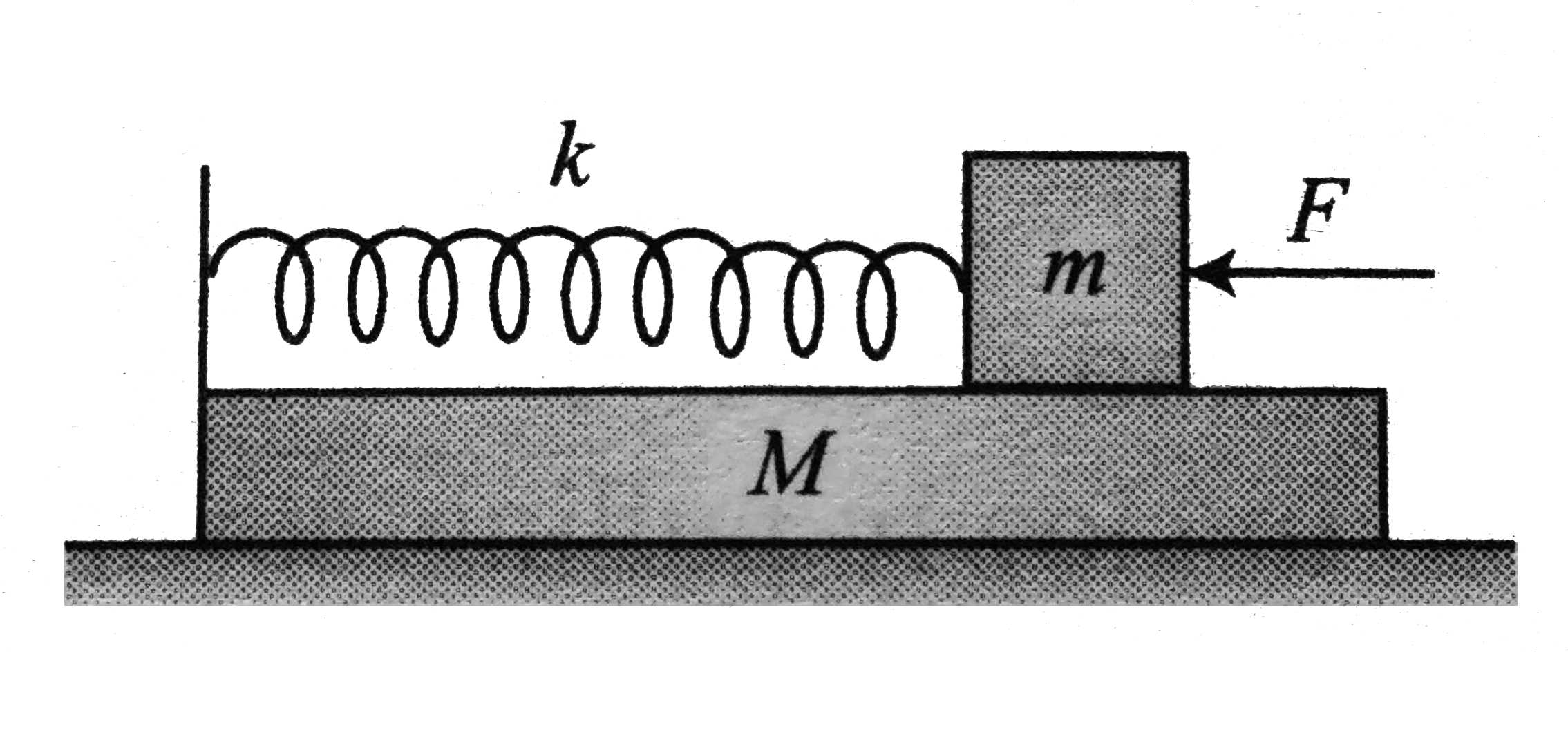
A constant force F pushes the block `m` till the wedge M starts sliding. If the stiffness of the light spring connecting M and m is K, coefficient of friction between block and wedge is `mu_1` and between the wedge and ground is `mu_2`, find the value of the force F

Text Solution

Verified by Experts

The correct Answer is:
`(mu_2^2(M+m)^2g^2-mu_1^2m^2g^2)/(2k)`

Let `x_0` is the compression required so that wedge M just starts moving.

`mu_1mg+kx_0=mu_2(M+m)g`
`impliesx_0=(mu_2(M+m)g-mu_1mg)/(k)`
Now for block: `W_(t otal)=Deltak=k_2-k_1`
`impliesFx_0-mu_1mgx_0-1/2kx_0^2=0`
`impliesW_F=Fx_0=mu_1mgx_0+(kx_0^2)/(2)`
`impliesW_F=(mu_1mg+(kx_0)/(2))x_0=(mu_2^2(M+m)^2g^2-mu_1^2m^2g^2)/(2k)`
Promotional Banner

Topper's Solved these Questions

  • WORK, POWER & ENERGY

    CENGAGE PHYSICS|Exercise Single Correct|100 Videos
  • WORK, POWER & ENERGY

    CENGAGE PHYSICS|Exercise Multiple Correct|25 Videos
  • WORK, POWER & ENERGY

    CENGAGE PHYSICS|Exercise Exercise 8.5|15 Videos
  • VECTORS

    CENGAGE PHYSICS|Exercise Exercise Multiple Correct|5 Videos

Similar Questions

Explore conceptually related problems

A block of mass m_(2) is placed on a horizontal table and another block of mass m_(1) is placed on top is it. An increasing horizontal force F = alpha t is exerted on the upper block but the lowwer block never moves as a result. If the coefficient of friction between the blocks is mu_(1) coefficient of friction between the blocks is mu_(1) and that between the lower block and the table is mu_(2), then what is the maximum possible value of mu_(1)//mu_(2) ?

Calculate angle of friction between wedge and block system is at rest M coefficient of friction between wedge and block.

Block A of mass m and block B of mass 2m are placed on a fixed triangular wedge by means of a light and inextensible string and a frictionless pulley as shown in fig . The wedge is inclined at 45^(@) to the horizontal on both sides . The coefficient of friction between the block A and the wedge is 2//3 and that between the block B and the wedge is 1//3 .If the system of A and B is released from rest then find . a. the acceleration of A b. tension in the string c.the magnitude and direction of the frictional force acting on A

In the figure shown coefficient of friction between block A and ground is 0.4 and that between wedge and block B is zero. Wedge is fixed. Find tension is string and acceleration of block A if F = 28 N.

a Block of mass m is placed on a wedge of mass M there is no friction between the block and the wedge .The minmum coefficient of friction between the wedge and the gound so that wedge does not move is,

In figure, the pulley shown is smooth. The spring and the string are light. Block B slides down from the top along the fixed rough wedge of inclination theta . Assuming that the block reaches the end of the wedge, find the speed of the block at the end. Take the coefficient of friction between the block and the wedge to be mu and that the spring was relaxed when the block was released from the top of the wedge.

In the figure shown the pulley is smooth . The spring and the string are light. The block 'B' slides down from the top along the fixed rought wedge of inclination theta . Assuming that the block reaches the end of the wedge. Find the speed of the block at the end. Take the coefficient of friction between the block and the wedge to be mu and the spring was relaxed when the block was relased from the top of the wedge.

CENGAGE PHYSICS-WORK, POWER & ENERGY-Subjective
  1. A small block of mass m=1kg is attached with one end of the spring of ...

    Text Solution

    |

  2. Two identical beads, each of m=100g, are connected by an inextensible ...

    Text Solution

    |

  3. AB is a quarter of smooth circular track of radius R=6m. A particle P ...

    Text Solution

    |

  4. In an ideal pulley particle system, mass m2 is connected with a vertic...

    Text Solution

    |

  5. Given k1=1500Nm^-1, k2=500Nm^-1, m1=2kg, m2=1kg. Find: a. potenti...

    Text Solution

    |

  6. A block of mass m is dropped onto a spring of constant k from a height...

    Text Solution

    |

  7. A particle of mass m attached with a massless spring natural length l ...

    Text Solution

    |

  8. Two blocks having masses 8kg and 16kg are connected to the two ends of...

    Text Solution

    |

  9. a. A 2-kg situated on a smooth fixed incline is connected to a spring ...

    Text Solution

    |

  10. A ring of mass m=1kg can slide over a smooth vertical rod. A light str...

    Text Solution

    |

  11. Find how much mass m will rise if 4m falls away. Blocks are at rest an...

    Text Solution

    |

  12. A block of mass m is released from rest onto a spring. A having stiffn...

    Text Solution

    |

  13. In figure, the light spring is of force constant k and is on a smooth ...

    Text Solution

    |

  14. A vehicle of mass m starts moving along a horizontal circle of radius ...

    Text Solution

    |

  15. A block A of mass m is held at rest on a smooth horizontal floor. A li...

    Text Solution

    |

  16. A constant force F pushes the block m till the wedge M starts sliding....

    Text Solution

    |

  17. Two blocks are connected by a massless string that passes over a frict...

    Text Solution

    |

  18. A bob of mass m is projected with a horizontal velocity v=sqrt((gl)/(...

    Text Solution

    |

  19. A block is projected with a speed v0 such that it strikes the point of...

    Text Solution

    |

  20. A small ball is suspended from point O by a thread of length l. A nail...

    Text Solution

    |

