Home
Class 11
PHYSICS
A block of mass m is attached with a mas...

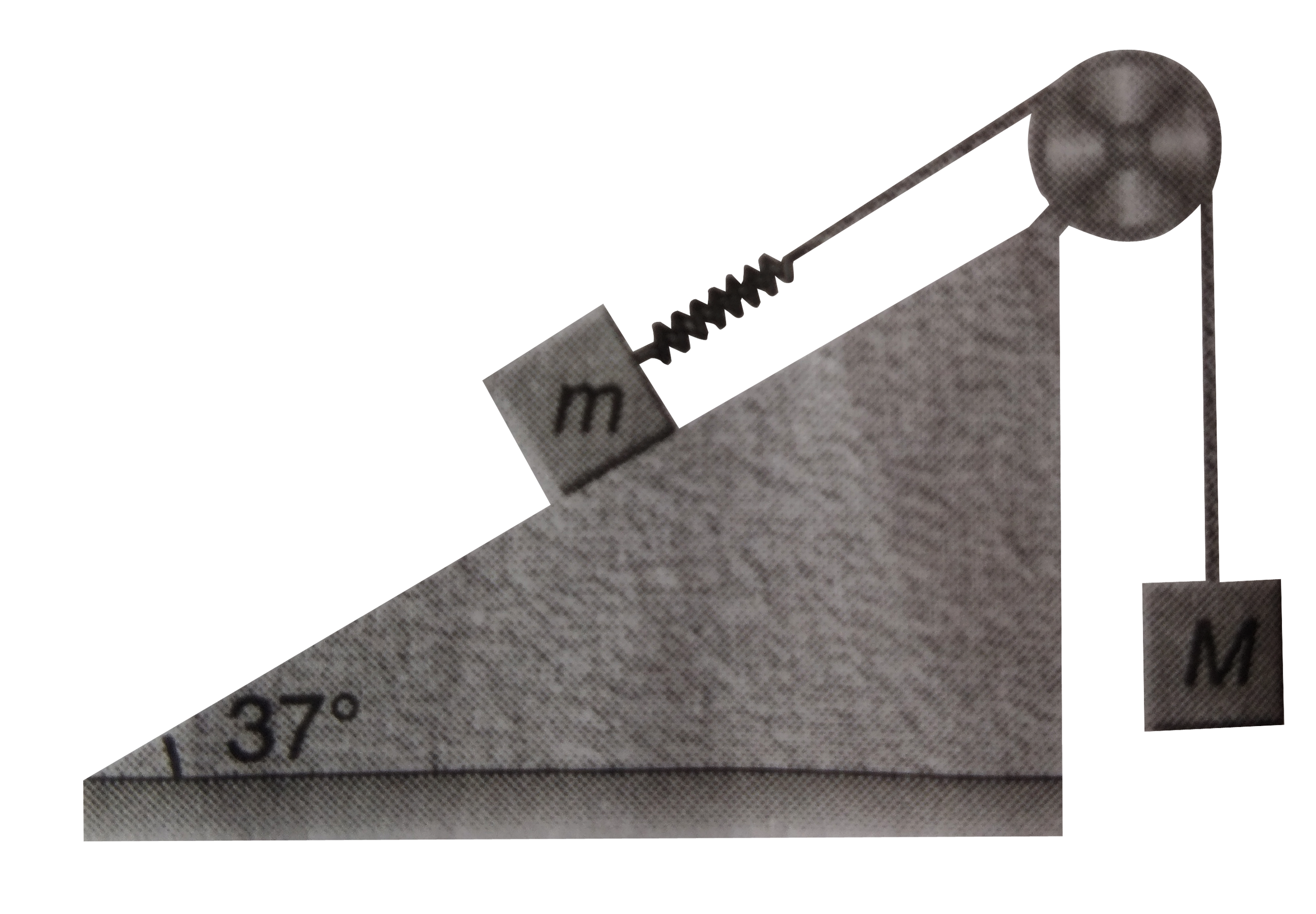
A block of mass m is attached with a massless spring of force constant K. the block is placed over a rough inclined surface for which the coefficient of friction is `mu =3/4` find the minimum value of M required to move the block up the place. (Neglect mass of string and pulley. Ignore friction in pulley).
.

A

`3/5m`

B

`4/5m`

C

`6/5m`

D

`3/2m`

Text Solution

Verified by Experts

The correct Answer is:

A

As long as the block of mass m remains staionary, the block of mass M released from rest let it comes down by distance x, applying conservation of mechanical energy
`DeltaK+DeltaU=0implies0+(DeltaU_(gravity)+DeltaU_(spri ng))=0`
`(-Mgx+1/2kx^2)=0impliesx=(2Mg)/(k)`
Thus at the maximum extension in spring is
`kx=2Mg` ...(1)
For block of mass m to just move up the incline
`kx=mg sin theta+mu mg cos theta` ...(2)
`2Mg=mgxx3/5+3/4mgxx4/5`
or `M=3/5m`
Promotional Banner

Topper's Solved these Questions

  • WORK, POWER & ENERGY

    CENGAGE PHYSICS|Exercise Multiple Correct|25 Videos
  • WORK, POWER & ENERGY

    CENGAGE PHYSICS|Exercise Linked Comprehension|55 Videos
  • WORK, POWER & ENERGY

    CENGAGE PHYSICS|Exercise Subjective|23 Videos
  • VECTORS

    CENGAGE PHYSICS|Exercise Exercise Multiple Correct|5 Videos

Similar Questions

Explore conceptually related problems

A block of mass m is attached with a massless spring of force constant k. The block is placed over a rough inclined surface for which the coefficient of friction is mu=(3)/(4) . The minimum value of M required to move the block up the plane is (Neglect mass of string, mass of pulley and friction in pulley)

A block of mass ''m' is attached with a mass - less spring of force constant k. The block is placed over a rough inclined surface for which the coefficient of friction is mu = 3//4 . The minimum value of 'M' required so that the block on the inclined plane is at rest (neglect mass of string and pulley).

A block of mass m attached with a massless spring of force constant k The block is placed over a rought inclined surface for which the coefficient of friction is 0.5M is released from rest when the spring was unstretched The minimum to move the value of M required to move the block m up the plane is (neglect mass of spring and pulley and friction in pulley)

A block of mass m is attached with a massless spring of force constant k . The block is placed over a fixed rought inclined surface for which the coefficient of friction is mu=(3)/(4) . The block of mass m is initially at rest . The block is mass M is released from rest with spring in unstretched state. The minimum value of M required to move the block up the plane is ( neglect mass of string and pulley and friction in pulley )

Two blocks, each of mass m are attached with a massless and inextensible string. One of the blocks is placed on the rough horizontal surface of a table for which coefficient of friction mu . Find out the force exerted by the table on the block if mu gt 1 .

A block of mass m attached with a an ideal spring of force constant k is placed on a rough inclined plane having inclination theta with the horizontal and coefficient of friction mu=1//2 tan theta , Initially the block is held stationary with the spring in its relaxed state, find the maximum extension in the spring if the block is released.

A block of mass m is at rest on a rough inclined plane of angle of inclination theta . If coefficient of friction between the block and the inclined plane is mu , then the minimum value of force along the plane required to move the block on the plane is

A block of mass m is lying on an inclined plane. The coefficient of friction between the plane and the block is mu . The force (F_(1)) required to move the block up the inclined plane will be:-

A block of mass m is placed at rest on a horizontal rought surface with angle of friction phi . The block is pulley with a force F at an angle theta with the horizontal. The minimum value of F required to move the block is

CENGAGE PHYSICS-WORK, POWER & ENERGY-Single Correct
  1. The potential energy for a force filed vecF is given by U(x,y)=cos(x+y...

    Text Solution

    |

  2. A particle is projected with a velocity u making an angle theta with t...

    Text Solution

    |

  3. A block of mass m is attached with a massless spring of force constant...

    Text Solution

    |

  4. In the above question, the maximum power delivered by the agent in pul...

    Text Solution

    |

  5. A particle A of mass 10//7kg is moving in the positive direction of x-...

    Text Solution

    |

  6. A particle is projected vertically upwards with a speed of 16ms^-1. Af...

    Text Solution

    |

  7. An engine can pull four coaches at a maximum speed of 20ms^-1. The mas...

    Text Solution

    |

  8. In figure, the variation of potential energy of a particle of mass m=2...

    Text Solution

    |

  9. Block A is hanging from vertical spring of spring constant K and is re...

    Text Solution

    |

  10. A machine delivers power to a body which is proportional to velocity o...

    Text Solution

    |

  11. The kinetic energy acquired by a mass m travelling a certain distance ...

    Text Solution

    |

  12. A particle of mass m slides on a frictionaless surface ABCD, starting ...

    Text Solution

    |

  13. A projectile is fired with some velocity making certain angle with the...

    Text Solution

    |

  14. Two constant forces vecF1 and vecF2 act on a body of mass 8kg. These f...

    Text Solution

    |

  15. Given vecF=(xy^2)hati+(x^2y)hatjN. The work done by vecF when a partic...

    Text Solution

    |

  16. A force vecF=(3xy-5z)hatj+4zhatk is applied on a particle. The work do...

    Text Solution

    |

  17. The potential energy of a particle is determined by the expression U=a...

    Text Solution

    |

  18. In the position shown in figure, the spring is at its natural length. ...

    Text Solution

    |

  19. In the figure shown, a spring of spring constant K is fixed at on end...

    Text Solution

    |

  20. Let r be the distance of a particle from a fixed point to which it is ...

    Text Solution

    |
