Home
Class 11
PHYSICS
A horizontal plane supports a plank with...

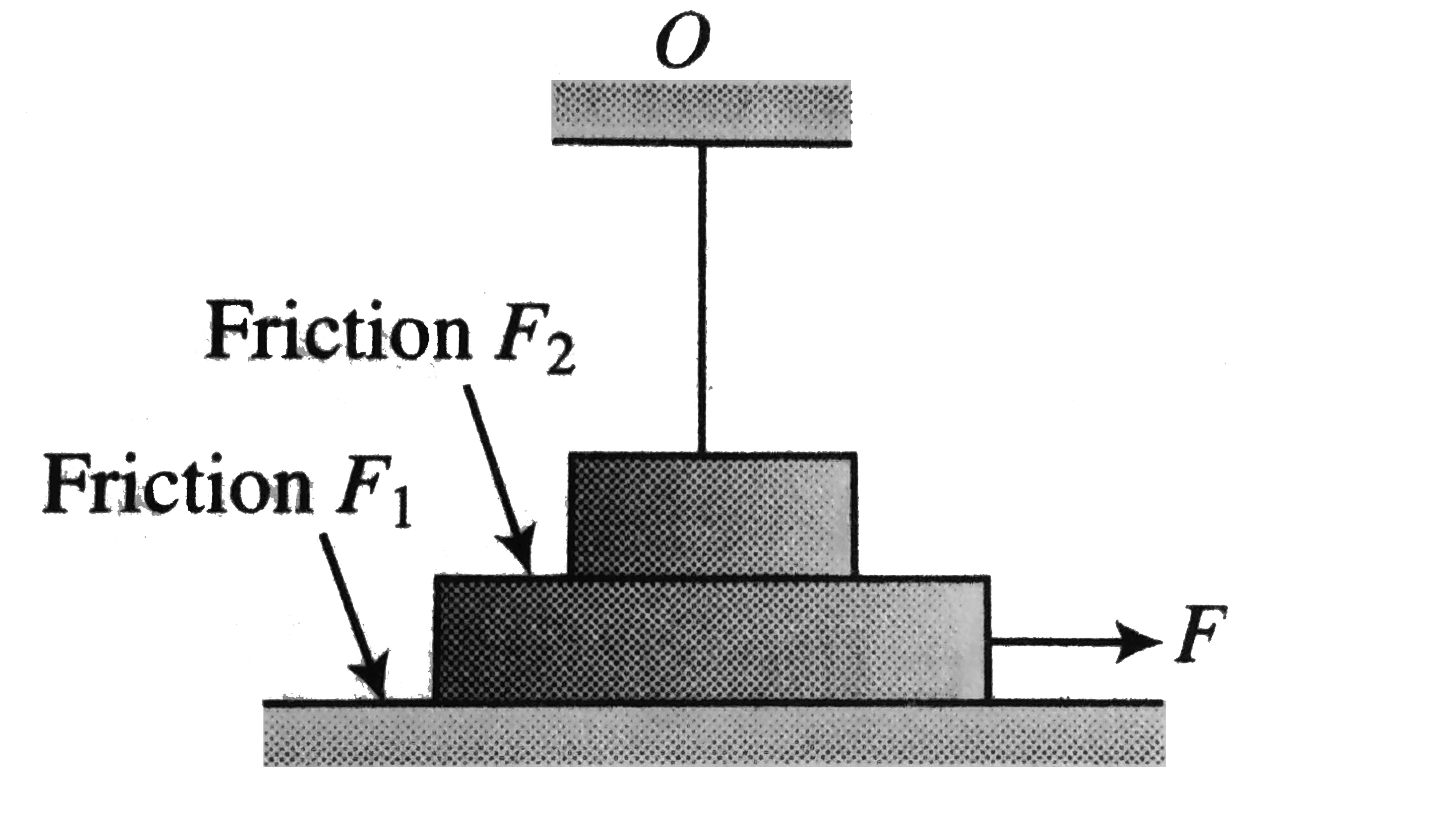
A horizontal plane supports a plank with a block placed on it. A light elastic string is attached to the block, which is attached to a fixed point O. Initially, the cord is unstretched and vertical. The plank is slowly shifted to right until the block starts sliding over it. It occurs at the moment when the cord deviates from vertical by an angle `theta=0^@`. Work done by the force F equals

A

(a) Energy lost against friction `F_1` plus strain energy in cord

B

(b) Work done against total friction acting on the plank alone

C

(c) Work done against total friction acting on the plank plus strain energy in the cord

D

(d) Work done against total friction acting on the plank plus strain energy in the cord minus work done by friction acting on the block

Text Solution

Verified by Experts

The correct Answer is:

A, B, D

When the plank is shifted, the cord elongates and becomes inclined with vertical. Therefore, a tenstion is developed in the cord and that tension has two components, a vertical component and a horizontal component: Horizontal component tries to slide the block leftwards, relative to the plank. But friction `F_2` prevents that slipping. Hence, the block moves to the right with the plank.
Since the block does not slip over the plank, no energy is lost against friction `F_2`. Hence, work done by the force F is used to overcome loss against friction `F_1` and to elongate the cord. Therefore, option (a) is correct.
The cord elongates due to displacement of the block and the block gets displaced due to friction `F_2` acting on it. Hence, the friction `F_2` is responsible for the elongation of the cord. Therefore, strain energy stored in the cord is equal to work done by the friction on the block or work done against friction acting on the upper surface of the plank. Hence, the total work done by F is equal to energy lost against friction `F_1` plus work done against friction acting on upper surface of the plank. Therefore, option (b) is correct. Hence, it is obvious that option (c) is wrong.
Since, strain energy stored in the cord is equal to work done by friction acting on the block, option (d) becomes same as option (b). Hence, it is also correct.
Promotional Banner

Topper's Solved these Questions

  • WORK, POWER & ENERGY

    CENGAGE PHYSICS|Exercise Linked Comprehension|55 Videos
  • WORK, POWER & ENERGY

    CENGAGE PHYSICS|Exercise Integer|14 Videos
  • WORK, POWER & ENERGY

    CENGAGE PHYSICS|Exercise Single Correct|100 Videos
  • VECTORS

    CENGAGE PHYSICS|Exercise Exercise Multiple Correct|5 Videos

Similar Questions

Explore conceptually related problems

A horizontal plane supports a plank with a bar of mass m placed on it and attached by a light elastic non-deformed cord of length l_0 , to a point O. The coefficient of friciton between the bar and the plank is equal to m . The plank is slowly shifted to the right until the bar starts sliding over it. It occurs at the moment when the cord derivates from the vertical by an angle theta . Find the work that has been performed by the moment by the frictional force acting on the bar in the reference frame fixed to the plane.

A horizontal plane supports a plank with a bar of mass m=1.0kg placed on it and attached by a light elastic non-deformed cord of length l_0=40cm to a point O(figure). The coefficient of friction between the bar and the plank equals k=0.20 . The plank is slowly shifted to the right until the bar starts sliding over it. It occurs at the moment when the cord deviates from the vertical by an angle theta=30^@ . Find the work that has been performed by that moment by the friction force acting on the bar in the reference frame fixed to the plane.

Asseration : A plank A is placed on a rough surface over which a block B is placed. In the shown situation, elastic cord is unstretched. Now a gradually increasing force F is appled slowly on A until the relative motion between the block and plank starts. . At this moment cord is making an angle theta with the vertical. Work done by force F is equal to energy lost against fricton f_(2) , plus potential energy stored in the cord. Reason : work done by static friction f_(1) on the system as a whole is zero.

A block is placed on a rough horizontal plane attached with an elastic spring as shown in the figure. Initially spring is unstretched. If the plane is now gradually lifted from 0^(@) to 90^(@) , then the graph showing extension in the spring (x) versus angle (theta) is

A plank with a uniform sphere placed on it rests on a smooth horizontal plane. The plank is pulled to the right by a constant force F . It the sphere does not slip over the plank, then

A horizontal plank has a rectangular block placed on it. The plank starts oscillating vertically and simple harmonically with an amplitude of 40 cm. The block just loses contact with the plank when the latter is at momentary rest Then.

A block is placed on inclined plane with two strings attached to it as shown in figure. Then calculate frequency of block for small displacement.

A block of mass m is suspended from a fixed support with the help of a cord. Another identical cord is attached to the bottom of the block. Which of the following statement is/are true?

One end of an elastic cord is attached to a block of mass m and the other end is held keeping the cord relaxed and vertical.Relaxed length of the cord is l and there is a mark P at a height 0.8l from the lower end.If the upper end is slowly raised,the block leaves the ground,when the mark P reaches the point where the upper end of the relaxed cord initially was.The work done by the force applied by the hand is (mgl)/(n) Find 'n' value

A block A of mass 5 sqrt( 4) m rests on a rough horizontal plane relative to which its coefficient of friction is mu A light string attached to this block passes over a light frictionless pulley and another block B of mass m hangs from it. It is observed that the block A just slips when the string makes an angle of 60^(@) with the horizontal . Find the coefficient of static friction between the block A and the plane. If the same force acting through the sting is applied to the block A in the horizontal direction, find the acceleration of the block A.

CENGAGE PHYSICS-WORK, POWER & ENERGY-Multiple Correct
  1. Mark the correct statement(s).

    Text Solution

    |

  2. Mark the correct statement(s).

    Text Solution

    |

  3. Select the correct option(s).

    Text Solution

    |

  4. When two blocks connected by a spring move towards each other under mu...

    Text Solution

    |

  5. When a bullet is fired from a gun

    Text Solution

    |

  6. A vehicle is driven along a straight horizontal track by a motor which...

    Text Solution

    |

  7. A block hangs freely from the end of a spring. A boy then slowly pushe...

    Text Solution

    |

  8. A charged particle X moves directly towards another charged particle Y...

    Text Solution

    |

  9. The potential energy varphi, in joule, of a particle of mass 1kg, movi...

    Text Solution

    |

  10. A body of mass M was slowly hauled up a rough hill by a force F which ...

    Text Solution

    |

  11. A block is suspended by an ideal spring of force constant k. If the bl...

    Text Solution

    |

  12. A horizontal plane supports a plank with a block placed on it. A light...

    Text Solution

    |

  13. A particle is projected from a point at an angle with the horizontal a...

    Text Solution

    |

  14. In which of the following cases no work is done by the force?

    Text Solution

    |

  15. A man of mass m is standing on a stationary flat car of mass M. The ca...

    Text Solution

    |

  16. The kinetic energy of a particle continuously icreses with time

    Text Solution

    |

  17. The potential energy curve for interaction between two molecules is sh...

    Text Solution

    |

  18. A particle is taken from point A to point B under the influence of a f...

    Text Solution

    |

  19. Which of the following statements is/are correct about work?

    Text Solution

    |

  20. A body of mass 1kg is taken from infinity to a point P. When the body ...

    Text Solution

    |
