Home
Class 11
PHYSICS
A boy of mass m climbs up a conveyor bel...

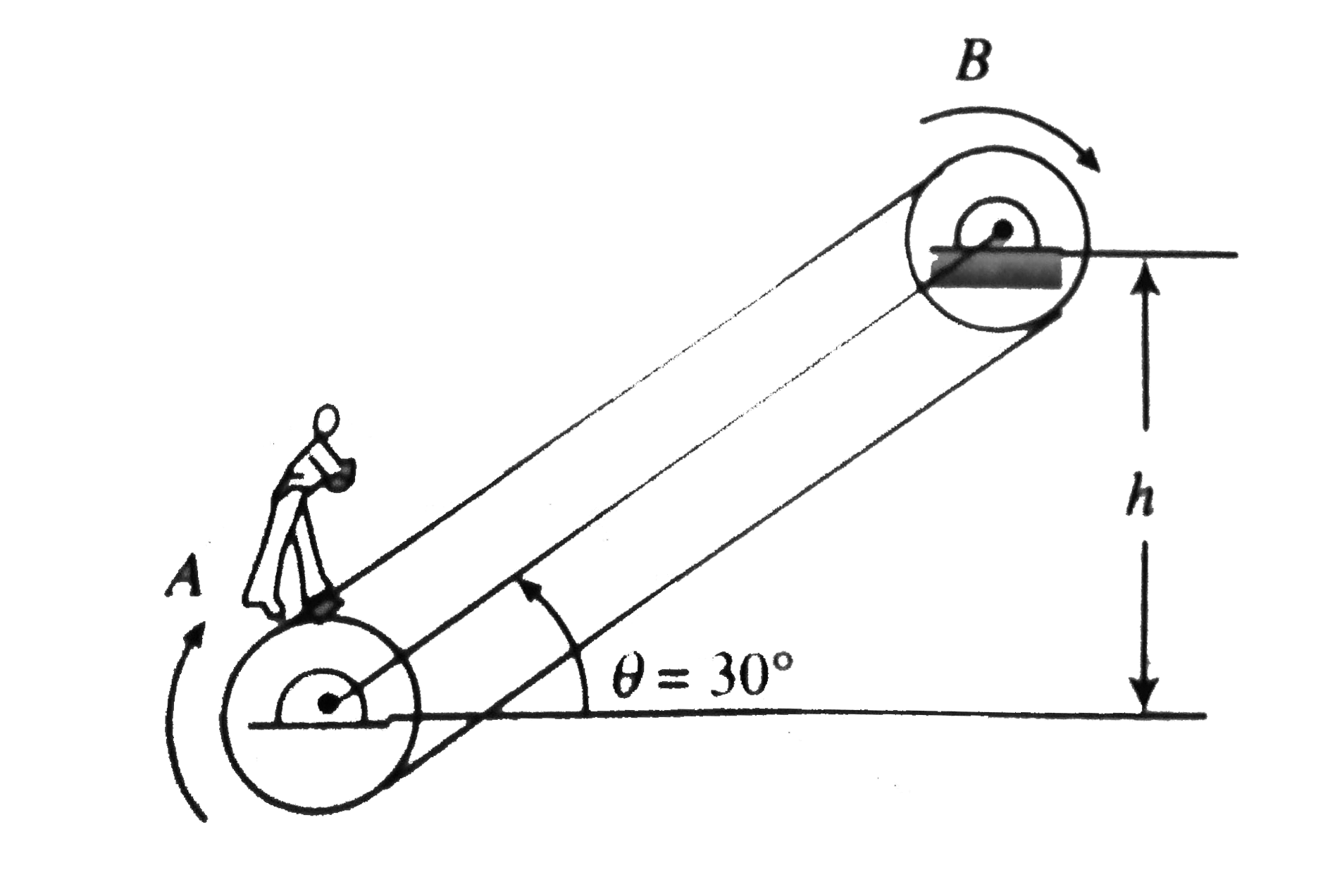
A boy of mass m climbs up a conveyor belt with a constant acceleration. The speed of the belt is `v=sqrt(gh//6)` and the coefficient of friction between the body and conveyor belt is `mu=(5)/(3sqrt3)`. The boy starts from A and moves with the maximum possible acceleration till he reaches the highest point B.

Work done by friction on the boy is

A

(a) Equal to work done by boy

B

(b) `Equal to work done by the motor in running the conveyor belt

C

(c) Zero

D

(d) None of above

Text Solution

Verified by Experts

The correct Answer is:
B

`a=(F_(max)-mg sin theta)/(m)`
`=(mumgcos theta-mg sin theta)/(m)=g/3`

`AB=vt+1/2at^2`
`(h)/(sin 30^@)=sqrt((gh)/(6))t+1/2g/3t^2`
`g t^2+sqrt(6ght)-12h=0`
Solving, we get `t=sqrt(6h/g)`
`v_f=v_i+at=sqrt((gh)/(6))+g/3sqrt(6h/g)=3sqrt((gh)/(6))`
`DeltaKE=1/2m(v_f^2-v_i^2)=2/3mgh`
Distance moved by conveyour belt till the boy reaches B:
`s=v_it=sqrt((gh)/(6))sqrt((6h)/(g))=h`
w.r.t. conveyor belt, distance moved by the boy,
`2h-h=h`
Work done by gravity w.r.t. conveyor
`W_(mg)=-mgh sin 30^@=-(mgh)/(2)`
From the frame of belt: `v_1=0`, `v_f=at=2sqrt((gh)/(6))`
`W_(boy)=DeltaKE+DeltaPE`
`=1/2m(v_f^2-v_i^2)+mgh/2`
`=1/2m[4(gh)/(6)]+(mgh)/(2)=(5mgh)/(6)`
From the frame of ground:
`W_(boy)+W_f+W_(mg)=DeltaKE`
`W_f=2/3mgh+mgh-5/6mgh=5/6mgh`
Promotional Banner

Topper's Solved these Questions

  • WORK, POWER & ENERGY

    CENGAGE PHYSICS|Exercise Integer|14 Videos
  • WORK, POWER & ENERGY

    CENGAGE PHYSICS|Exercise Archives (sinble Correct )|19 Videos
  • WORK, POWER & ENERGY

    CENGAGE PHYSICS|Exercise Multiple Correct|25 Videos
  • VECTORS

    CENGAGE PHYSICS|Exercise Exercise Multiple Correct|5 Videos

Similar Questions

Explore conceptually related problems

A boy of mass m climbs up a conveyor belt with a constant acceleration. The speed of the belt is v=sqrt(gh//6) and the coefficient of friction between the body and conveyor belt is mu=(5)/(3sqrt3) . The boy starts from A and moves with the maximum possible acceleration till he reaches the highest point B. Work done by the boy is

A boy of mass m climbs up a conveyor belt with a constant acceleration. The speed of the belt is v=sqrt(gh//6) and the coefficient of friction between the body and conveyor belt is mu=(5)/(3sqrt3) . The boy starts from A and moves with the maximum possible acceleration till he reaches the highest point B. Work done by gravity to w.r.t. the conveyor belt is

A boy of mass m climbs up a conveyor belt with a constant acceleration. The speed of the belt is v=sqrt(gh//6) and the coefficient of friction between the body and conveyor belt is mu=(5)/(3sqrt3) . The boy starts from A and moves with the maximum possible acceleration till he reaches the highest point B. The time taken by the boy to reach the height h is

A block of mass m is moving with a constant acceleration a on a rough horizontal plane. If the coefficient of friction between the block and ground is mu , the power delivered by the external agent in a time interval t from the beginning is equal to:

A block is gently placed on a conveyor belt moving horizontal with constant speed After t = 4s the velocity of the block becomes equal to velocity of the belt If the coefficient of friction between the block and the belt is mu = 0.2 , then the velocity of the conveyor belt is .

Figure shown a man standing stationary with respect to a horizontal converyor belt that is accelerationg with 1m//s^(-2) . What is the net force on the man?If the coefficient of ststic friction between the man's shoes and the belt is 0.2 upto what maximum acceleration of the belt can the man continue to be stationary relative to the belt? Mass of the man = 65kg (g =9.8m//s^(2))

A body of mass 0.3kg is taken up an inclined plane of length 10m and height 5m, and then allowed to slide down to the bottom again. The coefficient of friction between the body and the plane is 0.15 . What is the (a) work done by the gravitational force over the round trip ? (b) work done by the applied force on the upward journey ? (c) work done by the frictional force over the round trip , (d)kinetic energy of the body at the end of the trip ?

CENGAGE PHYSICS-WORK, POWER & ENERGY-Linked Comprehension
  1. A boy of mass m climbs up a conveyor belt with a constant acceleration...

    Text Solution

    |

  2. A boy of mass m climbs up a conveyor belt with a constant acceleration...

    Text Solution

    |

  3. A boy of mass m climbs up a conveyor belt with a constant acceleration...

    Text Solution

    |

  4. A boy of mass m climbs up a conveyor belt with a constant acceleration...

    Text Solution

    |

  5. Ram and Ali have been fast friends since childhood. Ali neglected stud...

    Text Solution

    |

  6. Ram and Ali have been fast friends since childhood. Ali neglected stud...

    Text Solution

    |

  7. Ram and Ali have been fast friends since childhood. Ali neglected stud...

    Text Solution

    |

  8. Ram and Ali have been fast friends since childhood. Ali neglected stud...

    Text Solution

    |

  9. Ram and Ali have been fast friends since childhood. Ali neglected stud...

    Text Solution

    |

  10. A srping lies along the x-axis attached to a wall at one end and a blo...

    Text Solution

    |

  11. A srping lies along the x-axis attached to a wall at one end and a blo...

    Text Solution

    |

  12. A srping lies along the x-axis attached to a wall at one end and a blo...

    Text Solution

    |

  13. A small ball is given some velocity at point A towards right so that i...

    Text Solution

    |

  14. A small ball is given some velocity at point A towards right so that i...

    Text Solution

    |

  15. A small ball is given some velocity at point A towards right so that i...

    Text Solution

    |

  16. The figure shows the variation of potential energy of a particle as a ...

    Text Solution

    |

  17. Figure shows the variation of potential energy of a particle as a func...

    Text Solution

    |

  18. Figure shows the variation of potential energy of a particle as a func...

    Text Solution

    |

  19. Force acting on a particle moving in the x-y plane is vecF=(y^2hati+xh...

    Text Solution

    |

  20. Force acting on a particle moving in the x-y plane is vecF=(y^2hati+xh...

    Text Solution

    |

