Home
Class 11
PHYSICS
A srping lies along the x-axis attached ...

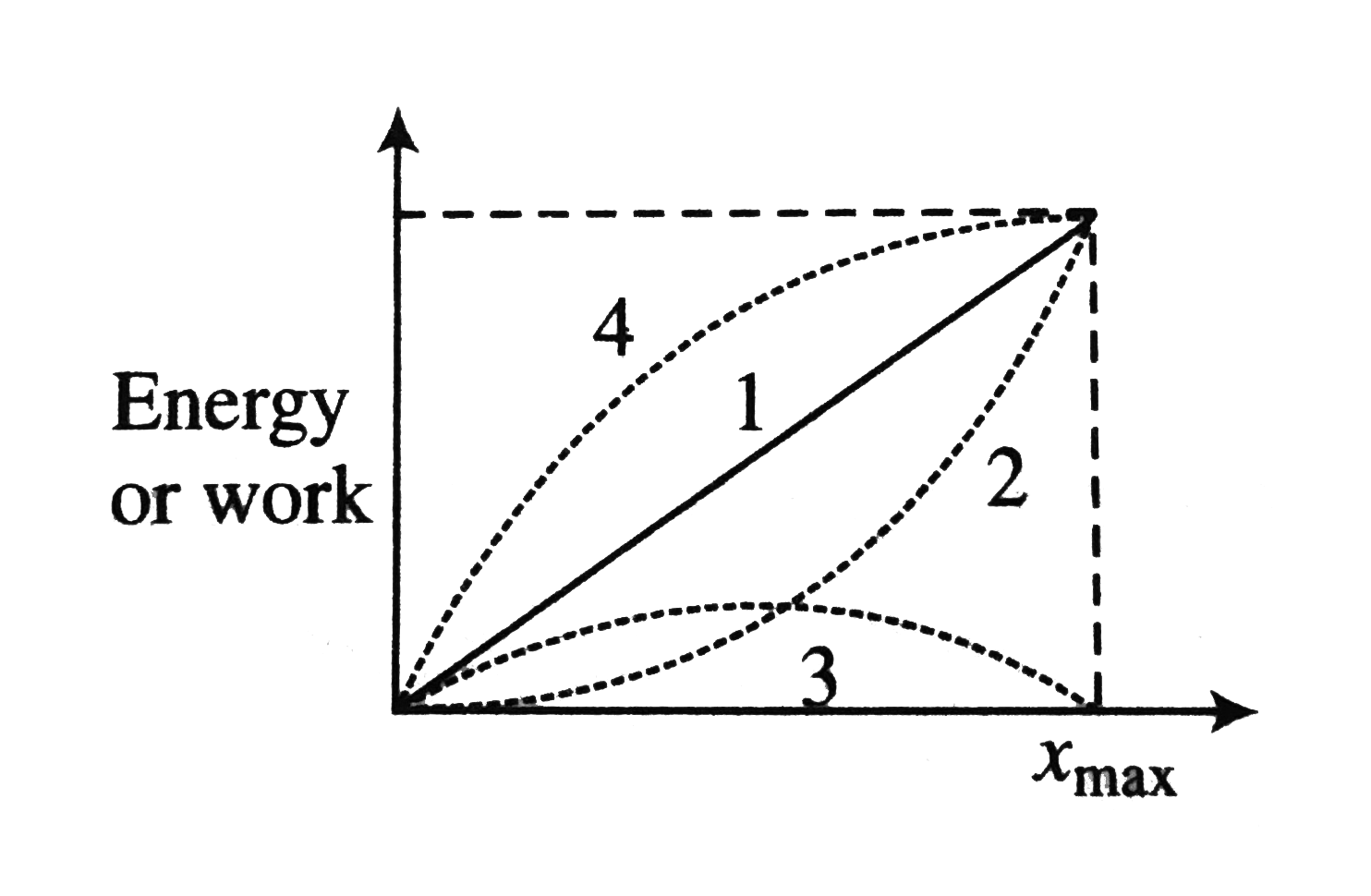
A srping lies along the x-axis attached to a wall at one end and a block at the other end. The block rests on a friction less surface at `x=0`. A force of constant magnitude F is applied to the block that begins to compress the spring, until the block comes to a maximum displacement `x_(max)`.

During the first half of the motion, applied force transfers more energy to the

A

(a) Kinetic energy

B

(b) Potential energy

C

(c) Equal to both

D

(d) Depends upon mass of the block

Text Solution

Verified by Experts

The correct Answer is:

C

From beginning to end of motion: `DeltaKE=0`
`x=(2F)/(K)` (from work-energy theorem)
First half corresponds to `0lexle(F/K)` Work done by force during first half:
`W_1=Fx/2=F^2/K`
Energy in spring `U_1=1/2K(x/2)^2=(F^2)/(2K)`
Promotional Banner

Topper's Solved these Questions

  • WORK, POWER & ENERGY

    CENGAGE PHYSICS|Exercise Integer|14 Videos
  • WORK, POWER & ENERGY

    CENGAGE PHYSICS|Exercise Archives (sinble Correct )|19 Videos
  • WORK, POWER & ENERGY

    CENGAGE PHYSICS|Exercise Multiple Correct|25 Videos
  • VECTORS

    CENGAGE PHYSICS|Exercise Exercise Multiple Correct|5 Videos

Similar Questions

Explore conceptually related problems

A srping lies along the x-axis attached to a wall at one end and a block at the other end. The block rests on a friction less surface at x=0 . A force of constant magnitude F is applied to the block that begins to compress the spring, until the block comes to a maximum displacement x_(max) . During the displacement, which of the curves shown in the graph best represents the work done on the spring block system by the applied force?

A srping lies along the x-axis attached to a wall at one end and a block at the other end. The block rests on a friction less surface at x=0 . A force of constant magnitude F is applied to the block that begins to compress the spring, until the block comes to a maximum displacement x_(max) . During the displacement, which of the curves shown in the graph best represents the kinetic energy of the block?

A block of mass M is pulled along a horizontal frictionless surface by a rope of mass m. If a force F is applied at one end of the rope. Find the force which the rope exerts on the block.

A block rests on a horizontal surface. A horizontal force F is applied to the block. The acceleration (a) produced in the block as a function of applied force (F) has been plotted in a graph (see figure). Find the mass of the block.

A block of mass m is lying on horizontal surface of coefficient of friction mu. A force is applied to the block at an angle theta with the horizontal. The block will move with a minimum force F if

A block of mass M is kept on a rough horizontal surface and is attached with massless spring of force constant k .The minimum constant force applied on the other end of the spring to lift the block is

A block of weight w rests on a horizontal plane. A force P inclined at an angle theta to the plane is applied to the block until it is on the of motion. Find the value of coefficient of friction.

A block of unknown mass is at rest on a rough, horizontal surface. A horizontal force F is applied to the block. The graph in the figure shows the acceleration of the block with respect to the applied force. The mass of the block is

CENGAGE PHYSICS-WORK, POWER & ENERGY-Linked Comprehension
  1. A srping lies along the x-axis attached to a wall at one end and a blo...

    Text Solution

    |

  2. A srping lies along the x-axis attached to a wall at one end and a blo...

    Text Solution

    |

  3. A srping lies along the x-axis attached to a wall at one end and a blo...

    Text Solution

    |

  4. A small ball is given some velocity at point A towards right so that i...

    Text Solution

    |

  5. A small ball is given some velocity at point A towards right so that i...

    Text Solution

    |

  6. A small ball is given some velocity at point A towards right so that i...

    Text Solution

    |

  7. The figure shows the variation of potential energy of a particle as a ...

    Text Solution

    |

  8. Figure shows the variation of potential energy of a particle as a func...

    Text Solution

    |

  9. Figure shows the variation of potential energy of a particle as a func...

    Text Solution

    |

  10. Force acting on a particle moving in the x-y plane is vecF=(y^2hati+xh...

    Text Solution

    |

  11. Force acting on a particle moving in the x-y plane is vecF=(y^2hati+xh...

    Text Solution

    |

  12. Force acting on a particle moving in the x-y plane is vecF=(y^2hati+xh...

    Text Solution

    |

  13. Force acting on a particle moving in the x-y plane is vecF=(y^2hati+xh...

    Text Solution

    |

  14. Force acting on a particle moving in the x-y plane is vecF=(y^2hati+xh...

    Text Solution

    |

  15. Force acting on a particle moving in the x-y plane is vecF=(y^2hati+xh...

    Text Solution

    |

  16. A small block of mass m is pushed on a smooth track from position A wi...

    Text Solution

    |

  17. A small block of mass m is pushed on a smooth track from position A wi...

    Text Solution

    |

  18. A small block of mass m is pushed on a smooth track from position A wi...

    Text Solution

    |

  19. A force F=50N is applied at one end of a string, the other end of whic...

    Text Solution

    |

  20. A force F=50N is applied at one end of a string, the other end of whic...

    Text Solution

    |
