Home
Class 11
PHYSICS
Force acting on a particle moving in the...

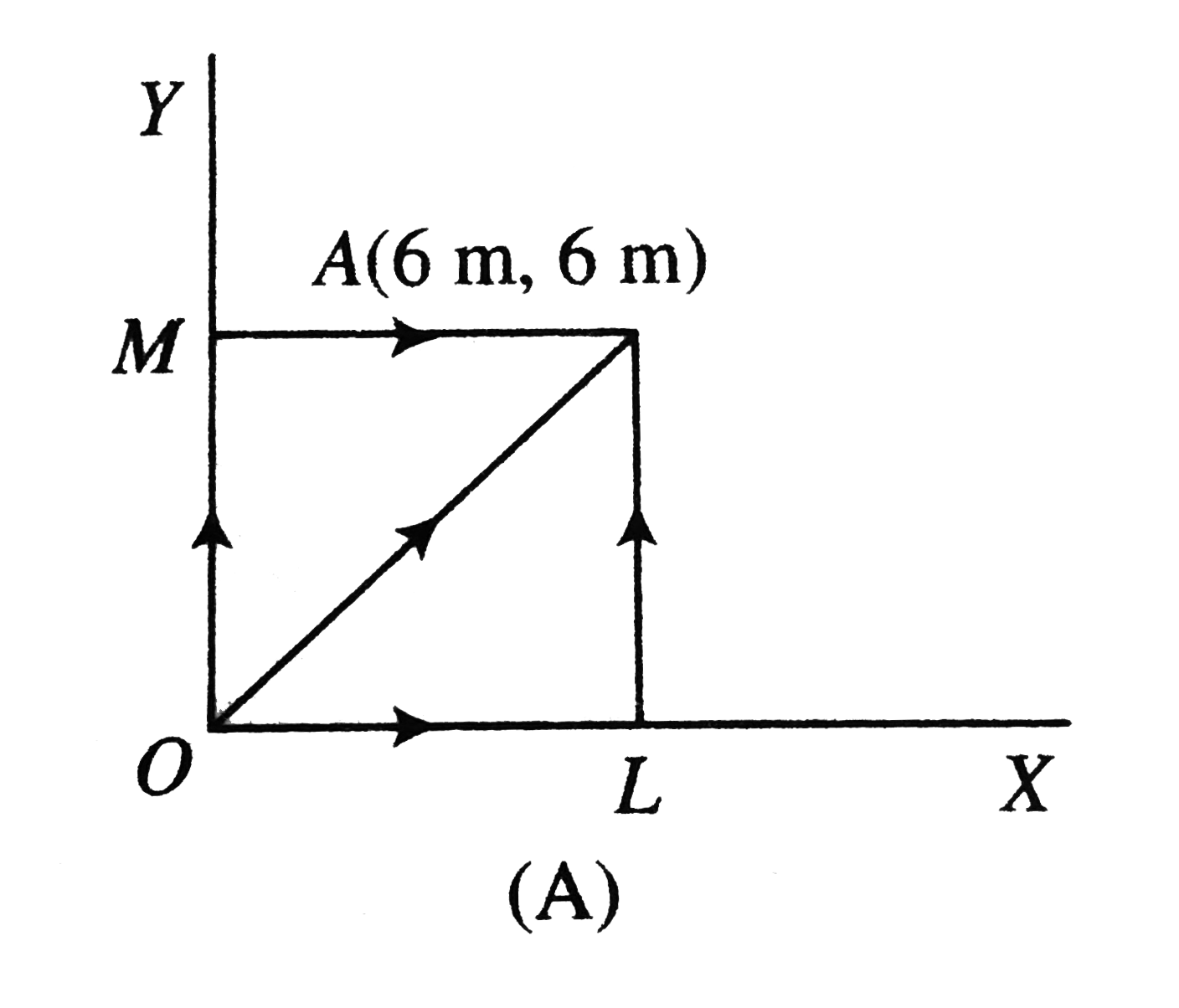
Force acting on a particle moving in the x-y plane is `vecF=(y^2hati+xhatj)N`, x and y are in metre. As shown in figure, the particle moves from the origin O to point A `(6m, 6m)`. The figure shows three paths, OLA, OMA, and OA for the motion of the particle from O to A.

Work done for motion along path OA is nearly

A

(a) `383J`

B

(b) `90J`

C

(c) `180J`

D

(d) None of these

Text Solution

Verified by Experts

The correct Answer is:

B

`W_(OA)=int F_xdx+intF_ydy`
`=underset0overset6inty^2dx+underset0overset6intxdy`, for this path: `y=x`
`=underset0overset6intx^2dx+underset0overset6intydy=[x^3/3]_0^6+[y^2/2]_0^6=90J`
Promotional Banner

Topper's Solved these Questions

  • WORK, POWER & ENERGY

    CENGAGE PHYSICS|Exercise Integer|14 Videos
  • WORK, POWER & ENERGY

    CENGAGE PHYSICS|Exercise Archives (sinble Correct )|19 Videos
  • WORK, POWER & ENERGY

    CENGAGE PHYSICS|Exercise Multiple Correct|25 Videos
  • VECTORS

    CENGAGE PHYSICS|Exercise Exercise Multiple Correct|5 Videos

Similar Questions

Explore conceptually related problems

Force acting on a particle moving in the x-y plane is vec F=(y^(2) hat i + x hat j) N, x and y are in metre. As shown in fig. the particle moves from the origin O to point A(6m,6m) . The figure shows three paths, OLA,OMA and OA for the motion of the particle from O to A . Work done for motion along path OA is nearly

Force acting on a particle moving in the x-y plane is vecF=(y^2hati+xhatj)N , x and y are in metre. As shown in figure, the particle moves from the origin O to point A (6m, 6m) . The figure shows three paths, OLA, OMA, and OA for the motion of the particle from O to A. Which of the following is correct?

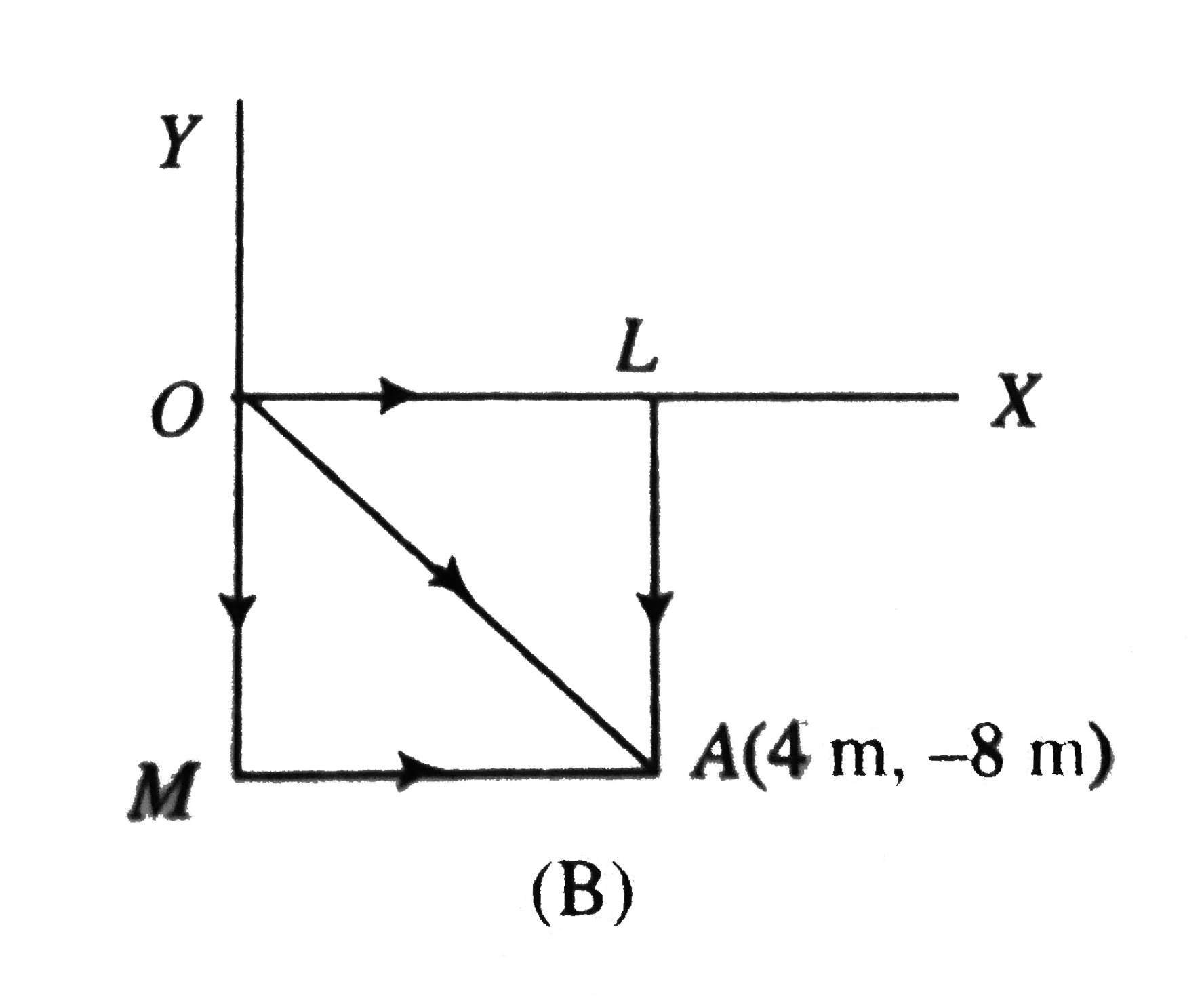
Force acting on a particle moving in the x-y plane is vecF=(y^2hati+xhatj)N , x and y are in metre. As shown in figure, the particle moves from the origin O to point A (6m, 6m) . The figure shows three paths, OLA, OMA, and OA for the motion of the particle from O to A. Now consider another situation. A force vecF=(4hati+3hatj)N acts on a particle of mass 2kg . The particle under the action of this force moves from the origin to a point A (4m, -8m) . Initial speed of the particle, i.e., its speed at the origin is 2sqrt6ms^-1 . Figure shows three paths for the motion of the particle from O to A. Speed of the particle at A will be nearly

Force acting on a particle moving in the x-y plane is vecF=(y^2hati+xhatj)N , x and y are in metre. As shown in figure, the particle moves from the origin O to point A (6m, 6m) . The figure shows three paths, OLA, OMA, and OA for the motion of the particle from O to A. Now consider another situation. A force vecF=(4hati+3hatj)N acts on a particle of mass 2kg . The particle under the action of this force moves from the origin to a point A (4m, -8m) . Initial speed of the particle, i.e., its speed at the origin is 2sqrt6ms^-1 . Figure shows three paths for the motion of the particle from O to A. If the potential energy at O is 16J , the potential energy at A will be

Force acting on a particle moving in the x-y plane is vec F=(y^(2) hat i + x hat j) N, x and y are in metre. As shown in fig. the particle moves from the origin O to point A(6m,6m) . The figure shows three paths, OLA,OMA and OA for the motion of the particle from O to A . Along which of the three paths is the work done maximum.

A force acting on a particle moving in the x-y plane is given by vecF=(2yhati+x^2hatj)N , where x and y are in meters. The particle moves from the origin to a final position having coordinates x=5.00m as shown in figure. Calculate the work done by vecF on the particle as it moves along (a) OAC, (b) OBC, and (c) OC. (d) Is vecF conservative or non-conservative? Explain.

A force acting on particle is given by vecF=(3x^2hati+4yhatj)N . The change in kinetic energy of particle as it moves from (0,2m) to (1m,3m) is

A particle moves in the x-y the accoding to the equatio, r = (hati + 2hatj) A cos omegat . The motion of the particle is

Force acting on a particle varies with x as shown in figure. Calculate the work done by the force as the particle moves from x = 0 to x = 6.0 m.

A force F acting on a particle varies with the position x as shown in figure. Find the work done by this force in displacing the particle from

CENGAGE PHYSICS-WORK, POWER & ENERGY-Linked Comprehension
  1. A srping lies along the x-axis attached to a wall at one end and a blo...

    Text Solution

    |

  2. A srping lies along the x-axis attached to a wall at one end and a blo...

    Text Solution

    |

  3. A small ball is given some velocity at point A towards right so that i...

    Text Solution

    |

  4. A small ball is given some velocity at point A towards right so that i...

    Text Solution

    |

  5. A small ball is given some velocity at point A towards right so that i...

    Text Solution

    |

  6. The figure shows the variation of potential energy of a particle as a ...

    Text Solution

    |

  7. Figure shows the variation of potential energy of a particle as a func...

    Text Solution

    |

  8. Figure shows the variation of potential energy of a particle as a func...

    Text Solution

    |

  9. Force acting on a particle moving in the x-y plane is vecF=(y^2hati+xh...

    Text Solution

    |

  10. Force acting on a particle moving in the x-y plane is vecF=(y^2hati+xh...

    Text Solution

    |

  11. Force acting on a particle moving in the x-y plane is vecF=(y^2hati+xh...

    Text Solution

    |

  12. Force acting on a particle moving in the x-y plane is vecF=(y^2hati+xh...

    Text Solution

    |

  13. Force acting on a particle moving in the x-y plane is vecF=(y^2hati+xh...

    Text Solution

    |

  14. Force acting on a particle moving in the x-y plane is vecF=(y^2hati+xh...

    Text Solution

    |

  15. A small block of mass m is pushed on a smooth track from position A wi...

    Text Solution

    |

  16. A small block of mass m is pushed on a smooth track from position A wi...

    Text Solution

    |

  17. A small block of mass m is pushed on a smooth track from position A wi...

    Text Solution

    |

  18. A force F=50N is applied at one end of a string, the other end of whic...

    Text Solution

    |

  19. A force F=50N is applied at one end of a string, the other end of whic...

    Text Solution

    |

  20. A force F=50N is applied at one end of a string, the other end of whic...

    Text Solution

    |
