Home
Class 11
PHYSICS
An insect jumps from ball A onto ball B,...

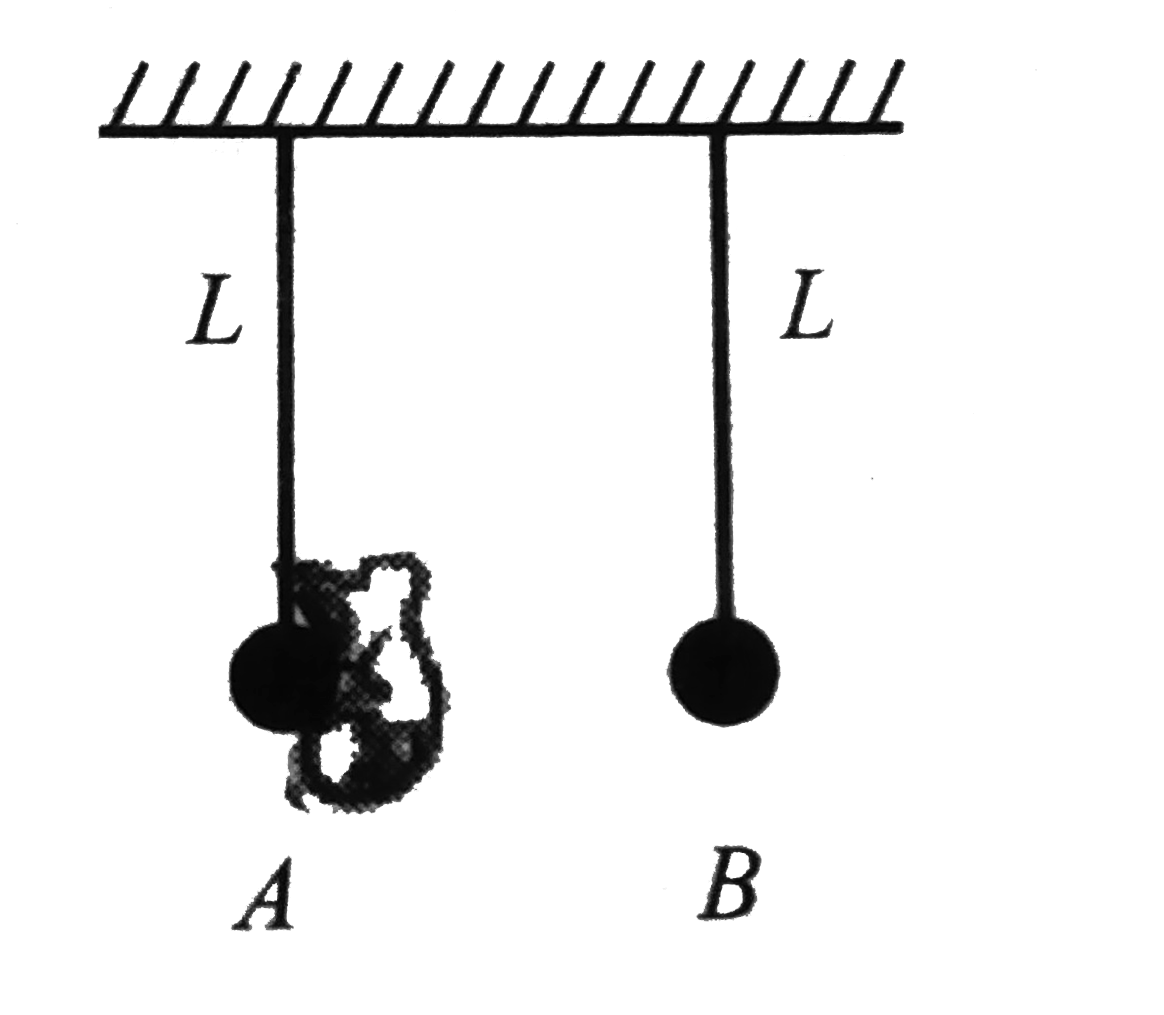
An insect jumps from ball A onto ball B, which are suspended from inextensible light strings each of length `L=8cm`. The mass of each ball and insect is same. What should be the minimum relative velocity (in `ms^-1`) of jump of insect w.r.t. ball A, if both the balls manage to complete the full circle?

Text Solution

Verified by Experts

The correct Answer is:
`(8)`

For completing the full circle:

`u/2=sqrt(5gL)impliesu=4ms^-1`
Relative velocity `=2u=8ms^-1`
Promotional Banner

Topper's Solved these Questions

  • WORK, POWER & ENERGY

    CENGAGE PHYSICS|Exercise Archives (sinble Correct )|19 Videos
  • WORK, POWER & ENERGY

    CENGAGE PHYSICS|Exercise Archives(multiple Correct)|3 Videos
  • WORK, POWER & ENERGY

    CENGAGE PHYSICS|Exercise Linked Comprehension|55 Videos
  • VECTORS

    CENGAGE PHYSICS|Exercise Exercise Multiple Correct|5 Videos

Similar Questions

Explore conceptually related problems

Two indentical pith balls, each carrying charge q, are suspended from a common point by two strings of equal length l. Find the mass of each ball if the angle between the strings is 2theta in equilibrium.

A small ball of mass m having charge q is suspended by a string of length L . Another identical ball having the same charge is kept at the point of suspension. Determine the minimum horizontal velocity which should be imparted to ball at lowest point so that it can make complete revolution.

Two small balls, each having equal positive charge Q are suspended by two insulationg strings of equal length l from a hook fixed to a stand. It mass of each ball =m and total angle between the two strings is 60^(@) m, then find the charge on each ball.

A small ball if mass 2 xx 10^(-3) Kg having a charges of 1 mu C is suspended by a string of length 0. 8 m Another identical ball having the same charge is kept at the point of suspension . Determine the minimum horizontal velocity which should be imparted to the lower ball so tht it can make complete revolution .

Vertical strings of same length L support two balls A and B of mass 2m each. There is a small monkey of mass m sitting on ball A. Suddenly, the monkey jumps off the ball A at an angle theta = 45^(@) to the horizontal and lands exactly on the ball B. Thereafter, the monkey and the ball B just manage to complete the vertical circle. (a) Find distance d between the two string and the speed with which the monkey jumped of the ball A. (b) Find the impulse of the string tension on ball A during the small period when the monkey interacted with the ball to jump off it.

A ball B is suspended from a string of length l attached to a cart A, which may roll on a frictionless surface. Initially the cart is at rest and the ball is given a horizontal velocity v_(0) . Determine the maximum height reached by the ball.

Two identical balls , each having a charge q and mass m , are suspended from a common point by two insultating strings each of length L . The balls are held at a separation x and then released. Find (a) the electric force on each ball (b) the component of the resultant force on a ball along and perpendicular to string (c ) the tension in the string (d) the acceleration of one of the balls. Consider the situation only for the instant just after the release.

A ball of mass m is attached to one end of a light rod of length l , the other end of which is hinged. What minimum velocity v should be imparted to the ball downwards, so that it can complete the circle ?

Two pith ball of mass 0.5 each are suspended from a common point O by means of silk threads, each of length 20 cm. When the balls are given equal and similar charges, they repel each other so that the two threads make an angle of 60^(@) with each-other. Determine the charge on each ball.

