Home
Class 11
PHYSICS
Two blocks A and H. each of mass m, are ...

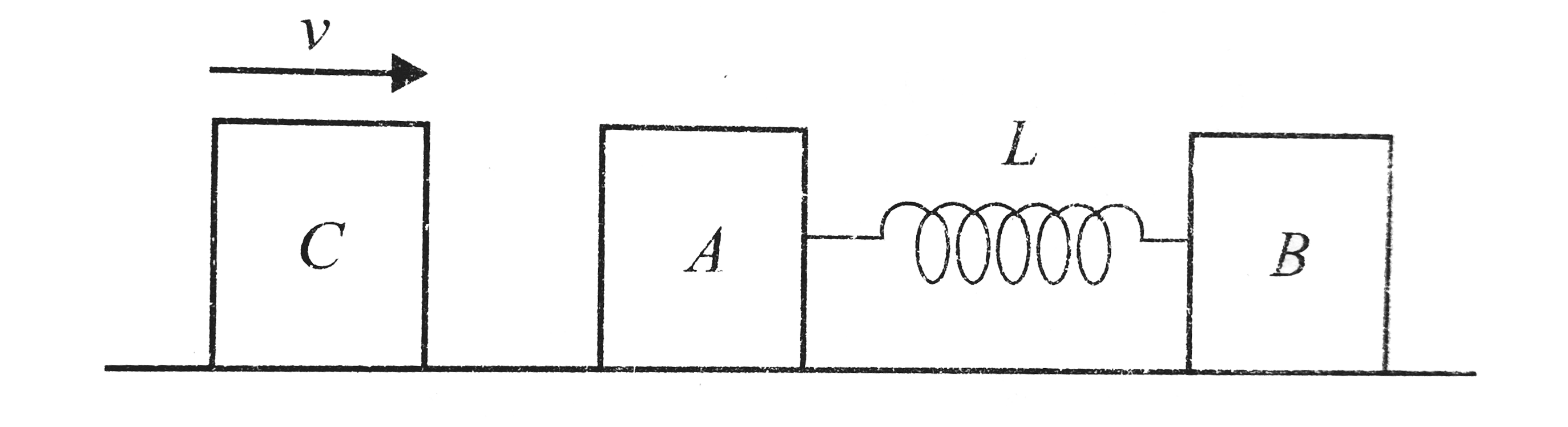
Two blocks `A` and `H`. each of mass `m`, are connected by a massless spring of natural length `I`. and spring constant `K`. The blocks are initially resting in a smooth horizontal floor with the spring at its natural length, as shown in Fig. A third identical block `C`, also of mass `m`, moves on the floor with a speed `v` along the line joining `A` and `B`. and collides elastically with `A`. Then

A

(a) The KE of the AB system at maximum compression of the spring is zero.

B

(b) The KE of the AB system at maximum compression of the spring is `(1//4)mv^2`.

C

(c) The maximum compression of the spring is `vsqrt(m/k)`.

D

(d) The maximum compression of the spring is `vsqrt((m)/(2k))`

Text Solution

Verified by Experts

The correct Answer is:

B, D

Initially, there will be collision between C and A which is elastic.
So by conservation of momentum, we have
`mv=mv_A+mv_C`
`v=v_A+v_C` (i)
And as in elastic collision, KE after collision is same as before collision, hence
`1/2mv^2=1/2mv_A^2+1/2mv_C^2`
i.e., `v^2=v_A^2+v_C^2`
Subtracting Eq. (ii) from the square of Eq. (i), we have
`2v_Av_C=0`
So, either `v_A=0` or `v_C=0`
`v_A=0` corresponds to no interaction between A and C, so the only physically possible solution is `v_C=0`, which is the light of Eq. (i) gives `v_A=v`, i.e., after collision C stops and A starts moving with velocity v. Now A will move and compress the spring which in turn accelerates B and retards A and finally both A and B will move with same velocity (say V). In this situation, compression of the spring will be maximum.
As external force is zero, momentum of the system `(A+B+spri ng)` is conserved, i.e.,
`mv=(m+m)VimpliesV=v/2`
By conservation of mechanical energy,
`1/2mv^2=1/2(m+m)V^2+1/2kx_0^(2_2)`
or `mv^2-2m(v_0/2)^2=kx^2`
i.e., `k=(mv^2)/(2x_0^2)` or `x_0=vsqrt((m)/(2k))`
Promotional Banner

Topper's Solved these Questions

  • WORK, POWER & ENERGY

    CENGAGE PHYSICS|Exercise Archives (assertion-reasoning)|1 Videos
  • WORK, POWER & ENERGY

    CENGAGE PHYSICS|Exercise Archives (linked Comprehension)|2 Videos
  • WORK, POWER & ENERGY

    CENGAGE PHYSICS|Exercise Archives (sinble Correct )|19 Videos
  • VECTORS

    CENGAGE PHYSICS|Exercise Exercise Multiple Correct|5 Videos

Similar Questions

Explore conceptually related problems

Two blocks A and B, each of mass m, are connected by a masslesss spring of natural length L and spring constant K. The blocks are initially resting on a smooth horizontal floor with the spring at its natural length, as shown in fig. A third identical block C, also of mass m, moves on the floor with a speed v along the line joining A and B, and collides elastically with A. Then

Two blocks A and B of masses m and 2m are connected by a massless spring of natural length L and spring constant k . The blocks are intially resting on a smooth horizontal floor with the spring at its natural length , as shown . A third identical block C of mass m moves on the floor with a speed v_(0) along the line joining A and B and collides elastically with A . FInd (a) the velocity of c.m. of system (block A + B + spri ng) and (b) the minimum compression of spring.

Two blocks A and B each of mass m are connected by a light spring of natural length L and spring constant k. The blocks are initially resting on a smooth horizontal floor with the spring at its natural length, as shown. A third identical block C, also of mass m, moves on the floor with a speed v along the line joining A to B and collides with A. Collision is elastic and head on. Then -

Two blocks A and B each of mass m are connected by a massless spring of natural length L and spring constant k. The blocks are initially resting on a smooth horizontal floor with the spring at its natural length. A third identical block C also of mass m moves on the floor with a speed v along the line joining A and B and collides with A. Then The kinetic energy of the A-B system at maximum compression of the spring is mv^(2)//4 The maximum compression of the spring vsqrt(m//3k) The kinetic energy of the A-B system at maximum compression The maximum coppression of the spring is vsqrt(m//k)

Two identical blocks A and B each of mass m resting on the smooth horizontal floor are connected by a light spring of natural length L and spring constant K. A third block Cof mass m moving with a speed v along the line joining A and B collides with A. The maximum compression in the spring is

Two identical blocks A and B , each of mass m resting on smooth floor are connected by a light spring of natural length L and spring constant k , with the spring at its natural length. A third identical block C (mass m ) moving with a speed v along the line joining A and B collides with A . The maximum compression in the spring is

A block of mass m is connected to another block of mass M by a massless spring of spring constant k . the blocks are kept of a smooth horizontal plane and are at rest. The spring is unstretched when a constant force F starts acting on the block of mass M of pull it. Find the maximum extension of the spring

Two blocks of masses m_(1) and m_(2) are connected by a massless spring and placed on smooth surface. The spring initially stretched and released. Then :

Two blocks A and B, each of mass m, are connected by a spring of force constant K. Initially, the spring is in its natural length. A horizontal constant force F starts acting on block A at time t=0 and at time t , the extension in the spring is seen to be l . What is the displacement of the block A in time t ?
