Home
Class 12
PHYSICS
In a photoelectric experiment the relati...

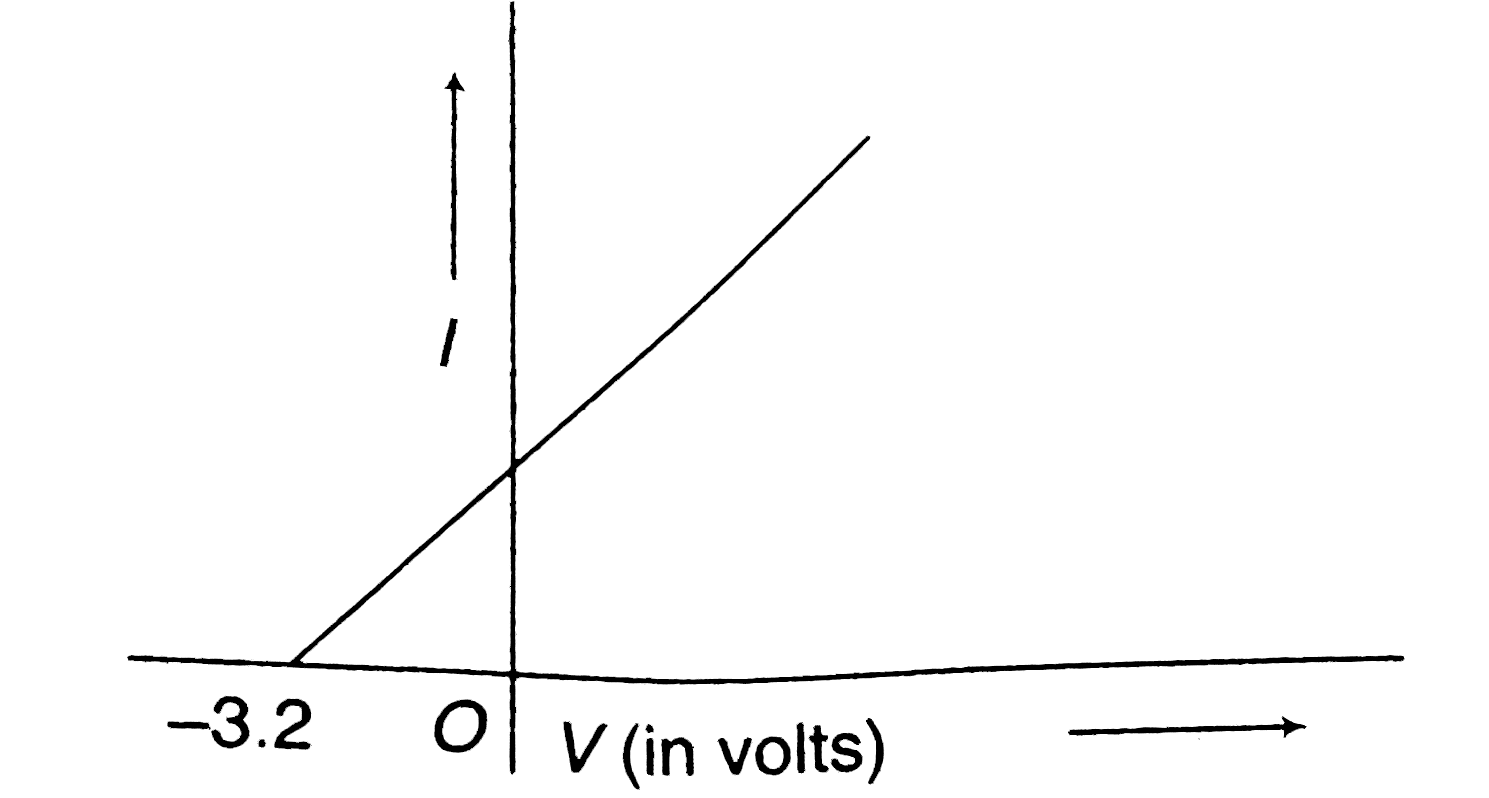
In a photoelectric experiment the relation between applied potential difference between cathode and anode V and the photoelectric current cathode and anode V and the photoelectric current l and was found to be shown in graph below. If planck's constant `h=6.6xx10^(-34)`Js, the frequency of incident radiation would e nearly (in `s^(-1)`)

A

`0.436xx10^(18)`

B

`0.436xx10^(17)`

C

`0.775xx10^(15)`

D

`0.775xx10^(16)`

Text Solution

Verified by Experts

The correct Answer is:

C

From the graph, stopping potential, `V_(0)=-3.2V`
for photoelectric effect,
`eV_(0)hv implies v=(eV_(0))/(h)`
`v=(1.6xx10^(-19)xx3.2)/(6.6xx10^(-34))`
`=0.775xx10^(15)Hz`
Promotional Banner

Topper's Solved these Questions

  • ELECTRONS AND PROTONS

    MHTCET PREVIOUS YEAR PAPERS AND PRACTICE PAPERS|Exercise MHT CET CORNER|19 Videos
  • ELECTRONS AND PROTONS

    MHTCET PREVIOUS YEAR PAPERS AND PRACTICE PAPERS|Exercise Exercise 1|50 Videos
  • ELECTROMAGNETIC INDUCTION

    MHTCET PREVIOUS YEAR PAPERS AND PRACTICE PAPERS|Exercise MHT CET CONER|34 Videos
  • ELECTROSTATICS

    MHTCET PREVIOUS YEAR PAPERS AND PRACTICE PAPERS|Exercise MHT CET Corner|29 Videos

Similar Questions

Explore conceptually related problems

In photoelectric experiment the plot between anode potential and photoelectric current is shown in figure 2.3.1. Which of the following is correct:

In photoelectric effect , the curve between photoelectric current and anode potential V (for different frequencies ) is shown in figure , then

In photoelectric effect experiment potential difference between plates increases keeping incident light on cathode plate remains unchanged which of the following is correct about saturation current :

In an experiment on photoelectic effect, the graph as shown in fig. were obtained between the photoelectric current (I) and the anode potential (V). Name the characterstic of the incident radiation that was kept constant in this experiment.

In a photoelectric experiment, the reciprocal of the slope of the straight line graph giving the relation between the stopping potential and the frequency of incident radiation gives

A photoelectric cell is connected to a source of variable potential difference, connected across it and the photoelectric current resulting (muA) is plotted against the applied potential difference (V). The graph in the broken line represents one for a given frequency and intensity of the incident radiation. If the frequency is increased and the intensity is reduced. Which of the following graphs of unbroken line represents the new situation?

A photoelectric cell is connected to a source of variable potential difference, connected across it and the photoelectric current resulting (muA) is plotted against the applied potential difference (V). The graph in the broken line represents one for a given frequency and intensity of the incident radiation . If the frequency is increased and the intensity is reduced, which of the following graphs of unbroken line represents the new situation?

In a photoelectric experiment, the graph of frequency v of incident light (in Hz) and stopping potential V (in V) is as shown in the figure. Planck's constant is (e is the elementary charge)

In photoelectric effect the slope of straight line graph between stopping potential (V_(s)) and frequency of incident light (v) gives

In an experiment on the photoelectric effect , the slope of the cut - off voltage versus frequency of incident light is found to be 4.12xx10^(-15) V s . The value of Planck's constant is

MHTCET PREVIOUS YEAR PAPERS AND PRACTICE PAPERS-ELECTRONS AND PROTONS-Exercise 2
  1. The act of photoelectric effect taking place with a certain photosensi...

    Text Solution

    |

  2. A point source of light is used in a photoelectric effect. If the sour...

    Text Solution

    |

  3. If the frequency of light in a photoelectric experiment is doubled the...

    Text Solution

    |

  4. The cathode of a photoelectric cell is changed such that the work func...

    Text Solution

    |

  5. In a photoelectric experiment, the potential difference V that must be...

    Text Solution

    |

  6. what should be the velocity of an electron so that its momentum becom...

    Text Solution

    |

  7. From the figure describing photoelectric effect we may infer correctly...

    Text Solution

    |

  8. Cathode rays enter a magnetic field makin oblique angle withh the line...

    Text Solution

    |

  9. The work function for aluminium is 4.125 eV. The cut-off wavelength fo...

    Text Solution

    |

  10. According to Einstein's photoelectric equation, the plot of the maximu...

    Text Solution

    |

  11. Photon and electron are given same energy (10^(-20) J). Wavelength ass...

    Text Solution

    |

  12. Match column I (fundamental experiment) with column II (its conclusion...

    Text Solution

    |

  13. When a certain metallic surface is illuminated with monochromatic ligh...

    Text Solution

    |

  14. Which of the following figure represents the variation of particle mom...

    Text Solution

    |

  15. Threshold wavelength for lithium metal is 6250 Å. For photo emission, ...

    Text Solution

    |

  16. In a photoelectric experiment the relation between applied potential d...

    Text Solution

    |

  17. Photoelectric effect experiments are performed using three different m...

    Text Solution

    |

  18. Light of two different frequencies whose photons have energies 1eV and...

    Text Solution

    |

  19. Light of intensity 10^(-5)Wm^(-2) falls on a sodium photocell of surfa...

    Text Solution

    |

  20. Work function for caesium metal is 2.14 eV. Let a beam of light of fre...

    Text Solution

    |
