Home
Class 11
PHYSICS
An object has velocity vecv1 w.r.t. grou...

An object has velocity `vecv_1` w.r.t. ground. An observer moving with constant velocity `vecv_0` w.r.t. ground measures the velocity of the object as `vecv_2`. The magnitudes of three velocities are related by

A

`v_0gev_1+v_2`

B

`v_1lev_2+v_0`

C

`v_2gev_1+v_0`

D

All of the above

Text Solution

Verified by Experts

The correct Answer is:
B

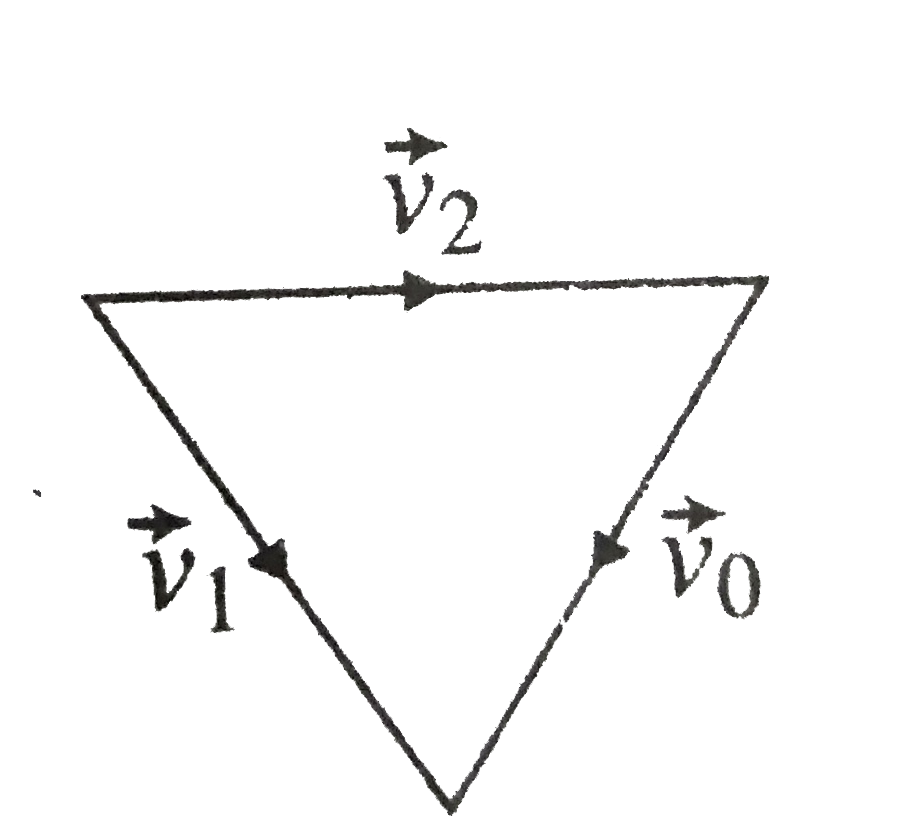
b. `vecv_2 = vecv_1 - vecv_0, vecv_2 + vecv_0 = vecv_1`
From the law of triangle, we can draw the
velocity vector diagram.

From triangle property, sum of two sides gethird
side. So `v_1le v_0 + v_2` .
Promotional Banner

Topper's Solved these Questions

  • MISCELLANEOUS KINEMATICS

    CENGAGE PHYSICS|Exercise Multiple Correct Answer Type|26 Videos
  • MISCELLANEOUS KINEMATICS

    CENGAGE PHYSICS|Exercise Linked Comprehension Type|35 Videos
  • LINEAR AND ANGULAR SIMPLE HARMONIC MOTION

    CENGAGE PHYSICS|Exercise Multiple Correct Answer Type|9 Videos
  • MISCELLANEOUS VOLUME 2

    CENGAGE PHYSICS|Exercise INTEGER_TYPE|10 Videos

Similar Questions

Explore conceptually related problems

The velocity of image w.r.t ground in the below figure is

A boat is moving with a velocity 3hati - 4hatj w.r.t ground. The water in the river is moving with a velocity - 3hati -4hatj w.r.t ground. What is the relative velocity of boat w.r.t water.

Find the acceleration of C w.r.t. ground.

A bird is flying towards south with a velocity 40km/h and a train is moving with a velocity 40 km/h towards east. What is the velocity of the bird w.r.t. an obserber in the train ?

We know that when a boat travels in water, its net velocity w.r.t. ground is the vector sum of two velocities. First is the velocity of boat itself in river and other is the velocity of water w.r.t. ground. Mathematically: vecv_(boat) = vecv_(boat,water) + vecv_(water) . Now given that velocity of water w.r.t. ground in a river is u. Width of the river is d. A boat starting from rest aims perpendicular to the river with an acceleration of a = 5t, where t is time. The boat starts from point (1,0) of the coordinate system as shown in figure. Assume SI units.

We know that when a boat travels in water, its net velocity w.r.t. ground is the vector sum of two velocities. First is the velocity of boat itself in river and other is the velocity of water w.r.t. ground. Mathematically: vecv_(boat) = vecv_(boat,water) + vecv_(water) . Now given that velocity of water w.r.t. ground in a river is u. Width of the river is d. A boat starting from rest aims perpendicular to the river with an acceleration of a = 5t, where t is time. The boat starts from point (1,0) of the coordinate system as shown in figure. Assume SI units.

We know that when a boat travels in water, its net velocity w.r.t. ground is the vector sum of two velocities. First is the velocity of boat itself in river and other is the velocity of water w.r.t. ground. Mathematically: vecv_(boat) = vecv_(boat,water) + vecv_(water) . Now given that velocity of water w.r.t. ground in a river is u. Width of the river is d. A boat starting from rest aims perpendicular to the river with an acceleration of a = 5t, where t is time. The boat starts from point (1,0) of the coordinate system as shown in figure. Assume SI units.

Two objects A and B are moving in opposite directions with velocities v_(A) and v_(B) respectively, the magnitude of relative velocity of A w.r.t. B is

The velocity varies with time as vecv = ahati + bthatj , where a and b are positive constants. The magnitude of instantaneous velocity and acceleration would be

