Home
Class 11
PHYSICS
Figure shows path followed by a particle...

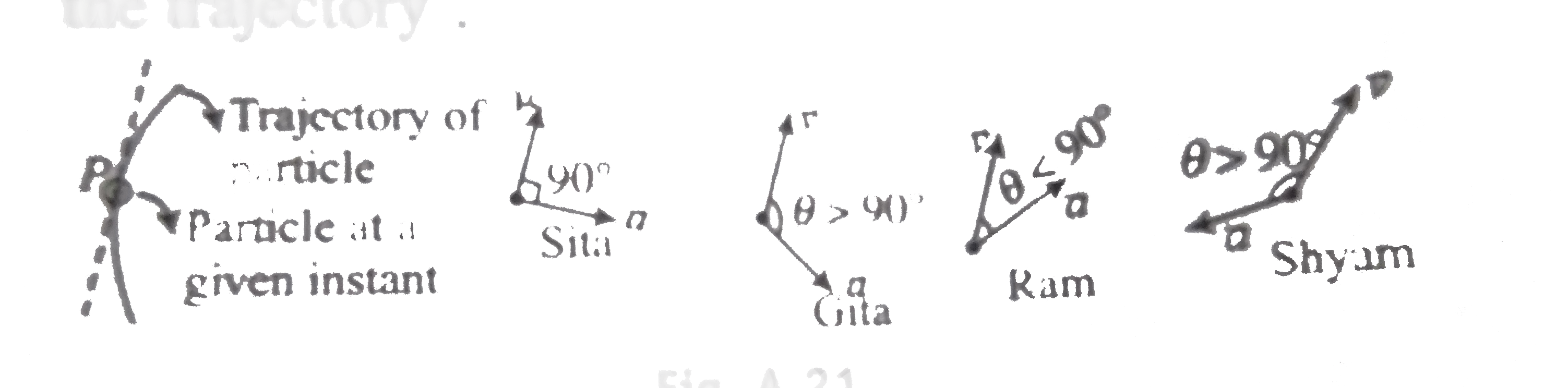
Figure shows path followed by a particle and position of a particle at any instant. Four different students have represented the velocity vectors and acceleration vectors at the given instant. Which vector diagram can not be true in any situation? (In each figure velocity is tangential to the trajectory).

A

Sita

B

Gita

C

Ram

D

Shyam

Text Solution

Verified by Experts

The correct Answer is:

D

d. In curved path is always within the curvature of trajectory.
Promotional Banner

Topper's Solved these Questions

  • MISCELLANEOUS KINEMATICS

    CENGAGE PHYSICS|Exercise Multiple Correct Answer Type|26 Videos
  • MISCELLANEOUS KINEMATICS

    CENGAGE PHYSICS|Exercise Linked Comprehension Type|35 Videos
  • LINEAR AND ANGULAR SIMPLE HARMONIC MOTION

    CENGAGE PHYSICS|Exercise Multiple Correct Answer Type|9 Videos
  • MISCELLANEOUS VOLUME 2

    CENGAGE PHYSICS|Exercise INTEGER_TYPE|10 Videos

Similar Questions

Explore conceptually related problems

Figure shows a path followed by a particle and position of a particle at any instant. Four different students have represented the velocity vectors and acceleration vectors at the given instant. Which vector diagram cannot be true in any situation? (In each figure, velocity is tangential to the trajectory).

A body executing uniform circular motion has at any instant its velocity vector and acceleration vector

Figure shows the path followed by a particle. Its velocity is shown at points A and B. Which of the vector in the given options best represents the average acceleration of the particle for its motion from A to B ?

A particle starts travelling on a circle with constant tangential acceleration. The angle between velocity vector and acceleration vector, at the moment when particle completes half the circular track. Is

The position vector of a particle is vecr=2t^(2)hatx+3thaty+4ghatz Then the instantaneous velocity vecv and acceleration veca respectively lie

The distance traversed by a moving particle at any instant is half of the product of its velocity and the time of travers. Show that the acceleration of particle is constant.

For a particle executing SHM, x = displacement from mean position, v = velocity and a = acceleration at any instant, then

Two particles A and B are projected from the same point in different direction in such a manner that their velocity vectors are shown in the diagram :- .

The position vector of a aprticle is given as vecr=(t^2-4t+6)hati+(t^2)hatj . The time after which the velocity vector and acceleration vector becomes perpendicular to each other is equal to

If y, v and a represent displacement velocity and acceleration at any instant for a particle executing SHM, which of the following statements are true?
