Home
Class 11
PHYSICS
A projectile is fired at a speed of 100 ...

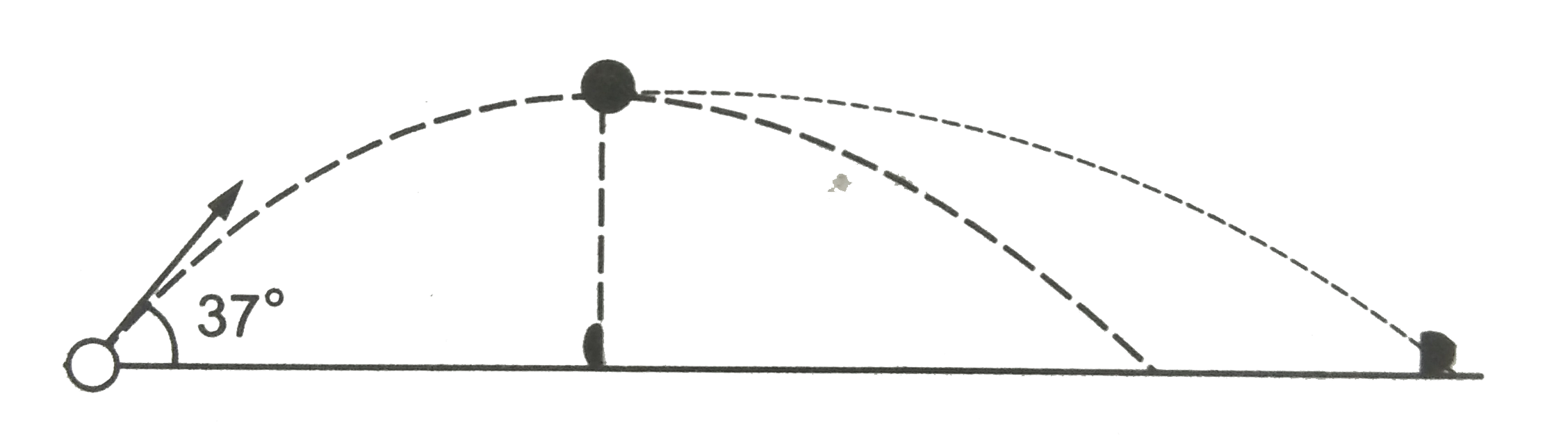
A projectile is fired at a speed of 100 m/s at an angel of `37^0` above the horizontal. At the highest point, the projectile breaks into two parts of mass ratio 1:3 the smaller coming to rest. Find the distance from the launching point to the where the heavier piece lands.

Text Solution

Verified by Experts

Internal forces do not affect the motion of the centre of mass, the centre of mass hits the ground at a position where the original projectile would have landed. The range of the original projectile is

`x_(CM)=(2u^(2)sinthetacostheta)/g=(2xx10^(4)xx3/5xx4/5)/10 m=960m`
The centre of mass will hit the ground at this position. As the smaller block comes to rest after breaking, it falls down vertically and hits the ground at half of the range i.e.,at `x=480m`. If the heavier block hits the ground at `x_(2)` then
`x_(CM)=(m_(1)x_(1)+m_(2)x_(2))/(m_(1)+m_(2))implies960((m)(480)+(3m)(x_(2)))/((m+3m))`
`:. x_(2)=1120m`
Promotional Banner

Topper's Solved these Questions

  • CENTRE OF MASS

    CENGAGE PHYSICS|Exercise Solved Examples|13 Videos
  • CENTRE OF MASS

    CENGAGE PHYSICS|Exercise Exercise 1.1|20 Videos
  • CALORIMETRY

    CENGAGE PHYSICS|Exercise Solved Example|13 Videos
  • DIMENSIONS & MEASUREMENT

    CENGAGE PHYSICS|Exercise Integer|2 Videos

Similar Questions

Explore conceptually related problems

A projectile is fired at a spedd of 100 m/s at an angel of 37^0 above the horizontal. At the highest point, the projectile breaks into two parts of mass ratio 1:3 the smaller coming to rest. Findthe distance from the launching point to the where the heavier piece lands.

A bomb is thrown at a speed 20 m//s at an angle 45^(@) . At the highest point , it explodes into two parts of equal mass , the one part coming to rest. Find the distance from the origin to the point where the other part strikes the ground.

A body is projected with a speed 160 m/s at an angle 53^(@) with the horizontal, At the highest point, body explodes into two pieces with mass ratio 1:3. Smaller piece comes to rest immediately after explosion. Find the distance of point from point of projection where heavier piece strikes the horizontal surface.

A bullet fired from gun with a velocity 30 m/s at an angle of 60^(@) with horizontal direction. At the highest point of its path, the bullet explodes into two parts with masses in the ratio 1 : 3. The lighter mass comes to rest immediately. Then the speed of the heavier mass is

A projectile of mass 20 kg is fired with a velocity of 400m//s at an angle of 45^(@) with the horizontal .At the highest point of the trajectocy the projectile explodes into two fragments of equal mass,one of which falls vertically downward with zero initial speed, The distance of the point where the other fragment falls from the point offiring is:

A particle is projected such that its horizontal range would be R. At the highest point, the particle breaks into two identical parts P and Q. If P comes to rest, the horizontal distance of point from the point of projection (i.e. origin) where the particle Q lands on the ground is

A particle is projected at an angle of60∘ above the horizontal with a speed of 10m/s .When the projectile reaches highest point, change in velocity is

An object of mass 5 kg is projected with a velocity of 20 m/s at angle of 60° to the horizontal. At the highest point of its path, the projectile explodes and breaks up into two fragments of masses 1 kg and 4 kg. The fragments separate horizontally after the explosion. The explosion releases internal energy such that the kinetic energy of the system at the highest point is doubled. If the separation between the two fragments when they reach the ground is x, then find the value of x/(5sqrt(3)) .

A projectile of mass "m" is projected from ground1 with a speed of 50 m/s at an angle of 53^(@) with the horizontal. It breaks up into two equal parts at the highest point of the trajectory. One particle coming to rest immediately after the explosion. The distance between the pieces of the projectile when they reach the ground are :

