Home
Class 11
PHYSICS
Two small discs of masses m(1) and m(2) ...

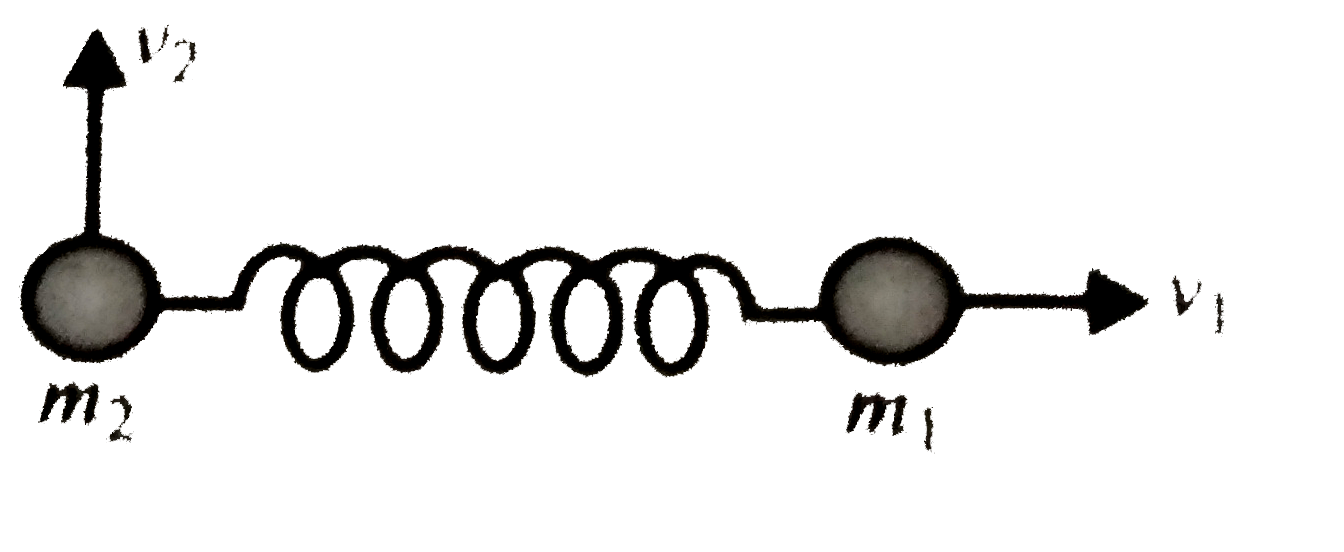
Two small discs of masses `m_(1)` and `m_(2)` are connected by a weightless spring resting on a smooth horizontal plance. The discs are set in motion with initial velocities `v_(1) and v_(2)` whose directions are mutually perpendicular and in the same horizontal plane. Find the total energy `E` of hte system with reference to the frame fixed to the centre of mass.

Text Solution

Verified by Experts

Let `vecv_(cm)` be the velocity of the centre of mass. Velcoity of `m_(1)` relative to thecentre of mas is `(vecv_(1)-vecv_(cm))` and that of `m_(2)` relative to the centre of mass is `(vecv_(2)-vecv_(1))`
Velocity of centre of mass `vecv_(cm)=(m_(1)vecv_(1)m_(2)vecv_(2))/(m_(1)+m_(2))`
`(vecv_(1)-vecv_(cm))=m_(2)/(m_(1)+m_(2))(vecv_(1)-vecv_(2))`
Hence `|vecv_(1)-vecv_(cm)|=m_(2)/(m_(1)+m_(2)(v_(1)^(2)+v_(2)^(2))^(1//2)`
and `vecv_(2)-vecv_(cm)=m_(1)/(m_(1)+m_(2))(vecv_(2)-vecv_(1))`
Hence `|vecv_(2)-vecv_(cm)|=m_(1)/(m_(1)+m_(2))(v_(1)^(2)+v_(2)^(2))^(1//2)`
total energy with respect to the centre of mass,
`E=1/2m_(1)|vecv_(1)-vecv_(cm)|^(2)1/2m_(1)|vecv_(2)-vecv_(cm)|^(2)`
`=1/2((m_(1)m_(2))/(m_(1)+m_(2)))(v_(1)^(2)+v_(2)^(2))`
where `mu=(m_(1)m_(2))/(m_(1)+m_(2))` is called reduced mass.
Promotional Banner

Topper's Solved these Questions

  • CENTRE OF MASS

    CENGAGE PHYSICS|Exercise Solved Examples|13 Videos
  • CENTRE OF MASS

    CENGAGE PHYSICS|Exercise Exercise 1.1|20 Videos
  • CALORIMETRY

    CENGAGE PHYSICS|Exercise Solved Example|13 Videos
  • DIMENSIONS & MEASUREMENT

    CENGAGE PHYSICS|Exercise Integer|2 Videos

Similar Questions

Explore conceptually related problems

Two small discs of masses m_1 and m_2 interconnected by a weightless spring rest on a smooth horizontal plane. The discs are set in motion with initial velocities v_1 and v_2 whose directions are mutually perpendicular and lie in a horizontal plane. Find the total energy overset~E of this system in the frame of the centre of inertia.

A system consists of two small spheres of masses m_1 and m_2 interconnected by a weightless spring. At the moment t=0 the spheres are set in motion with the initial velocities v_1 and v_2 after which the system starts moving in the Earth's uniform gravitational field. Neglecting the air drag, find the time dependence of the total momentum of this system in the process of motion and of the radius vector of its centre of inertia relative to the initial position of the centre.

Two bars of masses m_1 and m_2 connected by a weightless spring of stiffness ϰ (figure) rest on a smooth horizontal plane. Bar 2 is shifted a small distance x to the left and then released. Find the velocity of the centre of inertia of the system after bar 1 breaks off the wall.

Two bars of masses m_1 and m_2 connected by a weightless spring of stiffness k , rest on a smooth horizontal plane. Bar 2 is shifted by a small distance x_0 to the left and released. The veloicyt of the centre of mass of the system when bar 1 breaks off the wall is

Two smooth blocks of mases m_(1) and m_(2) attached with an ideal spring of stiffness k and kept on hrozontal surface. If m_(1) is projected with a horizontal velocity v_(0) . Find the maximum compression of the spring.

Two bodies of masses m_1 and m_2 are moving with velocity v_1 and v_2 respectively in the same direction. The total momentum of the system in the frame of reference attached to the centre of mass is ( v is relative velocity between the masses)

A closed system consists of two particles of masses m_1 and m_2 which move at right angles to each other with velocities v_1 and v_2 . Find: (a) the momentum of each particle and (b) the total kinetic energy of the two particles in the reference frame fixed to their centre of inertia.

Two blocks of masses m_(1) =1kg and m_(2) = 2kg are connected by a spring of spring constant k = 24 N/m and placed on a frictionless horizontal surface. The block m_(1) is imparted an initial velocity v_(0) = 12cm/s to the right. The amplitude of osciallation is

Two masses, m_(1) and m_(2) , are moving with velocities v_(1) and v_(2) . Find their total kinetic energy in the reference frame of centre of mass.
