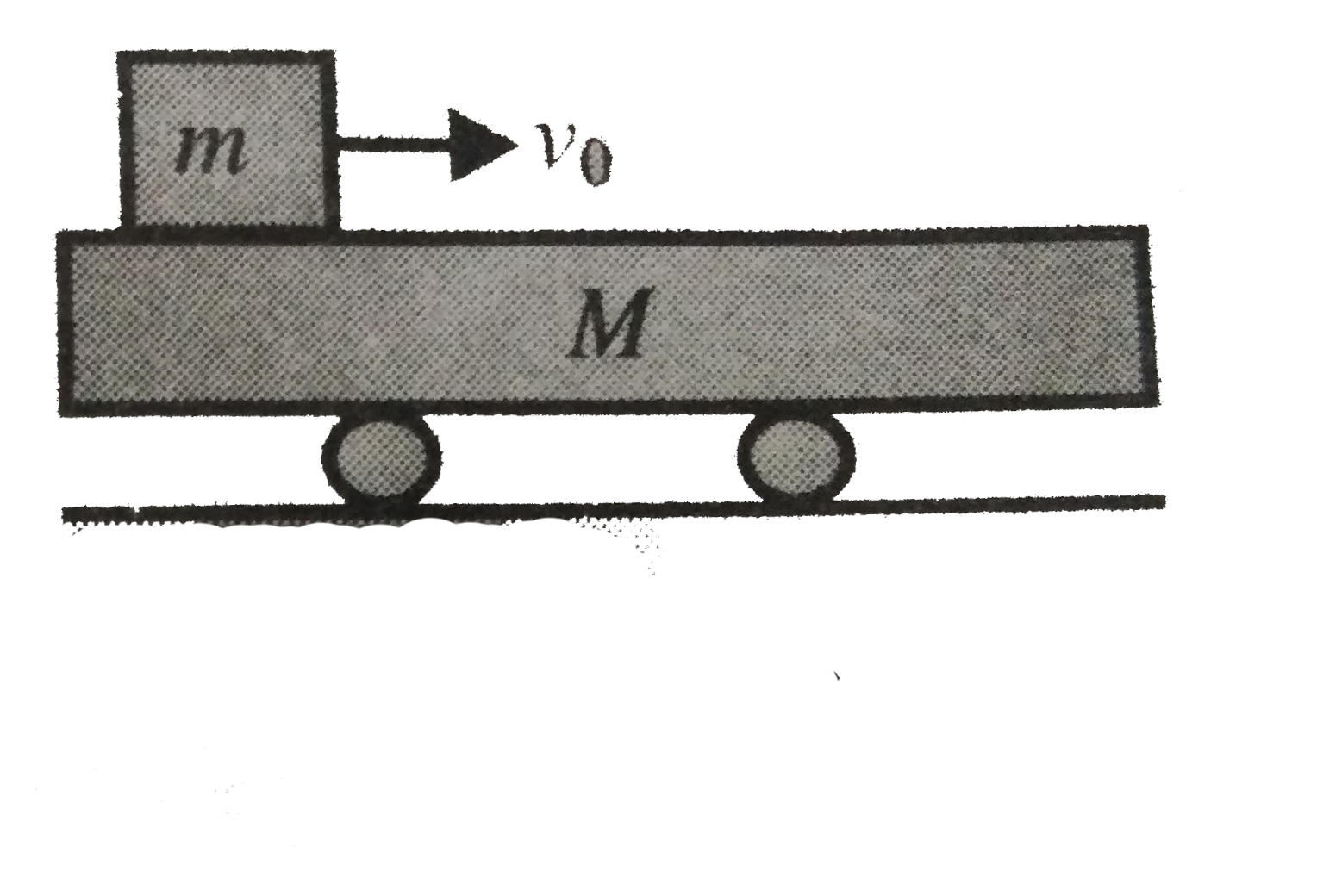
A block of mass `m` is pushed with a velocity `v_(0)` along the surface of a trolley car of mass `M`. If the horizontal ground is smooth and the coefficient of kinetic friction between the block of plank is `mu`. Find the minimum distance of relative sliding between the block and plank.
Text Solution
Verified by Experts
Method 1: Using ground frame method decide system: block and plank Observation: No external force acting on system nn horizontal direction Conclusion linear momentum of the system will be conserved. As friction in kinetic nature and system. when relative sliding between block and troley stops, velocity `V`. Problem solving: Using conservation of linear momentum in horizontal direction. ` mv_(0)+0=(m+M)VimpliesV=(mv_(0))/((m+M)`.........i now using WE theorem from ground frame. `W_(ext)+w_(int)=/_\K` `W_(ext)=0` `W_(int)=W_("friction")=-fx=-mumgx` `0+(-mumgx)=(1/2(m+M)V^(2)-1/2mv_(0)^(2))`..........ii From i and ii relative distance of sliding `x=v_(0)^(2)/(2(1+m/M)mug)` Method 2: work energy thoerem from centre of mass frame Considering the system from `CM` frame `W_(ext)+W_("int") =(/_\K)_(cm)=(k_(f)-k_(i))_(cm)` Initial kinetic energy of system w.r.t `CM` `(K_(i))_(cm)=1/2(mM)/((m+M) v_(0)^(2)` Final kinetic energy of sytem w.r.t `CM` `(K_(f))_(cm)=0` or `|(V_("rel"))f|=0` hence `0+(-mumgx)=0-1/2(mM)/((m+M))v_(0)^(2)` `impliesx=v_(0)^(2)/(2(1+m/M)mug`
A block of mass M is using on a rough horizontal surface. mu_R is the coefficient of kinetic friction between the block and the surface. What is the net force exerted by the surface on the block?
A varying horizental force F = at act on a block of mass m kept on a smooth horizontal surface An identical block is kept on the first block.The coefficient of friction between the blocks is mu . The time after which the relative sliding between the blocks prevails is
A block of mass m is slowly pulled along a curved surface from position 1 and 2. If the coefficient of kinetic friction between the block and surface is mu , find the work done by the applied force.
Two blocks of Masses M and 2M are connected by a spring of stiffness k .The coefficient of friction between the blocks and the surface is mu Find the minimum constant force F to be applied to 2m in order to slide the mass M .
A small block of mass 'm' is placed on a plank of mass 'M'. The block is connected to plank with the help of a light string passing over a light smooth pulley as shown in figure. The co-efficient of static friction between the block and plank is mu . The co-efficient of friction between the plank and the horizontal surface is zero. What maximum horizontal force F applied on the block of mass m can make the block and plank not to slide relatively?
A block of mass m = 2kg is accelerating by a force F = 20N applied on a smooth light pulley as shown in the figure. If the coefficient of kinetic friction between the block and the surface is mu=0.3 , find its acceleration.
A block of mass m is stationary on a horizontal surface. It is connected with a string which has no tension. The coefficient of friction between the block and surface is m . Then , the frictional force between the block and surface is:
In the adjoining figure, the coefficient of friction between wedge ( of mass M) and block ( of mass m) is mu . Find the minimum horizontal force F rquired to keep the block stationary with respect to wedge