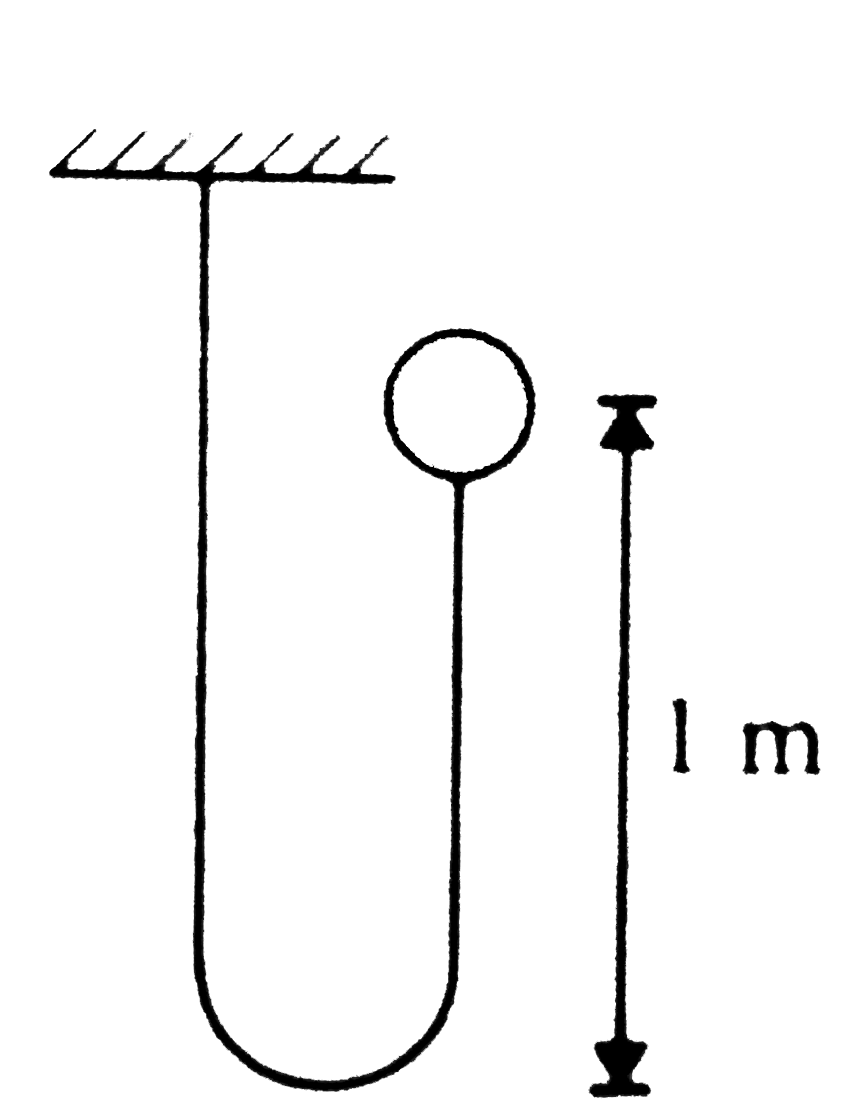
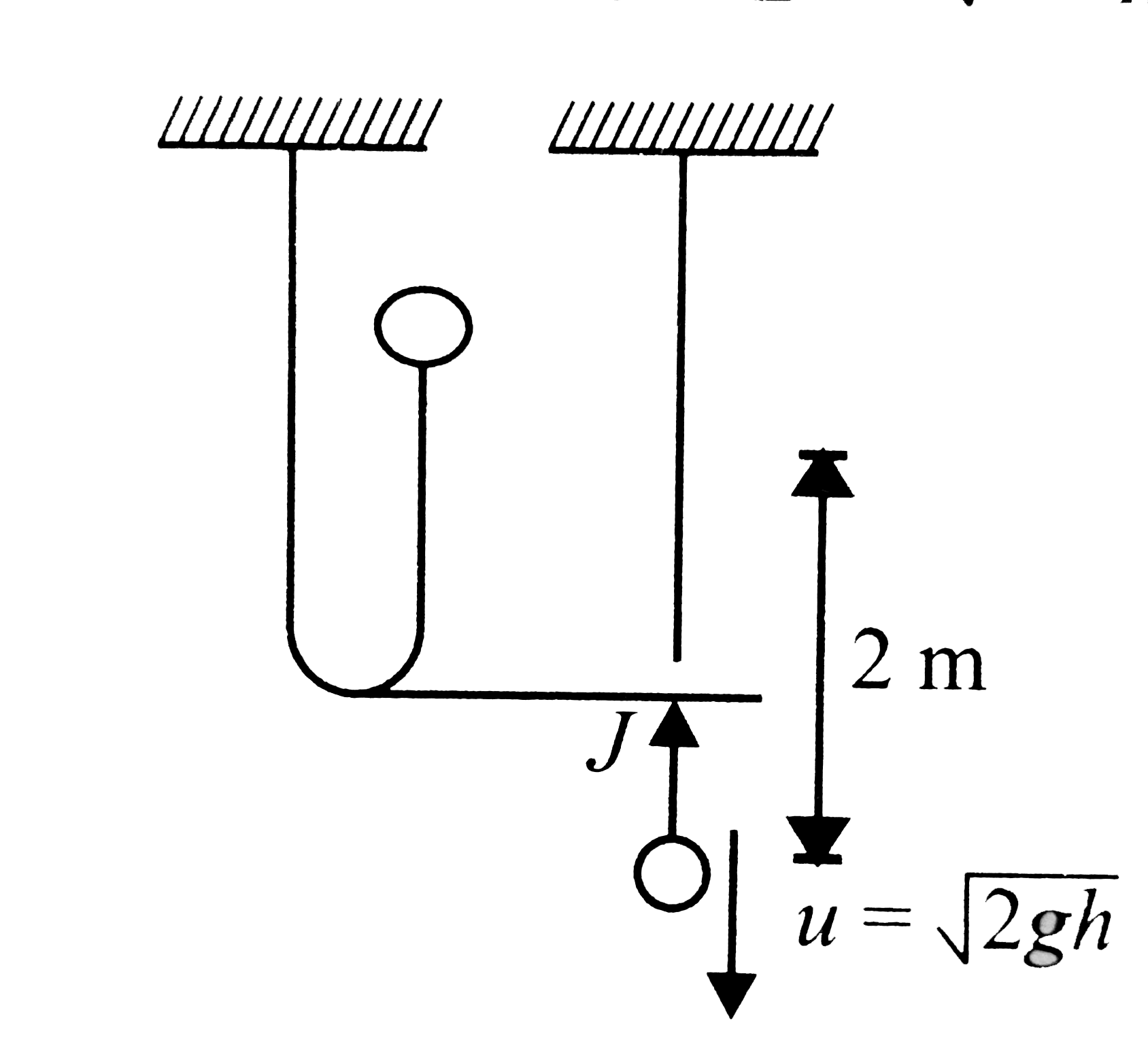
A ball of mass `1 kg` is attached to an inextensible string. The ball is released from the position shown in figure. Find the impulse imparted by the string to the ball immediately after the string becomes taut.
Text Solution
Verified by Experts
The string will become taut when the particle will fall through a distance `2 m` in downward direction. So the required impulse `J="mu"=1xxsqrt(2xx10x2)=sqrt(40) kg m//s`
A ball of mass 1.00 kg is attached to a loose string fixed to a ceiling. The ball is released from rest and falls 2.00 m, where the string suddenly stops it. Find the impulse on it from the string.
Two massless string of length 5 m hang from the ceiling very near to each other as shown in the figure. Two balls A and B of masses 0.25kg and 0.5kg are attached to the string. The ball A is released from rest at a height 0.45m as shown in the figure. The collision between two balls is completely elastic. Immediately after the collision, the kinetic energy of ball B is 1 J The velocity of ball A just after the collision is
Mass of the pulley is m & radius is R. Assume pulley to be disc. Block of mass m is released from the position shown. String is massless & inextensible. There is no slipping between rope and pulley. The impulse exerted by the string on the pulley at the moment string becomes taut is J then (2msqrt(gR))/(J) is equal to
A small ball of mass m is connected by an inextensible massless string of length with an another ball of mass M = 4m . They are released with zero tension in the string from a height h as shown in the figure. Find the time when the string becomes taut for the first time after the mass M collides with the ground. Take all collisions to be elastic.