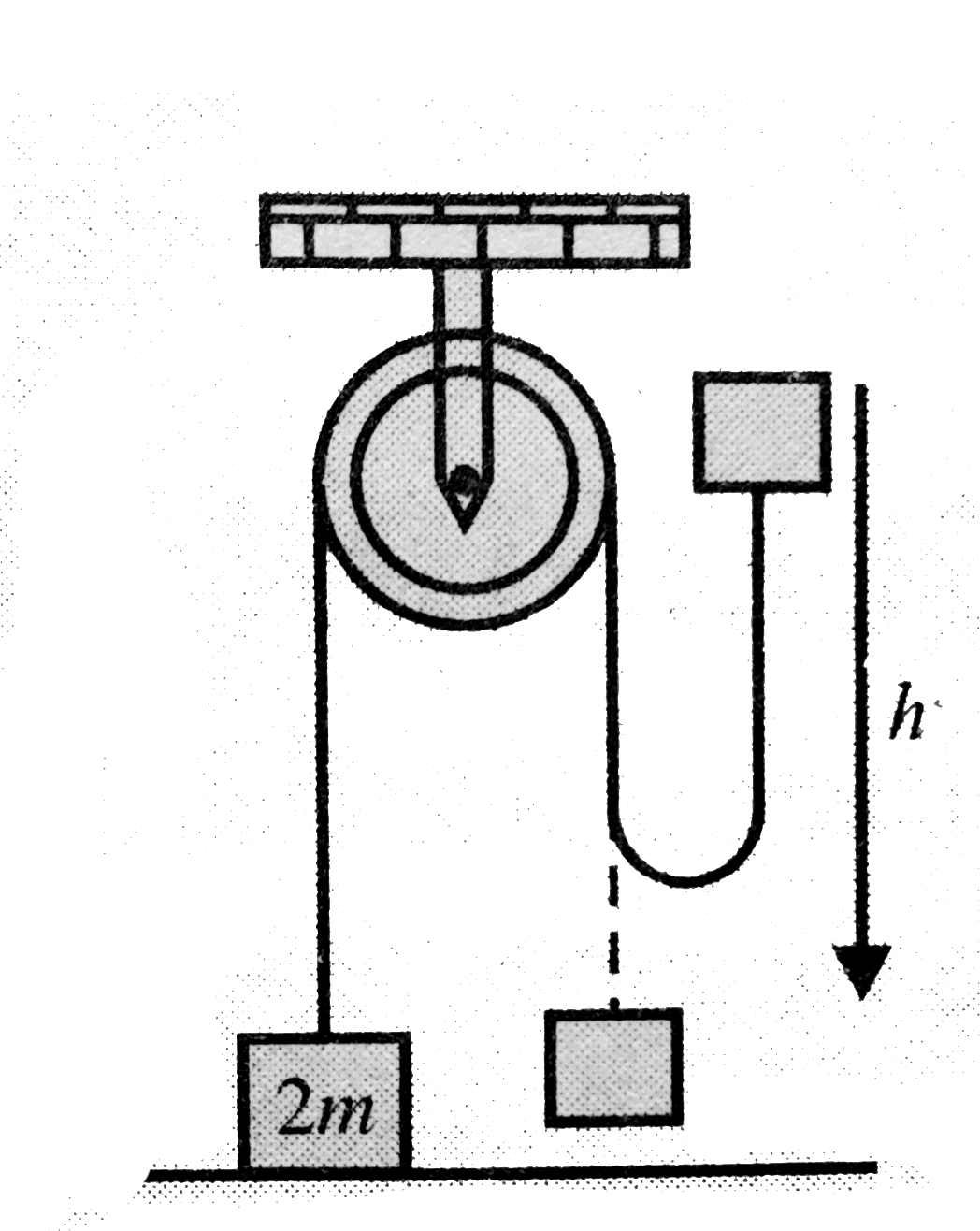
A mass `m` rests on a horizontal table. It is attached to a light inextensible string which passes over a smooth pulley and carries a mass `m` at the other end. If the mass `m` is raised vertically through a distance `h` and is then dropped, what is the speed with which the mass `2m` begins to rise?
Text Solution
Verified by Experts
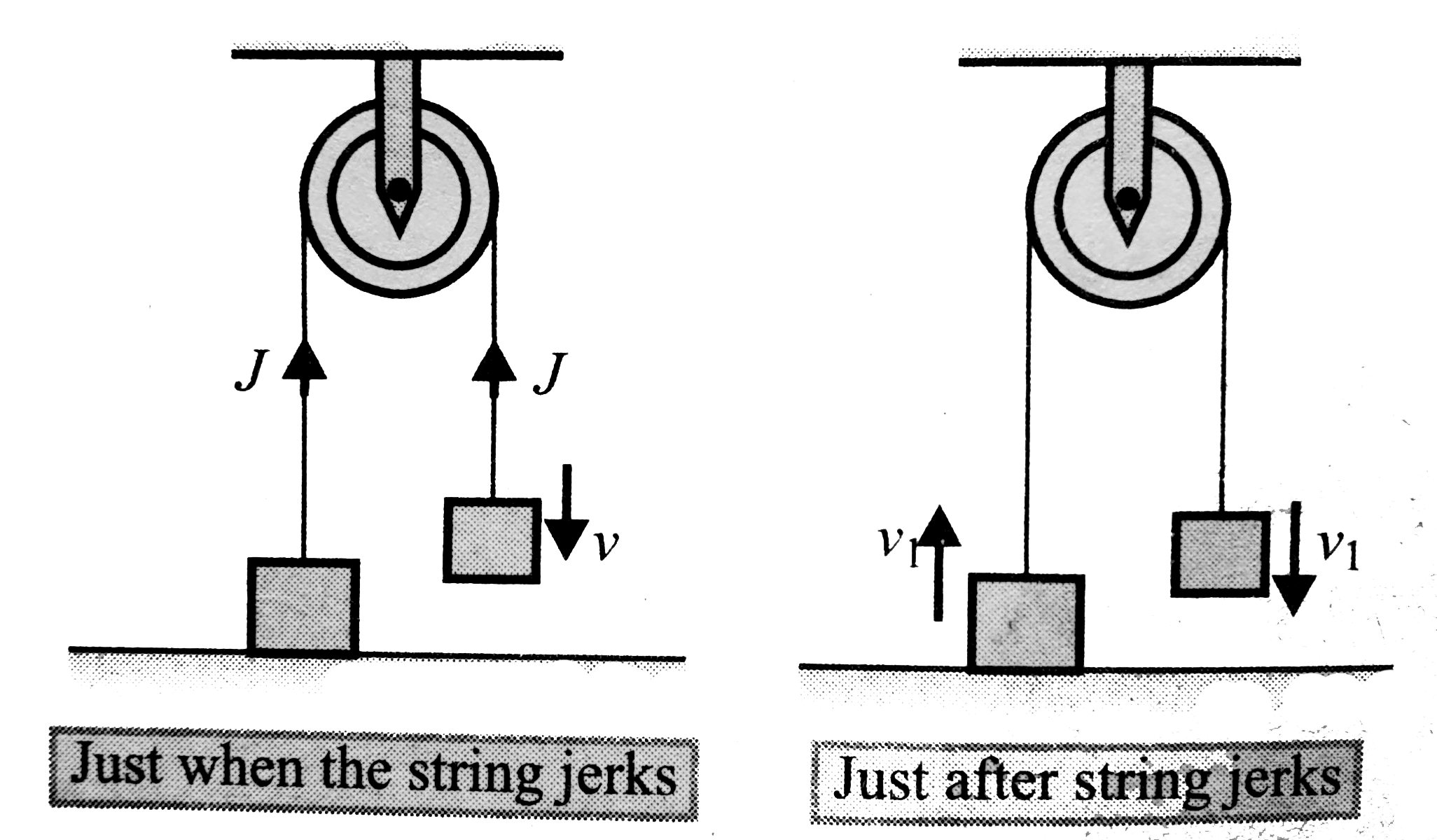
Velocity of the mass `m` just before string becomes tight. `v=sqrt(2gh)` ……….i Using impulse ` =` change in momentum For mass `2m` `J=2mv_(1)`……….ii For mass `m` `mv-J=mv_(1)` ………..iii Solving eqn i , ii and iii we get `v=sqrt((2gh)/3`
Two particle A and B, of mass 3m and 2m respectively, are attached to the ends of a light inextensible string which passes over a smooth fixed pulley of negligible mass. After the system is released and A falls through a distance L, it hits a horizontal inelastic table so that its speed is immediately reduced to zero. Assume that B never hits the table or the pulley. Find (a) the time for which A is resting on the table after the first collision and before it is jerked off, (b) the difference between the total kinetic energy of the system immediately before A first hits the table and total kinetic energy immediately after A starts moving upwards for the first time. Explain the loss in kinetic energy.
A block of mass m_(1) lies on a smooth horizontal table and is connected to another freely hanging block of mass m_(2) by a light inextensible string passing over a smooth fixed pulley situated at the edge o fthe table. Initially the system is at rest with m_(1) a distance d from the pulley. Then the time taken for m_(1) to reach the pulley is.
A smooth ring of mass m can slide on a fixed horizontal rod. A string tied to the ring pases over a fixed pulley B and carries a block C of mass 2m as shown below. As the ring starts sliding
A block of mass 2 m hangs by an inextensible light string that passes over a smooth pulley. Another mass m hangs from the other end of the string and is connected to a vertical massless spring. The system is stationary. Just after the string is cut, the accelerations of m and 2m, respectively, are -
A block of mass m_(1)=2 kg is kept on a smooth horizontal table. Another block of mass m_(2)=1 kg is connected to m_(1) by a light inextensible string passing over a smooth pulley as shown in the figure. If the blocks are released, what will be the (a) acceleration of each block (b) tension in the string?
A block of mass M is placed on a horizontal surface. It is tied with an inextensible string that passes through ideal pulleys. A mass m is connected to the pulley as shown. For what value of m, the block M will accelerate towards the fixed pulley ?
Two masses M and m are connected at the two ends of an inextensible string. The string passes over a smooth frictionless pulley. Calculate the acceleration of the masses and the tension in the string. Given Mgtm .
A block of mass M is placed on a rough horizontal surface. It is connected by means of a light inextensible string passing over a smooth pulley . The other end of string passing over a smooth pulley. The other end of string is connected to a block of mass m. There is no friction between vertical surface and block m If the whole system ( horizontal surface + blocks ) accelerates towards right the value of maximum on the horizontal surface is