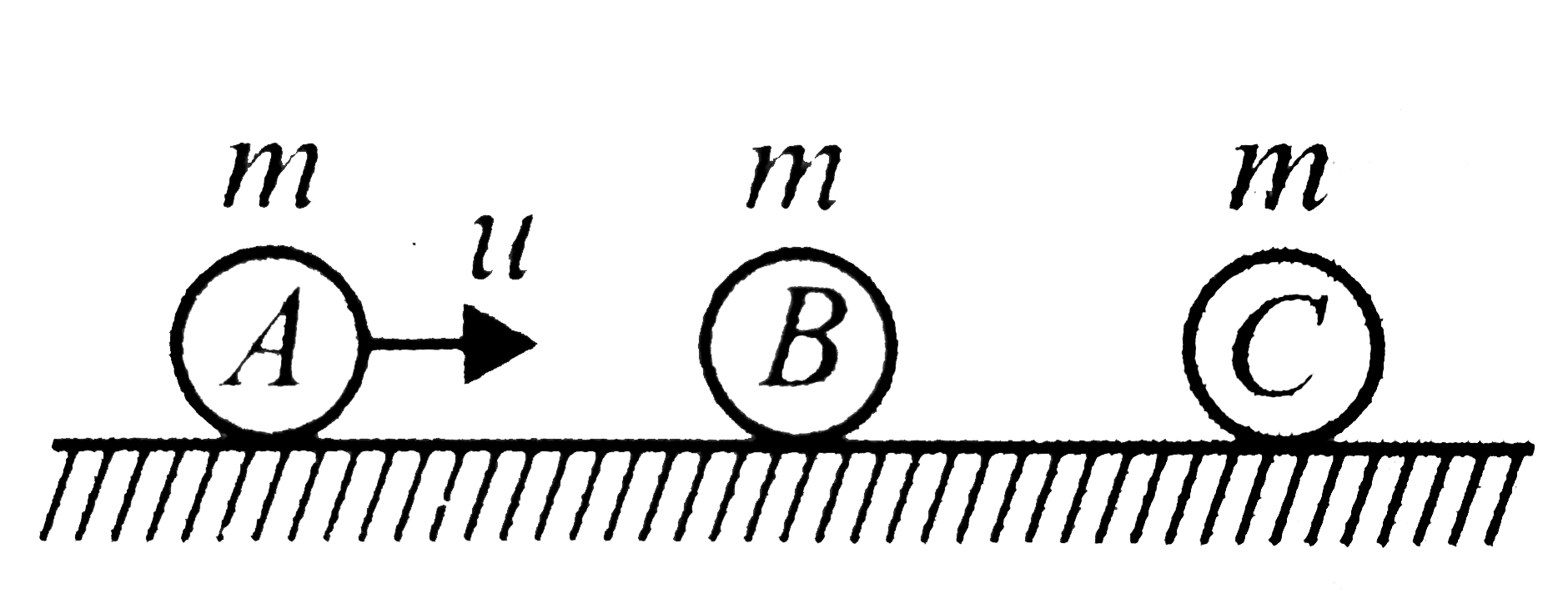
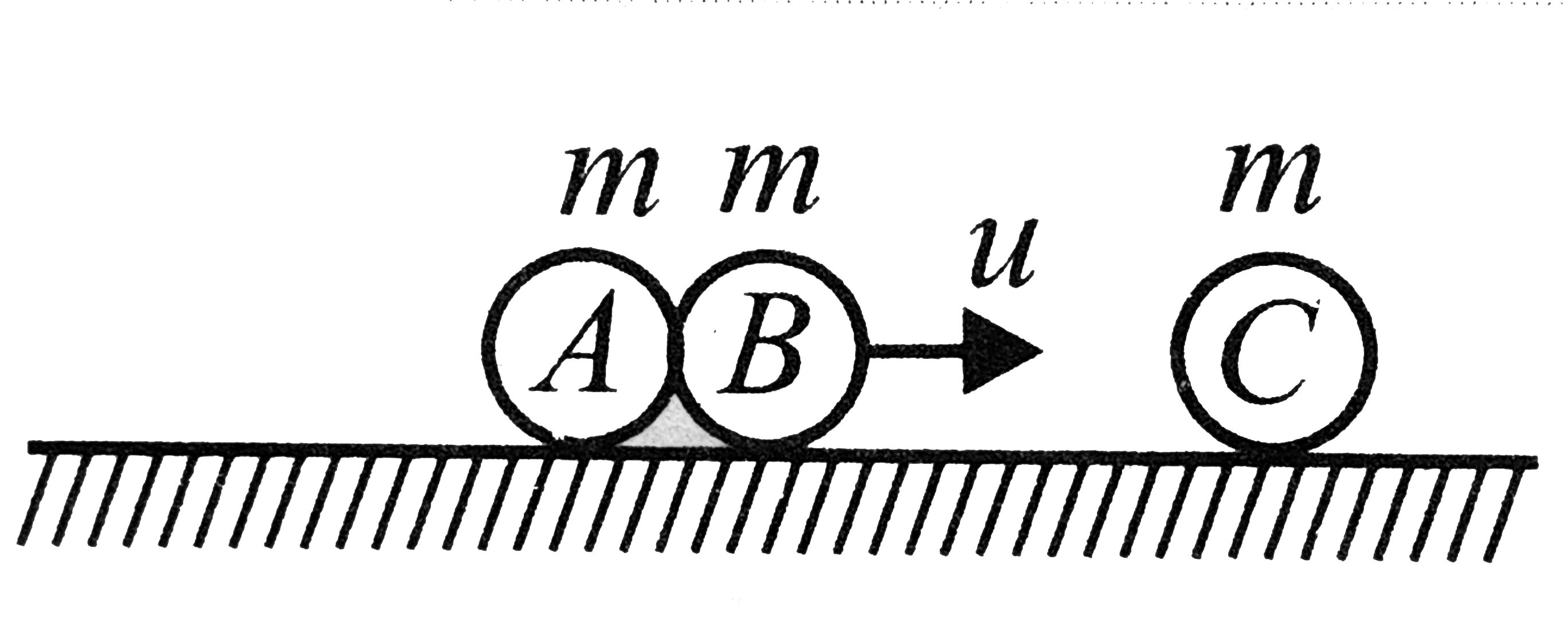
Three balls `A, B` and `C` of same mass `m` are placed on a frictionless horizontal plane in a straight line as shown. Ball `A` is moved with velocity `u` towards the middle ball `B`. If all the collisions are elastic, find the final velocities of all the balls.
Text Solution
Verified by Experts
A collides elastically with `B` and comes to rest but `B` starts moving with velocity `u`. After a while `B` collides elastically with `C` and comes to rest but `C` starts moving with velocity `u`. Therefore, final velocities, `V_(A)=0, V_(B)=0` and `V_(C)=u`.
Four identical balls A,B, C and D are placed in a line on frictionless horizontal surface. A and D are moed with the same speed u towards the middle as shown. Assuming elastic collisions, find the final velocities.
A smooth hollow U shaped tube of mass 2m is lying at rest on a smooth horizontal table. Two small balls of mass m, moving with velocity u enter the tube simultaneously in symmetrical fashion. Assume all collisions to be elastic. Find the final velocity of the balls and the tube.
Two balls marked 1 and 2 of the same mass m and a third ball marked 3 of mass M are arranged over a smooth horizontal surface as shown in the figure. Ball 1 moves with a velocity v_(1) towards ball 2. All collisions are assumed to be elastic. If Mltm , the number of collisions between the balls will be.
A smooth ball of mass M and radius R is lying on a smooth horizontal table. A smaller ball of radius r and mass m travelling horizontally on the table with velocity u hits the larger ball. Collision is elastic. During the interaction of the balls the larger ball does not lose contact with the table at any instant (i) Calculate the velocity of the balls after collision. (ii) Calculate the maximum possible interaction force between the balls during collision.
Three balls A, B and C are placed on a smooth horizontal surface. Given that m_A=m_C=4m_B . Ball B collides with ball C with an initial velocity v as shown in figure. Find the total number of collisions between the balls. All collisions are elastic.
Three identical balls 1, 2 and 3 are placed together at rest on a smooth horizontal surface. A fourth identical ball moving with velocity u in line of first three balls collides head on elastically as shown in figure, then
The figure below shows three identical balls A , B and C. Initially , the baiis B and C are at rest and the ball A while moving with a veiocity v, collides with ball B. if the collision is perfectiy elastic , then after the collision
Three balls A, B and C of masses 2 kg, 4 kg and 8 kg , respectively, move along the same straight line and in the same direction, with velocities 4m//s,1m//s, 3/4m//s . If A collides with B and subse-quently B collides with C , find the velocity of ball A and ball B after collision, taking the coefficient of restitution as unity.
Three balls A, B and C(m_(A)=m_(C)=4m_(B)) are placed onn a smooth horizontal surface. Ball B collides with ball C with an initial velocity v as shown in figure. Find the total number of collision betwenent the balls (all collisions are elastic).