Home
Class 11
PHYSICS
Two particles of masses m and 2m moving ...

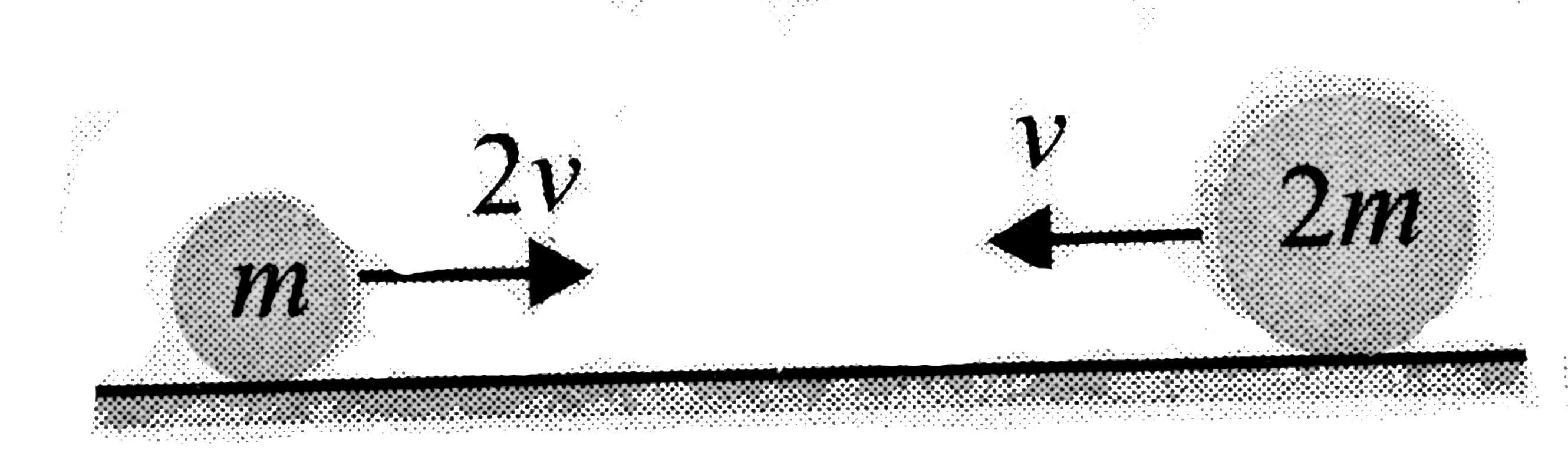
Two particles of masses `m` and `2m` moving in opposite directions collide elastically with velocity `2v` and `v`, respectiely. Find their velocities after collision.

Text Solution

Verified by Experts

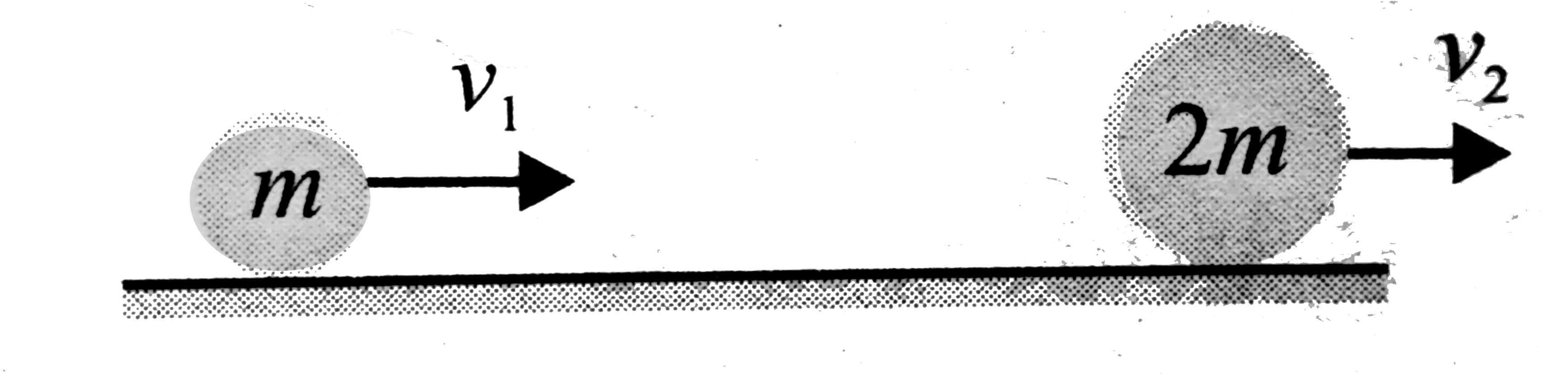
Let the final velocities of mass `m` and `2m` be `v_(1) and v_(2)` respectively as shown in figure.
By conservation of momentum, we get
`m(2v)+2m(-v)=m(v_(1))+2m(v_2)`
or `0=mv_(1)+2mv_(2)`
or `v_(1)+2v_(2)=0`
and since the collision is elastic
`v_(2)-v_(1)=2v-(-v)`
or `v_(2)-v_(1)=3v`
Solving the above two equations we get
`v_(2)=v` and `v_(1)=-2v`
That is mass `2m` returns with velocity `v` while mass `m` returns with velocity `2v` in the direction shown in figure.

Promotional Banner

Topper's Solved these Questions

  • CENTRE OF MASS

    CENGAGE PHYSICS|Exercise Solved Examples|13 Videos
  • CENTRE OF MASS

    CENGAGE PHYSICS|Exercise Exercise 1.1|20 Videos
  • CALORIMETRY

    CENGAGE PHYSICS|Exercise Solved Example|13 Videos
  • DIMENSIONS & MEASUREMENT

    CENGAGE PHYSICS|Exercise Integer|2 Videos

Similar Questions

Explore conceptually related problems

Two balls of masses m and 2m moving in opposite directions collide head on elastically with velocities v and 2v . Find their velocities after collision.

Two particles of mass m and 2 m moving in opposite directions collide elastically with velocities v and 2v. Find their velocities after collision.

Two identical balls are approaching towards each other on a straight line with velocity 2m//s and 4m//s , respectiely. Find the final velocities after elastic collision between them.

Two equal masses m_1 and m_2 moving along the same straight line with velocites +3 m//s and - 5 m//s respectively collide elastically. Their velocities after the collision will be respectively.

A particle of mass m moving on a smooth surface with velocity 10 m//s strikes another particle of mass 2 m moving with 5 m//s in the same direction . If the collision is elastic and head - on , find velocities of particles after the collision.

A particle of mass m moving with velocity u_(1) collide elastically with another particle of same mass moving with velocity u_(2) in the same direction. After collision their speeds are v_(1) and v_(2) respectively then (A) u_(1)+v_(1)=v_(2)+u_(2) , (B) u_(1)-v_(1)=v_(2)+u_(2)

A particle of mass m_1 moving with velocity v in a positive direction collides elastically with a mass m_(2) moving in opposite direction also at velocity v. If m_(2)gt gtm_(1) , then

A ball of mass m moving with velocity v collides head on elastically with another identical ball moving with velocity - V. After collision