Let `u` be the velocilty of sphere `A` before impact. As the spheres are identical, the triangle `ABC` formed by joining their centres is equilateral. The spheres `B` and `C` will move in directions `AB` and `AC` after impact making an angle `30^(@)` with the original line of motion of sphere `A`.
Let `v` be the speed of the other spheres after impact.
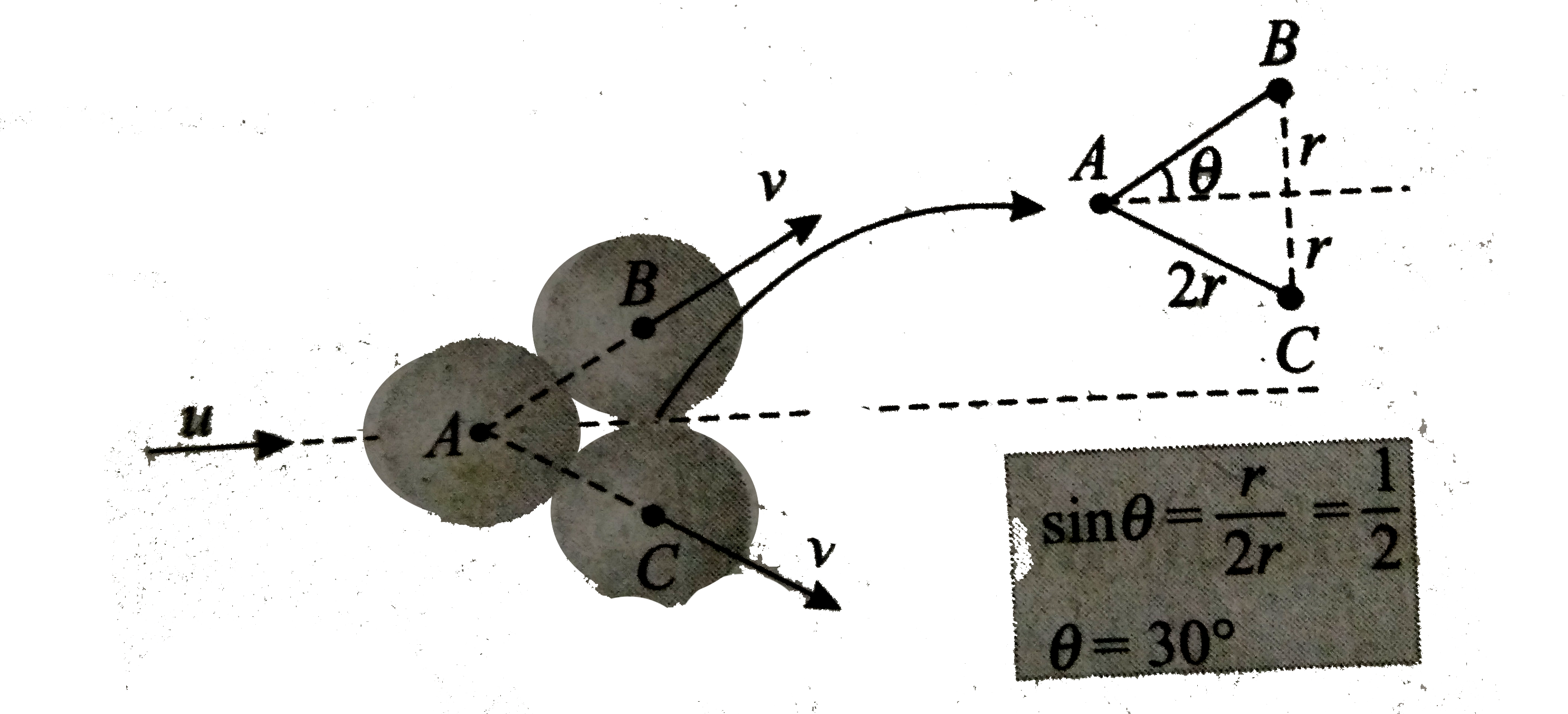
From momentum conservation,
`"mu"=mvcos30^(@)+mvcos30^(@)`
`u=vsqrt(3)`....i
From Newton's experimental law, for an oblique collision, we ahsve to take components along the normal, i.e. along `AB` for spheres `A` and `B`. Hence,
`v_(B)-v_(A)=-e(u_(B)-u_(A))`
`impliesv-0=-e(0-ucos30^(@))`
`v=eucos30^(@)`....ii
Combining eqn i and ii we get `e=2/3`
Loss in `KE =1/2"mu"^(2)-2(1/2mv^(2))`
`=1/2"mu"^(2)-m(u/sqrt3)^(2)=1/6mu^(2)`


