Home
Class 11
PHYSICS
A particle (a mud pallet, say) of mass m...

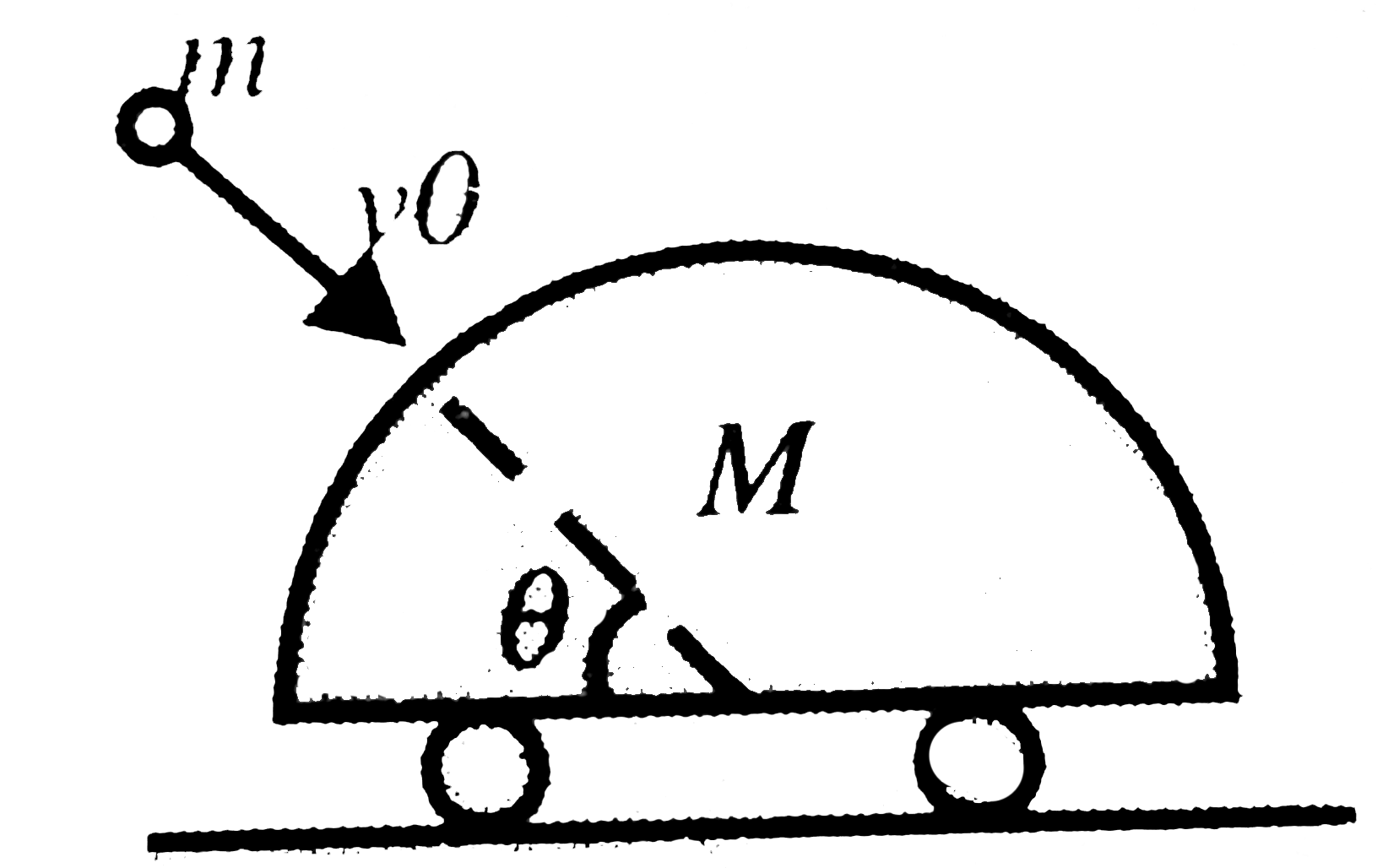
A particle (a mud pallet, say) of mass `m` strikes a smooth stationary wedge of mass `M` with as velocity `v_(0)` at an angle `theta` with horizontal. If the collision is perfectly inelastic, find the
a. velocity of the wedge just after the collision.
b. Chane in `KE` of the system `(M+m)` in collision.

Text Solution

Verified by Experts

a. Let the system `(M+m)` moves as a single mass with a velocity `v`.
conserving the momentum of the system in horizontal, we have
`mv_(0)costheta=(M+m)v`
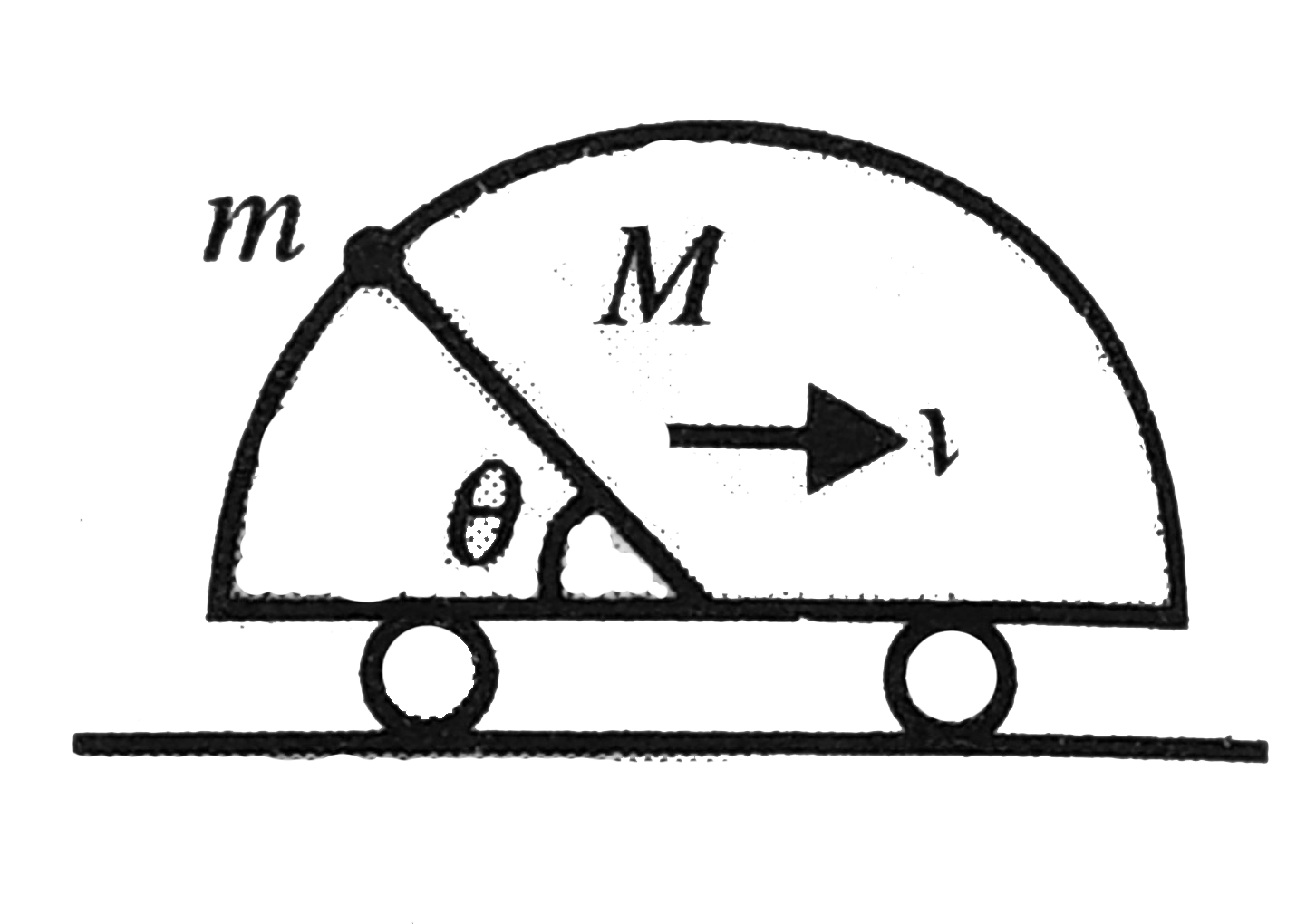
This gives `v=(mv_(0)costheta)/(M+m)`
b. the change in `KE` of the system is
`/_\K=1/2(M+m)v^(2)-1/2mv_(0)^(2)`
where `v=(mv_(0)costheta)/(M+m)` ltbr This gives `/_\K=((M+m))/2((mv_(0)costheta)/(M+m)^(2)-1/2mv_(0)^(2)`
`=-(mv_(0)^(2))/2(1-m/(M+m)cos^(2)theta)`
`=-((M+msin^(2)theta)mv_(0)^(2))/(2(M+m))`
Promotional Banner

Topper's Solved these Questions

  • CENTRE OF MASS

    CENGAGE PHYSICS|Exercise Solved Examples|13 Videos
  • CENTRE OF MASS

    CENGAGE PHYSICS|Exercise Exercise 1.1|20 Videos
  • CALORIMETRY

    CENGAGE PHYSICS|Exercise Solved Example|13 Videos
  • DIMENSIONS & MEASUREMENT

    CENGAGE PHYSICS|Exercise Integer|2 Videos

Similar Questions

Explore conceptually related problems

A particle of mass m strikes a disc of radius R and mass m with a speed u as shown in the figure. What is the speed of the particle just after the collision if the collision is perfectly inelastic ?

A particle of mass m strikes elastically with a disc of radius R , with a velocity vec"v" as shown in the figure. If the mass of the disc is equal to that of the particle and the surface of the contact is smooth, find the velocity of the disc just after the collision.

A tiny ball of mass m is released from the state of rest over a large smooth sphere of mass M and radius R , which is at rest on a smooth horizontal surface. If the ball strikes the sphere perfectly inelastically, find their velocities after collision.

A particle of mass m moving on a smooth surface with velocity 10 m//s strikes another particle of mass 2 m moving with 5 m//s in the same direction . If the collision is elastic and head - on , find velocities of particles after the collision.

Two balls of equal masses m each undergo oblique collision. If colision is perfectly elastic, then angle between their velocities after collision is

Two particles of masses 0.5 kg and 0.25kg moving with velocity 4.0 m // s and -3.0m // collide head on in a perfectly inelastic collision. Find the velocity of the composite particle after collision and KE lost in the collision.

A particle of mass m strikes another particle of same at rest. Find the angle between velocities of particles after the collision , if the collision is elastic.

A ball of mass m is projected with a velocity 'u' at angle theta with the horizontal. It collides with a smooth box of mass 'M' at its highest position. If the co-efficient of restitution is 'e' . FInd the velocity of the ball after collision

Two balls of masses m each are moving at right angle to each other with velocities 6 m/s and 8 m/s respectively. If collision between them is perfectly inelastic, the velocity of combined mass is

